• Menu
  • Skip to primary navigation
  • Skip to main content
  • Skip to primary sidebar

Country Life In BC Logo

The agricultural news source in British Columbia since 1915

  • Headlines
  • Calendar
  • Subscribe
  • Advertise
  • About
  • Archives
  • Contact
  • Search
  • Headlines
  • Calendar
  • Subscribe
  • Advertise
  • About
  • Archives
  • Contact
  • Search

Primary Sidebar

Originally published:

SEPTEMBER 2019
Vol. 105 Issue 9

Subscribe Now!

Sign up for free weekly FARM NEWS UPDATES

Select list(s) to subscribe to


By submitting this form, you are consenting to receive marketing emails from: Country Life in BC. You can revoke your consent to receive emails at any time by using the SafeUnsubscribe® link, found at the bottom of every email. Emails are serviced by Constant Contact
Your information will not be
shared or sold ever

Stories In This Edition

Livestock groups ramp up security

Gaurav Maan

EU tightens shipping rules

New waste control rules kick in October 1

Dibs on ribs

Nip the buds

Climate woes are everyone’s responsibility

Viewpoint: Weighing in on the battle of the burgers

Ag counil defendes cannabis sector on odour

Feds announce compensation package for dairy

Potato harvest looks promising for BC growers

Motor Vehicle Act covers tractors

Province urges armyworm precautions

Feast for the eyes

Funding helps cherry growers court new buyers

Oregon hazelnut optimism inspires BC growers

Dairy tour showcases innovative farming

Minimize the risk of corn silage fires

Teachers receive valuable lessons about farming

Climate change concerns grapegrowers

Canada eyes clean vines network

Province extends deadline for meat consultation

Top seller

Winery upstart banks on ranch’s rich history

Sidebar: Room to grow

Market Musings: Rain creates haying challenges

Nechako win

Forage council ready for a changing climate

Armyworm warning

Soda Creek social highlights land-matching

Research: The symbiotic relationship in pregnancy

Sheep farmers have high hopes for cooperative

PNE lamb

AAFC seeks volunteer weather reporters

Land commission orders Gleaners off ALR

Tour highlights adaption

Maan Farms keeps the focus on family

Ceadrow Farm tops Chilliwack sheep show

Island Holstein show and sale reflects quality

4-H sale saves the bacon for ranching student

4-H sale at the PNE is the best part of summer

Success is in the bag for barley entrepreneurs

Simple steps help to overcome gas exposure

Blueberries find a home in wine at Baccata

Woodshed: Henderson backs off while Frank closes in

Volunteers harvest for FV charities

Nutritious autumn eats

More Headlines

Follow us on Facebook

Comments Box SVG iconsUsed for the like, share, comment, and reaction icons

7 days ago

... See MoreSee Less

View Comments
  • Likes: 4
  • Shares: 0
  • Comments: 0

Comment on Facebook

7 days ago

On the last day of the BC Organic Conference, Thursday, Molly Thurston of Pearl Agricultural Consulting helped growers learn how to manage bugs such as codling moth, wireworm, and rootworm in organic growing systems. Her talk alongside Renee Prasad included hands-on activities in which participants checked out various traps and examined pests under microscopes. Be sure to look for more upcoming ag events on our online calendar at www.countrylifeinbc.com/calendar/

#BCAg
... See MoreSee Less

On the last day of the BC Organic Conference, Thursday, Molly Thurston of Pearl Agricultural Consulting helped growers learn how to manage bugs such as codling moth, wireworm, and rootworm in organic growing systems. Her talk alongside Renee Prasad included hands-on activities in which participants checked out various traps and examined pests under microscopes. Be sure to look for more upcoming ag events on our online calendar at www.countrylifeinbc.com/calendar/

#BCAg
View Comments
  • Likes: 15
  • Shares: 0
  • Comments: 0

Comment on Facebook

1 week ago

Well-known organic farmer and podcaster Jordan Marr gets interviewed by Country Life in BC’s own columnist and potato mavin Anna Helmer during the opening session of the BC Organic Conference at Harrison Hot Springs yesterday. Sessions run today (Wednesday) and Thursday and include organic and regenerative growing practices and expanding and advocating for the organic sector, all under the background of the newly launched Organic BC banner.

#BCAg
... See MoreSee Less

Well-known organic farmer and podcaster Jordan Marr gets interviewed by Country Life in BC’s own columnist and potato mavin Anna Helmer during the opening session of the BC Organic Conference at Harrison Hot Springs yesterday. Sessions run today (Wednesday) and Thursday and include organic and regenerative growing practices and expanding and advocating for the organic sector, all under the background of the newly launched Organic BC banner.

#BCAg
View Comments
  • Likes: 37
  • Shares: 2
  • Comments: 1

Comment on Facebook

Interested in finding out more about this

3 weeks ago

Today, we remember those who sacrificed their lives or their well-being for our freedom. Lest we forget. ... See MoreSee Less

Today, we remember those who sacrificed their lives or their well-being for our freedom. Lest we forget.
View Comments
  • Likes: 8
  • Shares: 0
  • Comments: 0

Comment on Facebook

1 month ago

FarmFolk CItyFolk is hosting its biennial BC Seed Gathering in Harrison Hot Springs November 27 and 28. Farmers, gardeners and seed advocates are invited to learn more about seed through topics like growing perennial vegetables for seed, advances in seed breeding for crop resilience, seed production as a whole and much more. David Catzel, BC Seed Security program manager with FF/CF will talk about how the Citizen Seed Trail program is helping advance seed development in BC. Expect newcomers, experts and seed-curious individuals to talk about how seed saving is a necessity for food security. ... See MoreSee Less

Link thumbnail

BC Seed Gathering - FarmFolk CityFolk

farmfolkcityfolk.ca

Save the date for our upcoming 2023 BC Seed Gathering happening this November 3rd and 4th at the Richmond Kwantlen Polytechnic University campus.
View Comments
  • Likes: 1
  • Shares: 0
  • Comments: 0

Comment on Facebook

Subscribe | Advertise

The agricultural news source in British Columbia since 1915
  • Email
  • Facebook

Province extends deadline for meat consultation

Industry says it was shut out of original consultation process

September 1, 2019 byTom Walker

MERRITT—The province’s latest bungle in the seemingly endless consultations on meat processing in the province have added yet another note of frustration to the voice of Julia Smith.

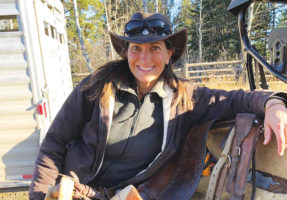
Smith, president of the Small-Scale Meat Producers Association, is baffled at the province’s reasoning for not including industry in a request for feedback from local governments about class D slaughter licences, which allow holders to slaughter 25 animal units and engage in limited retail sales in 10 of the province’s 27 regional districts.

“They said if they told us, they’d have to tell everybody,” she says. “What is the worst that could happen if you told everybody?”

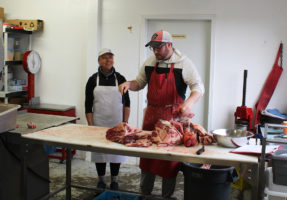
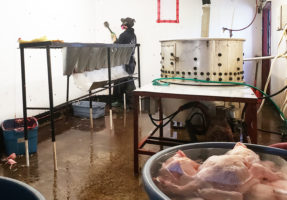
Unlike at facilities holding class A and B licences, the slaughter process at Class D establishments is not inspected by the province.

The BC Ministry of Agriculture asked local governments on June 3 for input on “proposals for new class D regions or sub-regions; and designation of new regions or sub-regions.”

Submissions were to be accepted through July 19.

Smith says there were three problems with the process: it came in the midst of summer holidays, regional districts are generally unfamiliar with the concept of class D licences, and the timeline was a short six weeks.

Moreover, industry wasn’t included.

“We heard about this second-hand,” says Smith. “We scrambled to make a big fuss and got an initial extension. And that’s when they told me they would have had to tell everybody.”

The initial extension ran until July 26, but was soon extended to October 1.

Smith says that the extra time gives small producers a chance to speak with their local governments and explain the business case for having a D-class abattoir in their region.

“We’d like to help the ministry get the feedback they are asking for,” says Smith. “The small-scale meat industry is a legitimate business with proven market demand and we need access to more processing – or we are hamstrung.”

Small-scale meat producers need to be able to process animals every month, explains Smith, who operates Blue Sky Ranch outside of Merritt, but that’s difficult right now given the long lead times abattoirs require.

“I’m trying to book for December and I can’t get a date,” she says. “I don’t even bother trying for September, October, November.”

Her association is asking for more D-class plants across the province, not only in the Thompson Nicola Regional District where she farms. TNRD is not considered remote and is not allowed to have D-class abattoirs at the present time.

“I think if the TNRD and other regional districts have a chance to learn about what the economic opportunity is here, I think they will get behind this,” she says.

Seasonal issue

Nova Woodbury, executive director of the BC Association of Abattoirs, isn’t sure more abattoirs are needed. (The province has commissioned a study of slaughter capacity in BC, due for delivery this fall.)

She travels across the province working with both inspected and uninspected plants, and feels the problems are limited to set times of the year.

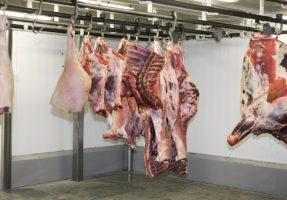
“My feeling is that we only have a capacity problem during the fall run in October and November when a lot of the beef and game is getting processed,” she says. “We have the capacity to kill animals. We may have a lack of cooler space to hang carcasses, and we certainly do have a labour shortage to staff the cut and wrap process.”

Kamloops mayor Ken Christian is a director with the TNRD and previously spent 37 years in public health, ending his career as regional director, health protection, for the Interior Health Authority.

Christian doesn’t think more D-class licences would be a problem.

“I don’t think constituents are very aware of the lower level of inspection for D and E licences,” says Christian. “There is an assumption that every piece of meat that shows up on your plate in a restaurant is inspected and that is a naive and impossible assumption.”

And that’s likely to remain the norm.

“I think that random testing and random inspection of slaughterhouse floors is probably the best that you will ever get,” he says.

However, he says better follow-up is needed when complaints arise to maintain public confidence in meat when food-borne illnesses occur. The current process is complaint-driven, and regulators need to make sure complaints are adequately addressed.

“If they did that better, then I think you would be able to nip these things in the bud,” he says.

Christian says staff did annual visits to licensed plants along with following up every complaint when he was with IHA.

A key area for concern, Christian says, are farmers’ markets, such as the one in Kamloops.

“It is more or less an extension of farmgate sales, and that is something that people turn a relatively blind eye, too,” he says.

The risk that worries him is a food-safety incident at a local market which could jeopardize the reputation of the entire meat industry. However, he doesn’t think the risk is any greater at uninspected plants than government-inspected plants.

“Quite frankly, even with the federal system, you have that potential,” he says. “I don’t think there is going to be a whole lot of difference.”

This doesn’t sit well with Woodbury, who believes government is missing the point by considering more

D-class licences.

“There is no reason to increase uninspected meat in this province,” she says. “Third-party oversight assures the consumer that food safety and animal welfare concerns are being addressed.”

Smith says her association isn’t opposed to inspections. She would like to see slaughter capacity in small communities, reducing travel time for animals even if it increases it for inspectors.

“Wouldn’t it be easier to say that the second and third Tuesday of the month are kill days in Merritt and they send an inspector to the Nicola Valley?” she asks. “Wouldn’t that be easier than having all of us haul our animals all over the place?”

But it’s a tough discussion to have, especially with governments throwing their support behind plant-based diets.

“I worry that meat is not a very politically popular topic right now,” she says. “Nobody wants to talk about killing animals, but that’s what we need to talk about.”
Related Posts

You may be interested in these posts from the same category.

New licences, new inspections

BC abattoir volume up 30% in 2020

Province reveals abattoir changes

SlaughterRight training launched by ag ministry

Rural recovery funds agriculture

Meat producers frustrated by consultations

Abattoir association calls for action

Closures underscore need for licensing reform

Rethinking the concept for mobile abattoirs

Industry mourns abattoir champion

Island farmers renew request for local abattoir

Abattoirs required to cut back overtime

Previous Post: « Minimize the risk of corn silage fires
Next Post: New waste control rules kick in October 1 »

Copyright © 2025 Country Life in BC · All Rights Reserved