• Menu
  • Skip to primary navigation
  • Skip to main content
  • Skip to primary sidebar

Country Life In BC Logo

The agricultural news source in British Columbia since 1915

  • Headlines
  • Calendar
  • Subscribe
  • Advertise
  • About
  • Archives
  • Contact
  • Search
  • Headlines
  • Calendar
  • Subscribe
  • Advertise
  • About
  • Archives
  • Contact
  • Search

Primary Sidebar

Originally published:

MARCH 2021
Vol. 107 Issue 3

Subscribe Now!

Sign up for free weekly FARM NEWS UPDATES

Select list(s) to subscribe to


By submitting this form, you are consenting to receive marketing emails from: Country Life in BC. You can revoke your consent to receive emails at any time by using the SafeUnsubscribe® link, found at the bottom of every email. Emails are serviced by Constant Contact
Your information will not be
shared or sold ever

Stories In This Edition

Province to make Premises ID law

A wee bit of green

No extension for groundwater

Pandemic trends a moving target as spring comes

Editorial: Safe and secure

Back 40: Making the most of a simple pleasure

Viewpoint: Regenerative agriculture is the way of the future

SlaughterRight training launched by ministry

Ottawa to bankroll foreign worker quarantine

Ag advocates honoured at virtual gala

Coping with adversity requires an open mind

Blueberry growers dodge US trade complaint

Open for business

Codling moth control strategy shows promise for SWD

Cherry growers continue to focus on export markets

Ministry prepares to lend support to tree fruit co-op

Delta farm entrepreneur built strong relationships

Dairy picks new entrant short list

Early advocate for farmworkers’ rights remembered

Markets consider allowing Alberta vendors

Ranchers plead with province to address elk issue

Sidebar: Fencing program protects hay

Falkland beef plant finetuning operations

District A sets ambitious agenda

Don’t underestimate scope of farmers institutes

Everlasting

Strict pandemic plan keeps workers safe

Growers face up to labour challenges

Time to tap

Sidebar: Housing key for SAWP workers

Tulip festival to bloom again in Spallumcheen

Hazelnut growers face increased disease, pest threats

Resources go online

Hope prevails as hazelnuts target expansion

Research: Wildfires influence pollinator offspring

Raspberry growers see improved IQF pricing

Raspberry researchers select for hardiness

Direct farm marketers prepared for new season

Sudden dieback now showing up in cherries

Viewpoint: Consumers need more than a Buy Local campaign

New framework to measure AITC outcomes

Farm News: Wishful thinkign for the winter that wasn’t

Ewe know it’s spring

Juiced up over local produce options

Peer groups help foster innovation, support

Sidebar: How to start

Sisters create website to help small producers

Woodshed: Divorce proceedings take off with a dog fight

Gardener pens book about mason bees

Jude’s Kitchen: Spring is coming

More Headlines

Follow us on Facebook

Comments Box SVG iconsUsed for the like, share, comment, and reaction icons

6 days ago

... See MoreSee Less

View Comments
  • Likes: 4
  • Shares: 0
  • Comments: 0

Comment on Facebook

6 days ago

On the last day of the BC Organic Conference, Thursday, Molly Thurston of Pearl Agricultural Consulting helped growers learn how to manage bugs such as codling moth, wireworm, and rootworm in organic growing systems. Her talk alongside Renee Prasad included hands-on activities in which participants checked out various traps and examined pests under microscopes. Be sure to look for more upcoming ag events on our online calendar at www.countrylifeinbc.com/calendar/

#BCAg
... See MoreSee Less

On the last day of the BC Organic Conference, Thursday, Molly Thurston of Pearl Agricultural Consulting helped growers learn how to manage bugs such as codling moth, wireworm, and rootworm in organic growing systems. Her talk alongside Renee Prasad included hands-on activities in which participants checked out various traps and examined pests under microscopes. Be sure to look for more upcoming ag events on our online calendar at www.countrylifeinbc.com/calendar/

#BCAg
View Comments
  • Likes: 15
  • Shares: 0
  • Comments: 0

Comment on Facebook

1 week ago

Well-known organic farmer and podcaster Jordan Marr gets interviewed by Country Life in BC’s own columnist and potato mavin Anna Helmer during the opening session of the BC Organic Conference at Harrison Hot Springs yesterday. Sessions run today (Wednesday) and Thursday and include organic and regenerative growing practices and expanding and advocating for the organic sector, all under the background of the newly launched Organic BC banner.

#BCAg
... See MoreSee Less

Well-known organic farmer and podcaster Jordan Marr gets interviewed by Country Life in BC’s own columnist and potato mavin Anna Helmer during the opening session of the BC Organic Conference at Harrison Hot Springs yesterday. Sessions run today (Wednesday) and Thursday and include organic and regenerative growing practices and expanding and advocating for the organic sector, all under the background of the newly launched Organic BC banner.

#BCAg
View Comments
  • Likes: 37
  • Shares: 2
  • Comments: 1

Comment on Facebook

Interested in finding out more about this

3 weeks ago

Today, we remember those who sacrificed their lives or their well-being for our freedom. Lest we forget. ... See MoreSee Less

Today, we remember those who sacrificed their lives or their well-being for our freedom. Lest we forget.
View Comments
  • Likes: 8
  • Shares: 0
  • Comments: 0

Comment on Facebook

1 month ago

FarmFolk CItyFolk is hosting its biennial BC Seed Gathering in Harrison Hot Springs November 27 and 28. Farmers, gardeners and seed advocates are invited to learn more about seed through topics like growing perennial vegetables for seed, advances in seed breeding for crop resilience, seed production as a whole and much more. David Catzel, BC Seed Security program manager with FF/CF will talk about how the Citizen Seed Trail program is helping advance seed development in BC. Expect newcomers, experts and seed-curious individuals to talk about how seed saving is a necessity for food security. ... See MoreSee Less

Link thumbnail

BC Seed Gathering - FarmFolk CityFolk

farmfolkcityfolk.ca

Save the date for our upcoming 2023 BC Seed Gathering happening this November 3rd and 4th at the Richmond Kwantlen Polytechnic University campus.
View Comments
  • Likes: 1
  • Shares: 0
  • Comments: 0

Comment on Facebook

Subscribe | Advertise

The agricultural news source in British Columbia since 1915
  • Email
  • Facebook

Ranchers plead with province to address elk issue

Feed, forage losses are costing ranchers hundreds of thousands

The BC Cattlemen’s Association is asking that ranchers be compensated for 100% of the costs resulting from the losses due to elk damage under the BC Agriculture Wildlife Program. wayne ray, smith creek ranch

March 1, 2021 byTom Walker

KAMLOOPS – Ranchers are asking the province to tighten management of elk populations as the ungulates become an increasing nuisance to agriculture.

“We believe that elk populations are growing in certain regions,” says Elaine Stovin, assistant general manager with the BC Cattlemen’s Association.

Vanderhoof rancher and wildlife biologist Olin Albertson with the Nechako Regional Cattlemen’s Association agrees.

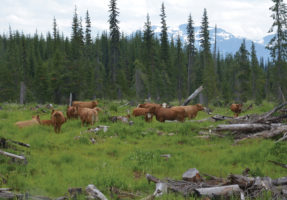
“We have certainly seen an increase in our area,” he says. “I can have up to 150 on my place at any one time and we now see herds of up to 300 crossing the highway. That wasn’t the case when I moved here in 2005.”

Staff with the BC Ministry of Forests, Lands, Natural Resource Operations and Rural Development have conducted surveys in selected areas but a province-wide elk count has never happened, meaning no one knows how much of a problem elk really are or whether it’s getting worse.

“You can’t manage what you don’t measure,” says Albertson.

Regional groups such as cattlemen’s associations or wildlife groups have taken it upon themselves to conduct local surveys, but that is not the same as a science-based inventory.

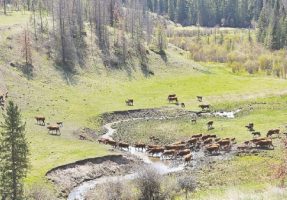
Elk are nocturnal animals. You can find them moving at dawn and dusk, and they feed primarily at night. Elk know where they are safe and can feed, Albertson points out, and over time the animals have become habituated to grazing on farm land.

“Agriculture areas tend to have less predators so the elk will gather in farmers’ fields,” he says.

Herd activity is the key problem. Elk are the second-largest member of the deer family after moose, but unlike the solitary moose they live together in herds. When you combine herd behaviour with grazing that clips plants close to the ground and sharp hooves that gouge the soil, a herd of elk can have a significant negative impact on a farmer’s field.

BC Cattlemen’s primary concern is the impact elk have on private lands but it is also worried about Crown range as well, an important source of grazing land for ranchers.

While elk pose minimal threat to range in the summer when plants are well-established, Albertson says it’s different in newly planted fields.

When elk get into a field with fresh sprouts, their browsing can stunt forage growth significantly. And if it is wet, their hooves do further damage to the young plants.

“When the forage is actively growing, there is not too much loss from grazing,” he says. “[But] if they get into a newly planted field, particularly with our fall rains, they can trample plants and will actually pull up the entire young plant when they are feeding and kill it.”

That is frustrating for ranchers who know to wait until a pasture can handle the impact of animals before turning cows out.

“If they get onto a pasture in early spring, that can really impact your grazing rotations,” he says.

There is also a risk of winter damage.

“Our snow cover is not as deep or as consistent as it used to be,” says Albertson. “The elk have gotten into my alfalfa and it looks like a moonscape. If there is a freeze and thaw cycle, the roots can actually snap.”

Haystacks ruined

Winter is also the time that elk can do extensive damage to a farmer’s stored feed supply.

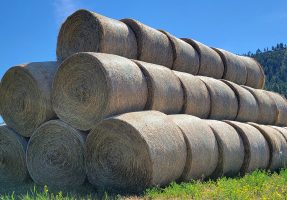
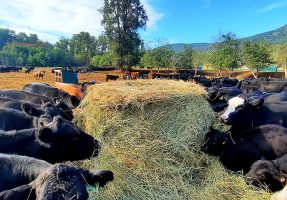
“This is the biggest measurable damage,” says Albertson. “A herd of 150 elk can do serious damage to a haystack even overnight.”

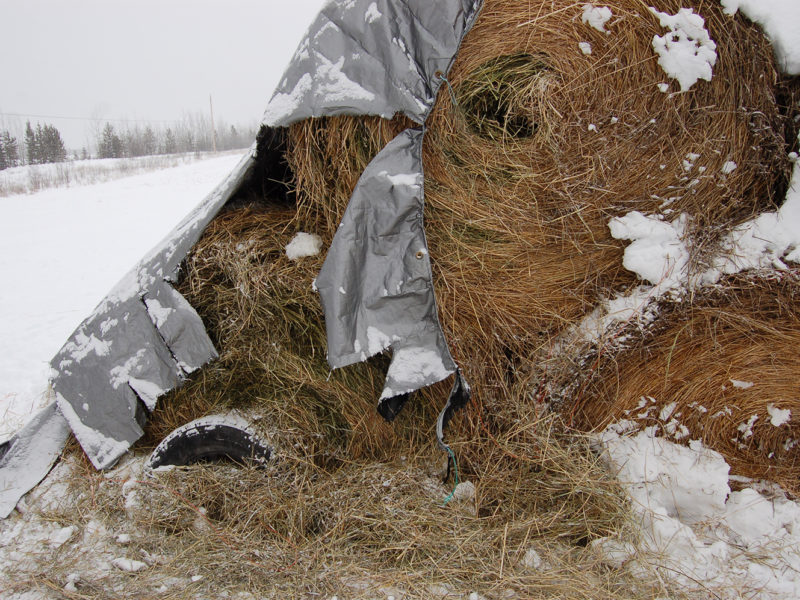
What hay the elk don’t eat they will trample, crush while bedding down in it and poison from defecation and urination. Impacted hay cannot even be used for bedding other animals. Wrap offers no protection to bales. The bulls tear the plastic with their antlers.

There’s also a concern about how high elk numbers may impact the animal unit months ranchers are allowed in a range plan based on available forage if the combination of cattle and elk numbers exceed the carrying capacity of the land. Stovin says there’s real fear that the province may require ranchers to reduce the number of animals they can place on Crown range.

Ongoing issue

BC Cattlemen’s have asked the province for years to address the elk issue.

“In our second letter to the government, in the fall of 2019, we again called on the province to actively manage wildlife populations in a manner with a goal of minimal impacts on private lands,” says Stovin.

A key part of a management strategy would be to open more areas for hunting, cattlemen believe.

“We believe they should open up all management units to both bull and cow elk hunts,” says Stovin.

The Nechako Regional Cattlemen’s Association has coordinated limited-entry hunts on private ranches as have ranchers in the Skeena region.

Houston rancher Linda Dykens thinks hunting provides enough pressure that when combined with a stackyard fencing program, the elk move on.

“We are asking that the government provide funding for a stackyard fencing program across the entire province,” says Stovin.
Related Posts

You may be interested in these posts from the same category.

Breathing new life into historic ranches

Province lacks reconciliation roadmap: ranchers

Beef herd drops

Feed available but stocks low

BC Cherry holds AGM

Land Act changes deferred

Land Act firestorm

Dam violations face fines

Rangeland forage allocation studied

Communication critical to solve water issues

Province funds feed access

Ranchers’ markets, practices praised

Previous Post: « Don’t underestimate scope of farmers institutes
Next Post: Cherry growers continue to focus on export markets »

Copyright © 2025 Country Life in BC · All Rights Reserved