
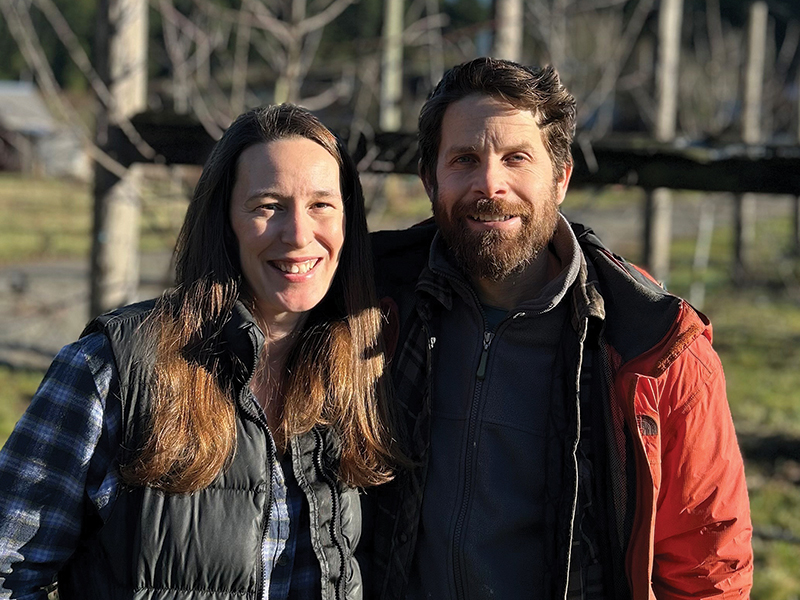
NANAIMO – A farm property should be taxed as a farm even if the farm operation includes value-added processing, according to a Nanaimo cidery facing a big boost to its property tax bill.
Big Bang Cider sits on 17.5 acres at 1235 Nanaimo Lakes Road, a location chosen because it lies within the Agricultural Land Reserve. This made it more affordable, says co-owner Colin Rombough, who together with his wife Kate Rycroft bought the property in 2019 and established an orchard now home to 25 varieties of cider apples across seven acres.
But in 2024, having received permission from the City of Nanaimo and Agricultural Land Commission, the couple began producing cider on site. When assessors sized up the property last year for the 2026 tax roll, they designated an 8,000-square-foot section of the farm where the cidery sits as light industrial. This resulted in a 49% increase in the property’s assessed value, to $360,079.
While much of the property is classed as farmland, the value of which is assessed at legislated rates, the gain of approximately $121,500 was due entirely to the new non-farm classification.
“What BC Assessment has come and done is, they’ve said we’re going to pluck out this fifth of an acre of your farm, and we’re going to designate that land and the buildings upon it as a light industrial building. That vastly increases the taxes that we’re going to have to pay,” explains Rombough.
Nanaimo’s tax rate for light industrial properties is 3.1 times the rate for residential properties, and well above the legislated rate for farm properties.
BC Assessment reports 49,691 properties holding farm class on this year’s tax roll, with a total value of
$1.26 billion. This is down from last year’s tally of 51,162 properties valued at $1.29 billion.
Rombough plans to appeal his assessment, but he says money isn’t the most important issue. Rather, classifying farm buildings as light industrial exposes inconsistencies in how government agencies define farm properties.
“It potentially causes a really big regulatory grey area. Are we a farm business, and are our buildings farm buildings?” he asks. “If we’re designated light industrial, can our municipality come around and say, ‘Well, the building you have there is not a farm building, so you need to get a retroactive building permit.’”
It’s not out of the question.
Nanaimo, despite having approved Big Bang’s on-farm retail shop as a farm building in 2021, has since flagged it as a retail building. With the addition of the cidery – which Rombough argues effectively prepares the farm’s fruit for sale – the farm has diversified its operations while remaining a farm.
“My farm business ends once my customer has that bottle in their hand,” he says. “Everything up to that point is my farm business because that’s the way the entire farm pays for itself. Arbitrarily just stepping in and being like, ‘the farming ends when you take your apple off the orchard’ is not reflective of the modern society that we live in.”
Pointing to the challenges facing Okanagan growers and the number of cider-making ventures in that region, Rombough says value-added processing is virtually essential to BC’s small-scale farms.
“It’s really, really difficult to have a modern farm business if you don’t have some degree of value-added processing associated with what you’re growing,” he says. “We would have very, very little ability, if any ability, to have a productive farm if we were just selling our apples.”
Rombough and his wife live on the property, which they also make available to local vegetable and flower growers, ensuring it remains in production.
“We specifically bought ALR land because we wanted to farm, and we wanted to be protected,” he says. “If we’re using it for permitted farm uses, we’ll get a bit of a tax break. But in this particular case, we’re getting all the regulations but none of the breaks. And that’s the hypocrisy that really annoys me.”
The frustration is genuine after working to ensure compliance with rules set by no less than 17 different government organizations prior to opening Big Bang.
“Every single one of them asks for different and contradictory things,” he says. “If you’re going to ask small farm businesses to cross so many regulatory jurisdictions, at least try to align what you consider a farm and what you’re not.”
The inconsistencies underscore the need for a review of farm classification in BC, a recommendation of last year’s Premier’s Task Force on Agriculture and Food Economy. The task force delivered its final recommendations at the end of November, including establishing a committee to “review and modernize the governance and structure of the Agricultural Land Commission … with the goal of protecting and preserving farmland and supporting food producers and processors” and developing “a land strategy for food processing that supports agricultural viability and advances BC’s food independence by increasing agricultural production and building infrastructure to process, store and distribute food efficiently.”
The impetus to review how processing fits within the mandate of farmland preservation encourages Rombough, but Chris Bodnar, a University of the Fraser Valley professor specializing in agribusiness who represented primary agriculture on the task force, says the answer isn’t simple.
“The real challenge is, how closely tied is processing going to be to agriculture?” he says.
While processing may be integral to farmers’ business plans, the regulations governing value-added activities often aren’t set by the BC Ministry of Agriculture and Food. Since the task force was an initiative of the premier, Bodnar expects its recommendations will be referred to more than one ministry for implementation.
There is no timeline for action, though the BC Agriculture Council – which spearheaded the initiative in partnership with processing sector association BC Food & Beverage – plans to hold government to account.
Rombough, a biologist whose professional work involves navigating environmental regulations, says the inconsistencies in farm classification leave him at a loss. And if he’s at a loss, he knows other farmers must be even more so.
“In my day job, I’m a bureaucrat, and I generally know how to bureaucrat,” he says. “I know my way around legislation versus regulation versus policy, and if it doesn’t make sense to me, then should we really expect all farmers to have to be policy wonks just to have a farm business?”
All content on this website is copyrighted, and cannot be republished or reproduced without permission.


 BC women break barriers in agriculture