• Menu
  • Skip to primary navigation
  • Skip to main content
  • Skip to primary sidebar

Country Life In BC Logo

The agricultural news source in British Columbia since 1915

  • Headlines
  • Calendar
  • Subscribe
  • Advertise
  • About
  • Archives
  • Contact
  • Search
  • Headlines
  • Calendar
  • Subscribe
  • Advertise
  • About
  • Archives
  • Contact
  • Search

Primary Sidebar

Originally published:

APRIL 2022
Vol. 108 Issue 4

Subscribe Now!

Sign up for free weekly FARM NEWS UPDATES

Loading form…

Your information will not be
shared or sold ever

Stories In This Edition

Taking root

No room

Farmland values soar

Orchardist grows international, domestic sales

Editorial: The choices we make

Back 40: Freedom has its boundaries in a civilized world

Viewpoint: Underinsured in a potential disaster zone

BCFGA sheds responsibilities, looks ahead

Province hikes minimum wage, piece rates

Climate Action Initiative disbanded by province

Dusty brown

Letters: Minister is misleading

Chicken growers on watch for avian influenza

Ag Briefs: OrganicBC pursues structural review

Ag Briefs: Online bull sale exceeds expectations

Ag Briefs: Groundwater deadline passes

Turkeys emerge from 2021 in a strong position

Sidebar: Benoit trades turkeys for flowers

Agri-industry project gets green light from ALC

Resilient cherry growers target exports

Labour shortage has abattoirs hogtied

No progress on livestock watering regulations

Soakin’ up the sun

Regenerative agriculture vision outlined

Strong yields and new strategy for cranberries

Tree fruit growers struggle to source plants

Fumigation options

Farm Story: Cull potatoes are about to earn their keep

Pilot program bridges the extension gap

There is a future for BC’s apple industry

A warming world calls for new strategies

Heat dome, cold snaps hit some, miss others

Boiler project cuts costs for Duncan farm

Woodshed Chronicles: A little tough love for Frank and Kenneth

Farm partnership supports local non-profit

BC entrepreneurs meet food waste challenge

It’s time to dust off the barbecue

More Headlines

Follow us on Facebook

Comments Box SVG iconsUsed for the like, share, comment, and reaction icons

4 hours ago

The Township of Langley Farm and Ranch Exhibition Society is hosting a public open house this evening to gather input on plans to transform the historic Belmont Farm into an agricultural exhibition, education and heritage hub. Farmers, ranchers, and community members are invited to share their feedback. The open house is at the George Preston Rec Centre, 6-8 pm.

Township of Langley Farm and Ranch Exhibition Society
#BCAg
... See MoreSee Less

The Township of Langley Farm and Ranch Exhibition Society is hosting a public open house this evening to gather input on plans to transform the historic Belmont Farm into an agricultural exhibition, education and heritage hub. Farmers, ranchers, and community members are invited to share their feedback. The open house is at the George Preston Rec Centre, 6-8 pm. 

Township of Langley Farm and Ranch Exhibition Society 
#BCAg
View Comments
  • Likes: 4
  • Shares: 0
  • Comments: 0

Comment on Facebook

7 hours ago

The sold-out Southern Interior Horticulture show continues today. Education sessions range from rodent control to new tree fruit varieties, with the afternoon devoted to improving spraying techniques for orchardists and vineyard managers. When not listening to speakers, producers are checking the trade show.

#BCAg
... See MoreSee Less

The sold-out Southern Interior Horticulture show continues today. Education sessions range from rodent control to new tree fruit varieties, with the afternoon devoted to improving spraying techniques for orchardists and vineyard managers. When not listening to speakers, producers are checking the trade show.

#BCAg
View Comments
  • Likes: 6
  • Shares: 0
  • Comments: 0

Comment on Facebook

9 hours ago

The BC Poultry Association has lowered its avian flu biosecurity threat level from red to yellow, citing declining HPAI risk factors and fewer wild bird infections. Strong biosecurity practices helped BC limit cases this winter to 38 premises, down from 81 last year. For more, see today's Farm News Update from Country Life in #BCAg#BCAg ... See MoreSee Less

Link thumbnail

Poultry biosecurity notches down

www.countrylifeinbc.com

Declining risk factors for highly pathogenic avian influenza (HPAI) have prompted the BC Poultry Association to lower the industry’s biosecurity threat level from red to yellow. The decision…
View Comments
  • Likes: 11
  • Shares: 2
  • Comments: 1

Comment on Facebook

🐥💛

1 day ago

The application deadline for cost-shared funding through the Buy BC program is coming up on February 20. Up to $2 million through the Buy BC Partnership Program is available annually to BC producers and processors to support local marketing activities that increase consumer awareness of BC agriculture and BC food and beverages. For more information, visit buybcpartnershipprogram.ca/.

Buy BC

#BCAg
... See MoreSee Less

Link thumbnail

Home - Buy BC Partnership Program

buybcpartnershipprogram.ca

Buy BC Partnership Program Increase your visibility with Buy BC The Buy BC Partnership Program is a fundamental component of Buy BC that provides up to $2 million in cost-shared funding annually to lo...
View Comments
  • Likes: 3
  • Shares: 0
  • Comments: 0

Comment on Facebook

1 day ago

The Sik-E-Dakh (Glen Vowell) First Nation's Skeena Fresh hydroponic operation has doubled production capacity thanks to a $130,632 Northern Development Infrastructure Trust grant. Growing lettuce, kale, herbs and more in shipping containers, the operation uses 90% less water than traditional farming while providing 1,200 people with year-round access to fresh, locally grown greens. Their story is in the February edition of Country Life in BC, the agricultural news source for BC’s farmers and ranchers.

Northern Development Initiative Trust
#BCAg
... See MoreSee Less

The Sik-E-Dakh (Glen Vowell) First Nations Skeena Fresh hydroponic operation has doubled production capacity thanks to a $130,632 Northern Development Infrastructure Trust grant. Growing lettuce, kale, herbs and more in shipping containers, the operation uses 90% less water than traditional farming while providing 1,200 people with year-round access to fresh, locally grown greens. Their story is in the February edition of Country Life in BC, the agricultural news source for BC’s farmers and ranchers. 

Northern Development Initiative Trust 
#BCAg
View Comments
  • Likes: 15
  • Shares: 1
  • Comments: 0

Comment on Facebook

Subscribe | Advertise

The agricultural news source in British Columbia since 1915
  • Email
  • Facebook

There is a future for BC’s apple industry

Newly elected BCFGA president eyes better days ahead

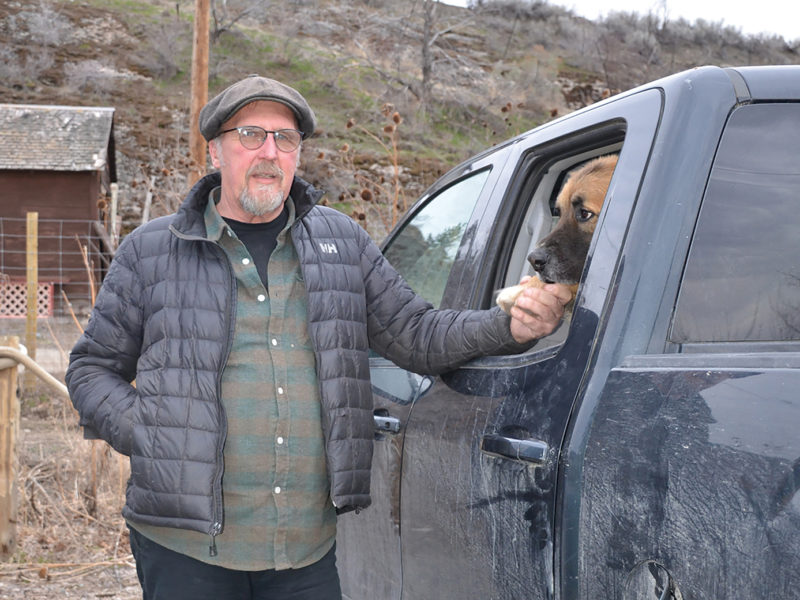
BCFGA president Peter Simonsen says he is optimistic about the future of the tree fruit industry, but government needs to step up. TOM WALKER

April 1, 2022 byTom Walker

NARAMATA — The new president of the BC Fruit Growers Association is a life-long farmer who believes he can influence a change in the province’s tree fruit industry.

“I’ve been involved in farming all my life,” says Peter Simonsen, an organic grower who was elected to head the 133-year-old association at its annual convention at the end of February. “I worked on a cousin’s ranch when I was a teenager and I liked it so much I went and got an agriculture degree at UBC.”

He tended a strawberry patch in Victoria while his wife obtained her teaching certificate, then grew vegetables in the Lower Mainland before moving to Naramata, where his wife’s family had farmed since 1910.

Simonsen grows apples, peaches and pears on 45 acres. His son Andrew is now a fifth-generation fruit grower and his daughter Annelise Simonsen and daughter-in-law Kaleigh Jorgensen run Creek and Gully Cidery, which uses some of the farm’s fruit.

“I’ve been involved in some aspect of the BCFGA since we started orcharding in 1987,” Simonsen says.

He was a convention delegate, eventually a board member and served as vice-president for three years.

“I took a year off when I lost the VP position,” he says. “When Pinder [Dhaliwal] was stepping down, he urged me to run for president. He phoned a lot of people and I phoned a lot of people and I won the vote on February 23.”

Simonsen has a strong mandate from growers. In an uncustomary move, BCFGA directors voted to reveal the results of the election; Simonsen received 121 votes, while current vice-president Jeet Dukhia received 63. Turnout was strong; more than 55% of the 332 association members cast votes.

Simonsen will count on that support as he steers the association through some very difficult times.

“We are into a five-year crisis in the apple industry,” he says. “We have been hit with multiple weather events and grower returns have been extremely poor for the last several years. There is a chronic labour shortage, apple acreage is at an all-time low and growers are planting cherries and grapes instead. We have board members who tell me if things don’t change they won’t be farming in three years.”

This wasn’t always the case, Simonsen recalls.

World leaders

“During the 1990s, we were world leaders. We were getting a dollar a pound for Galas. Growers from other countries came to see our high-density planting systems and the Ambrosia apple that was developed here in BC was winning customers everywhere.”

The province can’t all be planted in grapes and cherries, Simonsen says.

“There are only so many sites that are suitable for soft fruit and grapes are a luxury item. We need the diversity that the apple industry provides,” he says.

An industry stabilization initiative led by the province recently completed a blueprint for the industry that contains 19 recommendations to resolve the issues plaguing the industry, but it has yet to commit resources to implementation.

Simonsen is positive there is a future for the industry.

“We have some of the top apple-growing conditions anywhere in North America,” he says. “But there needs to be a change in attitude. Farmers are feeling defeated and we don’t see any support from the government for our industry. To date there is no indication they will implement the report.”

Simonsen hopes that he can reset the sector’s relationship with government.

“There is not a lot of support for any agriculture within this government,” he says. “BC spends $17 per capita on agriculture, Ontario $40, Quebec $80 and Saskatchewan $400.”

BCFGA priorities for the industry, as chosen by members, include a better labour strategy and improvements to regulations governing the Agricultural Land Reserve and municipal rules for worker housing.

Seasonal labour is also an issue. Smaller orchards cannot employ a temporary farm worker full time, but current rules make it difficult to transfer workers between orchards. It is often difficult to get worker housing or summer camping approved by municipal jurisdictions.

A one-time support payment would go a long way to addressing the industry’s woes, and remains a key BCFGA demand of government.

“Washington growers have had a seven-cent a pound support payment over the last two years,” Simonsen says. “A support payment would help growers recover from the recent conditions. Many are wondering if they will have the money to spend on inputs for the coming year.”

Cash isn’t enough

But cash alone is not the answer. Innovation and technology, continuing the replant program and developing a solid extension program are also priorities.

“The cherry industry has benefited enormously from the world-class research that has gone onto the cherry breeding program. We need continual development of new apple varieties as well,” Simonsen says. “And renewing the replant program should have been settled over a cup of coffee. For every dollar the government puts in, the industry puts in 10.”

The apple marketing commission outlined in the industry stabilization document and being promoted by the New Tree Fruit Varieties Development Council makes a lot of sense, says Simonsen.

“Personally, I’m totally in favour of it. I think that all of us working together is the best strategy. I’ve heard there’s up to 38 packing houses now. That’s competition with the grower’s money,” he says. “We would like to see the packers embrace it, but in the end it will be a grower vote that decides.”

Simonsen believes the democratically elected BCFGA is the organization to continue to lead the industry.

“I am happy with our new, leaner business model. I think that we can continue with programs that support our member growers while also being a lobbying organization for the whole tree fruit industry,” he says. “We passed a solid set of resolutions at the AGM that will guide the board.”

Simonsen, who organized the Apple Farewell Tour at the Kelowna Farmers Market in October 2020, doesn’t think the industry is ready to say goodbye. But many growers can’t hold out much longer. Several have already left, with BCFGA member down a third from more than 500 a few years ago.

“We sold apples for12 cents a pound which was what on average our growers were receiving,” he says of the farewell tour event. “We need a change. I worry that it’s getting awfully late.”
Related Posts

You may be interested in these posts from the same category.

Cherry growers focus on labour

Federal budget kills Living Labs

Cherry bonanza no jubilee

Islands Trust sidelines ag in policy statement

ALC rejects Cowichan dike removal

Council calls for review of farm classification rules

Regulatory hurdles threaten farm income solutions

Arts leads BCFGA forward

Tesche leaving BCFGA

United front for fruit growers

Apple growers discuss marketing commission

BC Fruit Growers list test orchard

Previous Post: « Bird flu hits Enderby farm
Next Post: Fruit tree protocols reviewed »

Copyright © 2026 Country Life in BC · All Rights Reserved