• Menu
  • Skip to primary navigation
  • Skip to main content
  • Skip to primary sidebar

Country Life In BC Logo

The agricultural news source in British Columbia since 1915

  • Headlines
  • Calendar
  • Subscribe
  • Advertise
  • About
  • Archives
  • Contact
  • Search
  • Headlines
  • Calendar
  • Subscribe
  • Advertise
  • About
  • Archives
  • Contact
  • Search

Primary Sidebar

Originally published:

APRIL 2022
Vol. 108 Issue 4

Subscribe Now!

Sign up for free weekly FARM NEWS UPDATES

Loading form…

Your information will not be
shared or sold ever

Stories In This Edition

Taking root

No room

Farmland values soar

Orchardist grows international, domestic sales

Editorial: The choices we make

Back 40: Freedom has its boundaries in a civilized world

Viewpoint: Underinsured in a potential disaster zone

BCFGA sheds responsibilities, looks ahead

Province hikes minimum wage, piece rates

Climate Action Initiative disbanded by province

Dusty brown

Letters: Minister is misleading

Chicken growers on watch for avian influenza

Ag Briefs: OrganicBC pursues structural review

Ag Briefs: Online bull sale exceeds expectations

Ag Briefs: Groundwater deadline passes

Turkeys emerge from 2021 in a strong position

Sidebar: Benoit trades turkeys for flowers

Agri-industry project gets green light from ALC

Resilient cherry growers target exports

Labour shortage has abattoirs hogtied

No progress on livestock watering regulations

Soakin’ up the sun

Regenerative agriculture vision outlined

Strong yields and new strategy for cranberries

Tree fruit growers struggle to source plants

Fumigation options

Farm Story: Cull potatoes are about to earn their keep

Pilot program bridges the extension gap

There is a future for BC’s apple industry

A warming world calls for new strategies

Heat dome, cold snaps hit some, miss others

Boiler project cuts costs for Duncan farm

Woodshed Chronicles: A little tough love for Frank and Kenneth

Farm partnership supports local non-profit

BC entrepreneurs meet food waste challenge

It’s time to dust off the barbecue

More Headlines

Follow us on Facebook

Comments Box SVG iconsUsed for the like, share, comment, and reaction icons

4 hours ago

The Township of Langley Farm and Ranch Exhibition Society is hosting a public open house this evening to gather input on plans to transform the historic Belmont Farm into an agricultural exhibition, education and heritage hub. Farmers, ranchers, and community members are invited to share their feedback. The open house is at the George Preston Rec Centre, 6-8 pm.

Township of Langley Farm and Ranch Exhibition Society
#BCAg
... See MoreSee Less

The Township of Langley Farm and Ranch Exhibition Society is hosting a public open house this evening to gather input on plans to transform the historic Belmont Farm into an agricultural exhibition, education and heritage hub. Farmers, ranchers, and community members are invited to share their feedback. The open house is at the George Preston Rec Centre, 6-8 pm. 

Township of Langley Farm and Ranch Exhibition Society 
#BCAg
View Comments
  • Likes: 4
  • Shares: 0
  • Comments: 0

Comment on Facebook

7 hours ago

The sold-out Southern Interior Horticulture show continues today. Education sessions range from rodent control to new tree fruit varieties, with the afternoon devoted to improving spraying techniques for orchardists and vineyard managers. When not listening to speakers, producers are checking the trade show.

#BCAg
... See MoreSee Less

The sold-out Southern Interior Horticulture show continues today. Education sessions range from rodent control to new tree fruit varieties, with the afternoon devoted to improving spraying techniques for orchardists and vineyard managers. When not listening to speakers, producers are checking the trade show.

#BCAg
View Comments
  • Likes: 6
  • Shares: 0
  • Comments: 0

Comment on Facebook

9 hours ago

The BC Poultry Association has lowered its avian flu biosecurity threat level from red to yellow, citing declining HPAI risk factors and fewer wild bird infections. Strong biosecurity practices helped BC limit cases this winter to 38 premises, down from 81 last year. For more, see today's Farm News Update from Country Life in #BCAg#BCAg ... See MoreSee Less

Link thumbnail

Poultry biosecurity notches down

www.countrylifeinbc.com

Declining risk factors for highly pathogenic avian influenza (HPAI) have prompted the BC Poultry Association to lower the industry’s biosecurity threat level from red to yellow. The decision…
View Comments
  • Likes: 11
  • Shares: 2
  • Comments: 1

Comment on Facebook

🐥💛

1 day ago

The application deadline for cost-shared funding through the Buy BC program is coming up on February 20. Up to $2 million through the Buy BC Partnership Program is available annually to BC producers and processors to support local marketing activities that increase consumer awareness of BC agriculture and BC food and beverages. For more information, visit buybcpartnershipprogram.ca/.

Buy BC

#BCAg
... See MoreSee Less

Link thumbnail

Home - Buy BC Partnership Program

buybcpartnershipprogram.ca

Buy BC Partnership Program Increase your visibility with Buy BC The Buy BC Partnership Program is a fundamental component of Buy BC that provides up to $2 million in cost-shared funding annually to lo...
View Comments
  • Likes: 3
  • Shares: 0
  • Comments: 0

Comment on Facebook

1 day ago

The Sik-E-Dakh (Glen Vowell) First Nation's Skeena Fresh hydroponic operation has doubled production capacity thanks to a $130,632 Northern Development Infrastructure Trust grant. Growing lettuce, kale, herbs and more in shipping containers, the operation uses 90% less water than traditional farming while providing 1,200 people with year-round access to fresh, locally grown greens. Their story is in the February edition of Country Life in BC, the agricultural news source for BC’s farmers and ranchers.

Northern Development Initiative Trust
#BCAg
... See MoreSee Less

The Sik-E-Dakh (Glen Vowell) First Nations Skeena Fresh hydroponic operation has doubled production capacity thanks to a $130,632 Northern Development Infrastructure Trust grant. Growing lettuce, kale, herbs and more in shipping containers, the operation uses 90% less water than traditional farming while providing 1,200 people with year-round access to fresh, locally grown greens. Their story is in the February edition of Country Life in BC, the agricultural news source for BC’s farmers and ranchers. 

Northern Development Initiative Trust 
#BCAg
View Comments
  • Likes: 15
  • Shares: 1
  • Comments: 0

Comment on Facebook

Subscribe | Advertise

The agricultural news source in British Columbia since 1915
  • Email
  • Facebook

Tree fruit growers struggle to source plants

Rootstock is in dire short supply across North America

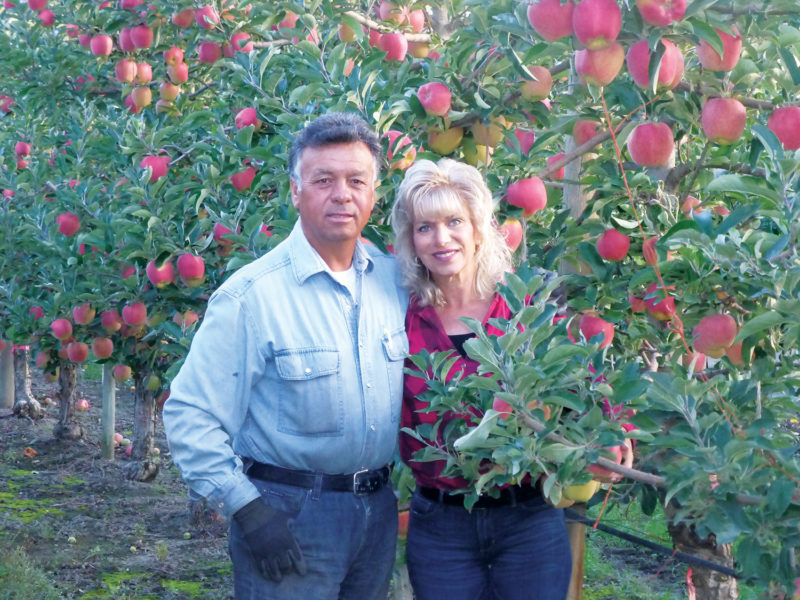
Sam and Patti DiMaria of Bella Rosa Orchards in Kelowna are finding it a struggle to update their orchard with new trees because of a lack of rootstock. SUBMITTED

April 1, 2022 byKate Ayers

KELOWNA – Weather challenges and growing demand over the past two years mean some tender fruit growers are struggling to secure new trees for their orchards.

“My son and I attempted to source some peach trees for next spring and the spring two years from now and there’s absolutely nothing. So, we tried to find some rootstock. No rootstocks whatsoever for soft fruits anywhere,” says Sam DiMaria of Bella Rosa Orchards in Kelowna. “This year we attempted to look for rootstocks for pears. It’s been extremely hard. There’s virtually nobody here in Canada, that’s for sure. In the States, if you do happen to find rootstocks, you’re extremely lucky and then there are other problems.”

The nurseries supplying the sector say a number of factors, including the extreme weather events of recent years, have all contributed to the supply pinch.

“We’ve experienced significant losses in our crops over the last three years,” says Mike Byland, vice-president and general manager of Bylands Nurseries Ltd. in West Kelowna.

He says damage occurred “pretty much across the board with all of our commercial fruit trees.”

Bylands also brings in some rootstock from across the border and says the weather-related losses mean tree orders are “really backed up.”

“We don’t have any trees left for 2022, and tree availability will be very limited in 2023 as well because it takes a few years to work through some of the challenges,” says Byland.

The difficulties prompted Byland to change tack and streamline operations, growing to order rather than maintaining a large planting vulnerable to the weather. The high cost of labour for tending trees that may or may not sell was also a factor.

“We used to grow on spec, but it takes four years to grow a tree from start to finish,” he explains. “This long production time, along with high costs of rootstocks, labour challenges and issues with regards to losses, have really impacted our operation and forced us to adapt our practices.”

While the nursery will take orders for 2023 as usual, beginning in June, orders for 2024 and beyond will require a minimum order of 500 trees of a single variety.

“We are moving towards custom growing for the industry,” says Byland. “These custom orders will require a minimum order and for growers to work further ahead with order timeframes, but these details still need to be finalized and communicated to our customers.”

Byland hopes BC does not get battered with another year of weather extremes.

“It’s got to the point where it’s become difficult to be profitable with commercial fruit tree sales,” he says. “We’ve had three years in a row where environmental pressures have had huge impacts on our yield and ultimately, profitability.”

Short supply makes diversification hard

Stock shortages in Canada combined with the challenges of importing clean plant material from the US have BC producers looking high and low for plants to renew and expand their orchards.

Katie Sardinha of Kaleidoscope Fruit Ranch in Summerland primarily grow organic apples, but the family-run farm is looking to diversify with pears, hardy kiwis and some soft fruits.

Sardinha has struggled to find a nursery that would fulfill her 150-tree order.

“We are a small grower with about 10 acres,” Sardinha says. “That’s very common around here, to be small-scale growers, so it makes sense for our business plan to do small replants on a regular basis.”

With the new minimum order requirements at Bylands, she called Van Well Nursery Inc. and C&O Nursery in Washington. Both say they’re no longer accepting orders from Canada, with C&O citing business risks as the key factor.

DiMaria says US nurseries are largely opposed to Canadian Food Inspection Agency rules requiring that incoming trees undergo fumigation to kill invasive species like the Oriental fruit moth, which is still unknown in BC.

“Fumigation is quite an involved process and it’s very expensive for the nurseries to do,” he says. “In order for them to do fumigation, they require a minimum amount of trees for them to cover their costs.”

But even if producers are willing to place the minimum required order for fumigation and cover the costs, nurseries face issues getting their stock into Canada. The nurseries he’s spoken with in Washington and Oregon all claim Canada Border Services Agency officers impose all sorts of red tape that makes shipping to Canada extremely difficult.

“It’s not worth their trouble to ship those things into Canada even after they’re fumigated,” says DiMaria. “They were telling me that I would have to deal with [CBSA] and that I would have to try and resolve any issues that come out of [CBSA] at the border when importing any plant material. They’ve washed their hands of that and thrown it on our lap.”

DiMaria has gone through the process of importing trees from south of the border himself and notes it really is a hassle – “to the point where you’re willing to say, ‘forget it.’”

To renew her aging orchard, Sardinha reached out to smaller nurseries in BC. She was eventually able to secure stock from Similkameen Nurseries Ltd. in Cawston, thanks to the business’s flexibility.

“They only do apples and they agreed to try doing pears. We were lucky that they agreed to do that because otherwise we were basically going to have to do our own nursery, which is a whole new thing for us and kind of overwhelming,” says Sardinha.

She’ll have to wait three years for their new stock to be ready, but it’s easier than doing it herself.

Still, the short supply of rootstock across North America makes it difficult for growers to plan ahead.

“If I want to plant, what do I plant that can make me money? Where do I find the plants,? Where do I find the trees? What’s the cost of the trees, and if I can find them in the US, what are the hurdles that have to be overcome to bring them here?” asks DiMaria. “I’m afraid that a lot of tree fruit growers in the valley are putting off decisions to replant and renew their orchards. … Our choices have been very limited in terms of what we can plant.”

A resolution passed at the BC Fruit Growers’ Association’s annual general meeting in February directed the association to determine ways to improve access to fruit trees from nurseries.

Related Posts

You may be interested in these posts from the same category.

Federal budget kills Living Labs

Cherry bonanza no jubilee

On the rebound

Arts leads BCFGA forward

Tesche leaving BCFGA

United front for fruit growers

Apple growers discuss marketing commission

BC Fruit Growers list test orchard

Staccato cherry rights defended

New fruit co-op discussed

Peach report bullish on future opportunities

BC Tree Fruits shuts down

Previous Post: « Second high-path AI case
Next Post: Weevil monitoring begins »

Copyright © 2026 Country Life in BC · All Rights Reserved