• Menu
  • Skip to primary navigation
  • Skip to main content
  • Skip to primary sidebar

Country Life In BC Logo

The agricultural news source in British Columbia since 1915

  • Headlines
  • Calendar
  • Subscribe
  • Advertise
  • About
  • Archives
  • Contact
  • Search
  • Headlines
  • Calendar
  • Subscribe
  • Advertise
  • About
  • Archives
  • Contact
  • Search

Primary Sidebar

Originally published:

APRIL 2025
Vol. 111 Issue 3

Subscribe Now!

Sign up for free weekly FARM NEWS UPDATES

Select list(s) to subscribe to


By submitting this form, you are consenting to receive marketing emails from: Country Life in BC. You can revoke your consent to receive emails at any time by using the SafeUnsubscribe® link, found at the bottom of every email. Emails are serviced by Constant Contact
Your information will not be
shared or sold ever

Stories In This Edition

Standing her ground

Minister endorses farmland loss

BC ag funding hits record level

Okanagan drives increase in land values

Editorial: Choosing engagement

Back 40: Trade war claims lack economic reality

Viewpoint: Tried of the to and fro of the tariff foe?

Popham fields questions at town hall

Fruit growers find strength in united front

Sidebar: Tesche quits

BC research leading way on avian influenza

Ag Briefs: Premier’s task force members announced

Ag Briefs: Carbon tax under fire

Cuthberts win Outstanding Young Farmers award

BC delegation urges  review of foreign ownership

Alliance strengthens Westgen’s bottom line

Major BC Tree fruit Co-op asset changes hands

Elbows up

Island farmers insitutes garner local support

Potato processors hold key to tariffs

Tech solutions highlight packed hort show

BC-bed apple set to fill market niche in 2026

Cherry growers optimistic after tough years

Local bylaw will increase access to farmland

Sidebar: First of its kind

Drone technology takes flight on BC farms

Sidebar: Okanagan pilot project heads off problems

Tech investments transform BC farm operations

Ranchers cry foul over green energy projects

Top bull

Ranchers oppose plans for solar energy project

Johne’s disease management critical for sheep

Food Shed gets $1 million for distribution

Market farm works smarter, not harder

Digging deep into soil amendments

Farm Story: Spring thaw unveils winter’s secrets

Berry farm goes soil-free for strawberries

Woodshed: Rocket’s revenge makes a cowboy out of Kenneth

Comox Valley sweeps farmers market awards

Jude’s Kitchen: Cooking Canadian is not a problem

More Headlines

Follow us on Facebook

Comments Box SVG iconsUsed for the like, share, comment, and reaction icons

6 days ago

... See MoreSee Less

View Comments
  • Likes: 4
  • Shares: 0
  • Comments: 0

Comment on Facebook

7 days ago

On the last day of the BC Organic Conference, Thursday, Molly Thurston of Pearl Agricultural Consulting helped growers learn how to manage bugs such as codling moth, wireworm, and rootworm in organic growing systems. Her talk alongside Renee Prasad included hands-on activities in which participants checked out various traps and examined pests under microscopes. Be sure to look for more upcoming ag events on our online calendar at www.countrylifeinbc.com/calendar/

#BCAg
... See MoreSee Less

On the last day of the BC Organic Conference, Thursday, Molly Thurston of Pearl Agricultural Consulting helped growers learn how to manage bugs such as codling moth, wireworm, and rootworm in organic growing systems. Her talk alongside Renee Prasad included hands-on activities in which participants checked out various traps and examined pests under microscopes. Be sure to look for more upcoming ag events on our online calendar at www.countrylifeinbc.com/calendar/

#BCAg
View Comments
  • Likes: 15
  • Shares: 0
  • Comments: 0

Comment on Facebook

1 week ago

Well-known organic farmer and podcaster Jordan Marr gets interviewed by Country Life in BC’s own columnist and potato mavin Anna Helmer during the opening session of the BC Organic Conference at Harrison Hot Springs yesterday. Sessions run today (Wednesday) and Thursday and include organic and regenerative growing practices and expanding and advocating for the organic sector, all under the background of the newly launched Organic BC banner.

#BCAg
... See MoreSee Less

Well-known organic farmer and podcaster Jordan Marr gets interviewed by Country Life in BC’s own columnist and potato mavin Anna Helmer during the opening session of the BC Organic Conference at Harrison Hot Springs yesterday. Sessions run today (Wednesday) and Thursday and include organic and regenerative growing practices and expanding and advocating for the organic sector, all under the background of the newly launched Organic BC banner.

#BCAg
View Comments
  • Likes: 37
  • Shares: 2
  • Comments: 1

Comment on Facebook

Interested in finding out more about this

3 weeks ago

Today, we remember those who sacrificed their lives or their well-being for our freedom. Lest we forget. ... See MoreSee Less

Today, we remember those who sacrificed their lives or their well-being for our freedom. Lest we forget.
View Comments
  • Likes: 8
  • Shares: 0
  • Comments: 0

Comment on Facebook

1 month ago

FarmFolk CItyFolk is hosting its biennial BC Seed Gathering in Harrison Hot Springs November 27 and 28. Farmers, gardeners and seed advocates are invited to learn more about seed through topics like growing perennial vegetables for seed, advances in seed breeding for crop resilience, seed production as a whole and much more. David Catzel, BC Seed Security program manager with FF/CF will talk about how the Citizen Seed Trail program is helping advance seed development in BC. Expect newcomers, experts and seed-curious individuals to talk about how seed saving is a necessity for food security. ... See MoreSee Less

Link thumbnail

BC Seed Gathering - FarmFolk CityFolk

farmfolkcityfolk.ca

Save the date for our upcoming 2023 BC Seed Gathering happening this November 3rd and 4th at the Richmond Kwantlen Polytechnic University campus.
View Comments
  • Likes: 1
  • Shares: 0
  • Comments: 0

Comment on Facebook

Subscribe | Advertise

The agricultural news source in British Columbia since 1915
  • Email
  • Facebook

Vet urges dairies to be vigilant against HPAI

Barns quickly become hospitals when herds are infected

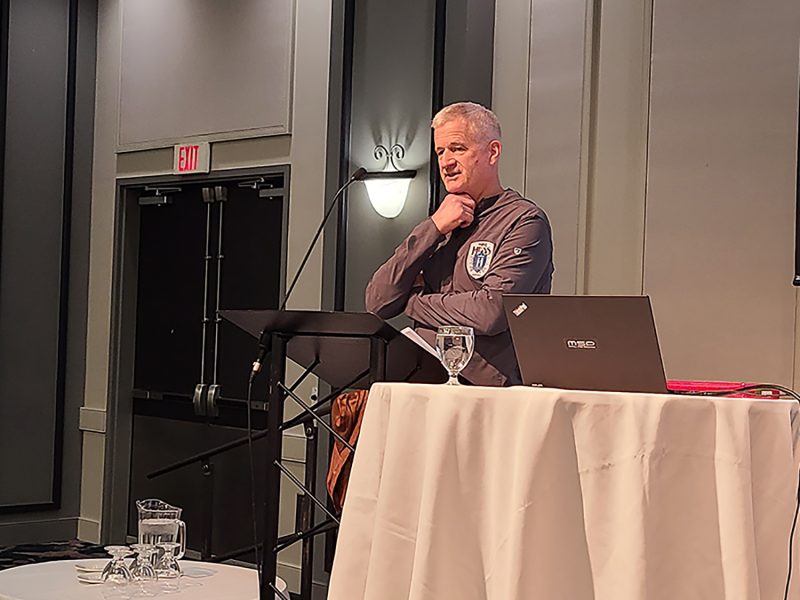
California veterinarian Murray Minnema told Mainland Milk Producers he wouldn’t wish cases of highly pathogenic avian influenza in cattle on anyone. RONDA PAYNE

April 1, 2025 byRonda Payne

ABBOTSFORD – The devastation California dairy herds are experiencing from highly pathogenic avian influenza (HPAI) has BC dairy producers taking note.

There are no reported cases of HPAI-infected dairy or beef cattle in Canada to date, but with borders still open to the free movement of non-lactating animals and BC at the northern end of the Pacific flyway that includes California, the risk is real.

“The flyway that you have here and the poultry that has been decimated from it, I can’t believe you don’t have it and I think that’s great,” California vet Murray Minnema told the Mainland Milk Producers annual meeting in Abbotsford, January 17.

Minnema retired in 2019, but has been working with dairy producers since the initial outbreaks in early 2024 and wants BC farmers to have information in their toolbox.

Texas had the first identified cases of HPAI in dairy cattle in North America in February 2024. Minnema suspected the disease was in Idaho cows about a month later, a suspicion confirmed in early April. In August, the first cases were confirmed in California.

More than 950 US herds have been infected with the B3.13 strain as of early February 2025 and another strain, D1.1 which infected a BC teen, has now been discovered in cows through genome sequencing of milk in Nevada.

The initial cases were first mistaken for winter dysentery, but this didn’t line up with the symptoms of high temperatures, respiratory distress (including bloody or mucousy nasal discharge), manure with undigested feed, thickened yellow colostrum-like milk, lesions on vulvas, reduced feeding and lack of rumination.

“A very sharp veterinarian named Barb Peterson was standing under the eave of a milk barn when a stiff breeze came by and a bunch of dead birds blew off the roof,” Minnema says.

Peterson, a Texas vet, had the dead birds and farm cats tested and confirmed HPAI. The feline deaths were suspected to be from eating birds as well as ingesting contaminated raw milk.

“The standard number of cows that we saw that needed treatment were between 60% and 70%,” Minnema says.

Asymptomatic cows ruminate about 400 to 500 minutes a day. Prior to showing symptoms, rumination drops to 100 to 150 minutes.

“Just think about that,” Minnema says. “That cow is sitting there with a rumen full of feed and she’s ruminating about 20% of what she could be.”

Milk production of the first cows infected in California went from about 35 kilograms a day to 10 kilograms. As the disease progressed, the overall milk loss per herd was as much as half of total production.

“When you look at how the cow recovers from it within 10, 15, 20 days, that rumination comes back,” he says. “But look at that production. You don’t get your milk back.”

The pattern held for older cows as well as heifers. In an analysis of a 3,500-cow dairy over 120 days, mortality rates rose from 1.3% in non-infected cows to 6.8% in affected animals. Fever abortions also occurred regularly.

Cull rates among cattle that recovered were about 31%, underscoring the long-lasting effects.

Responding to the first signs of trouble is important in managing an outbreak, but Minnema warned that diagnosis is subjective.

“It’s not like we’re sitting there doing PCR,” he says. “You’ve got to lock up the animals, look at them, make a diagnosis and do a treatment. Over time, we’re pretty confident in making these diagnoses.”

When the disease began, milkers would mark cows with chalk if they saw the symptomatic yellowish, thick milk.

“You look at the chalk mark on their leg and then you just do a quick clinical evaluation of them. Are they dehydrated? If you had time, you would temp them,” he says.

The cows would be pulled from the main herd and treated, but there are no silver bullets when an outbreak happens. Production drops and the barn quickly becomes an animal hospital.

“These cows are extremely dehydrated, extremely stressed and they need rapid attention,” Minnema says. “We modified our plan and started drenching. That at least kept them going.”

Drenching included tubing sick cows with water and electrolytes. Minnema also recommended painkillers to ease discomfort.

“These animals are miserable and they need to be rehydrated and they need that temperature to go down,” he says. “And that rumen is just sitting there. You need to inoculate that rumen. You need to give them a binder. I fed a lot of charcoal.”

With the close proximity of poultry and dairy operations in the Fraser Valley, Minnema urged producers to be on the lookout for HPAI.

“If it’s in your neighbourhood, get a test on all your cows. Dry up as many cows as you can,” he says. “Because once you’re under it, you’re stuck and you’re going to be under it for anywhere from two to three weeks. After that, it’s a variable period of time as to recovery. I wouldn’t wish this on anybody.”
Related Posts

You may be interested in these posts from the same category.

Province funds avian flu upgrades

Red biosecurity remains for poultry

MMP announces new executive assistant

Avian flu response keeping pace

AI hit chick placement

Avian influenza grows

AI risk rises with fall

Avian influenza returns

BC’s chief veterinarian highlights key animal diseases

Westgen looks beyond challenges

AI response in spotlight

Avian influenza threat looms

Previous Post: « Reminiscences of a honeyed career
Next Post: Landowners push back against rail trail plans »

Copyright © 2025 Country Life in BC · All Rights Reserved