• Menu
  • Skip to primary navigation
  • Skip to main content
  • Skip to primary sidebar

Country Life In BC Logo

The agricultural news source in British Columbia since 1915

  • Headlines
  • Calendar
  • Subscribe
  • Advertise
  • About
  • Archives
  • Contact
  • Search
  • Headlines
  • Calendar
  • Subscribe
  • Advertise
  • About
  • Archives
  • Contact
  • Search

Primary Sidebar

Originally published:

July 2018
Vol. 104 Issue 7

Subscribe Now!

Sign up for free weekly FARM NEWS UPDATES

Loading form…

Your information will not be
shared or sold ever

Stories In This Edition

Sweet basil

Committee cancels meetings

Sidebar: Greater co-ordination; less conflict

Prince George packing plant gets further study

Sidebar: Co-op model lets producers pocket profits

Editorial: Buy the billions

Back Forty: Canada isn’t the cure for what ails US dairy

OpEd: Dairy industry will endure current trade issues

ALC allegations nix Delta farmer’s vision

Letters: Elk know no boundaries

Precautions taken against Japanese beetle

Great spring for nurseries

Chicken pricing formula isn’t right

Pitt crew

Criteria for Crown tenure still unclear

McClary’s leased to Aquilinis

Strawberries kick berry season off to good start

Food advocates grapple with rural-urban interface

Research updates presented to cherry growers

New farmers need to research livestock needs

Time for tea

Ag Brief: Farmers still waiting on new ag waste regs

Ag Brief: Drought watch

AgBrief: Good to meet ewe

Ag Brief: Staff change at FF/CF

Ag Brief: Market trail

Riparian restorations benefit from farm funding

Young Farmers network at Okanagan tour

Salmon Arm fleece brings top dollar

Perseverance, ingenuity aid haskap harvest

BC ranchers praised for wildfire response

Committee work pinpoints rancher priorities

Mentorship program helps expand horizons

Tour gives public insight to dairy farming

Island welcomes Angus breeders

Experts weigh in on future of raspberry cultivars

Preparation, customer service key to market success

Top 10 list for market success

UVF ag curriculum continues to diversify

Research: Going green

Buy BC relaunched

Farm camps for kids

Henderson continues on crash course

Jude’s Kitchen: It’s easy to make July veggie month

More Headlines

Follow us on Facebook

Comments Box SVG iconsUsed for the like, share, comment, and reaction icons

4 hours ago

The Township of Langley Farm and Ranch Exhibition Society is hosting a public open house this evening to gather input on plans to transform the historic Belmont Farm into an agricultural exhibition, education and heritage hub. Farmers, ranchers, and community members are invited to share their feedback. The open house is at the George Preston Rec Centre, 6-8 pm.

Township of Langley Farm and Ranch Exhibition Society
#BCAg
... See MoreSee Less

The Township of Langley Farm and Ranch Exhibition Society is hosting a public open house this evening to gather input on plans to transform the historic Belmont Farm into an agricultural exhibition, education and heritage hub. Farmers, ranchers, and community members are invited to share their feedback. The open house is at the George Preston Rec Centre, 6-8 pm. 

Township of Langley Farm and Ranch Exhibition Society 
#BCAg
View Comments
  • Likes: 4
  • Shares: 0
  • Comments: 0

Comment on Facebook

7 hours ago

The sold-out Southern Interior Horticulture show continues today. Education sessions range from rodent control to new tree fruit varieties, with the afternoon devoted to improving spraying techniques for orchardists and vineyard managers. When not listening to speakers, producers are checking the trade show.

#BCAg
... See MoreSee Less

The sold-out Southern Interior Horticulture show continues today. Education sessions range from rodent control to new tree fruit varieties, with the afternoon devoted to improving spraying techniques for orchardists and vineyard managers. When not listening to speakers, producers are checking the trade show.

#BCAg
View Comments
  • Likes: 6
  • Shares: 0
  • Comments: 0

Comment on Facebook

9 hours ago

The BC Poultry Association has lowered its avian flu biosecurity threat level from red to yellow, citing declining HPAI risk factors and fewer wild bird infections. Strong biosecurity practices helped BC limit cases this winter to 38 premises, down from 81 last year. For more, see today's Farm News Update from Country Life in #BCAg#BCAg ... See MoreSee Less

Link thumbnail

Poultry biosecurity notches down

www.countrylifeinbc.com

Declining risk factors for highly pathogenic avian influenza (HPAI) have prompted the BC Poultry Association to lower the industry’s biosecurity threat level from red to yellow. The decision…
View Comments
  • Likes: 11
  • Shares: 2
  • Comments: 1

Comment on Facebook

🐥💛

1 day ago

The application deadline for cost-shared funding through the Buy BC program is coming up on February 20. Up to $2 million through the Buy BC Partnership Program is available annually to BC producers and processors to support local marketing activities that increase consumer awareness of BC agriculture and BC food and beverages. For more information, visit buybcpartnershipprogram.ca/.

Buy BC

#BCAg
... See MoreSee Less

Link thumbnail

Home - Buy BC Partnership Program

buybcpartnershipprogram.ca

Buy BC Partnership Program Increase your visibility with Buy BC The Buy BC Partnership Program is a fundamental component of Buy BC that provides up to $2 million in cost-shared funding annually to lo...
View Comments
  • Likes: 3
  • Shares: 0
  • Comments: 0

Comment on Facebook

1 day ago

The Sik-E-Dakh (Glen Vowell) First Nation's Skeena Fresh hydroponic operation has doubled production capacity thanks to a $130,632 Northern Development Infrastructure Trust grant. Growing lettuce, kale, herbs and more in shipping containers, the operation uses 90% less water than traditional farming while providing 1,200 people with year-round access to fresh, locally grown greens. Their story is in the February edition of Country Life in BC, the agricultural news source for BC’s farmers and ranchers.

Northern Development Initiative Trust
#BCAg
... See MoreSee Less

The Sik-E-Dakh (Glen Vowell) First Nations Skeena Fresh hydroponic operation has doubled production capacity thanks to a $130,632 Northern Development Infrastructure Trust grant. Growing lettuce, kale, herbs and more in shipping containers, the operation uses 90% less water than traditional farming while providing 1,200 people with year-round access to fresh, locally grown greens. Their story is in the February edition of Country Life in BC, the agricultural news source for BC’s farmers and ranchers. 

Northern Development Initiative Trust 
#BCAg
View Comments
  • Likes: 15
  • Shares: 1
  • Comments: 0

Comment on Facebook

Subscribe | Advertise

The agricultural news source in British Columbia since 1915
  • Email
  • Facebook

ALC allegations nix Delta farmer’s vision

Cranberry venture bogged down in legal wrangling

July 1, 2018 bySean Hitrec

DELTA – Don Malenstyn has all but given up on his career and passion after losing an appeal of a remediation and stop-work order from the Agricultural Land Commission.

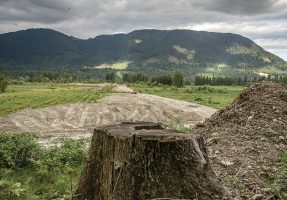
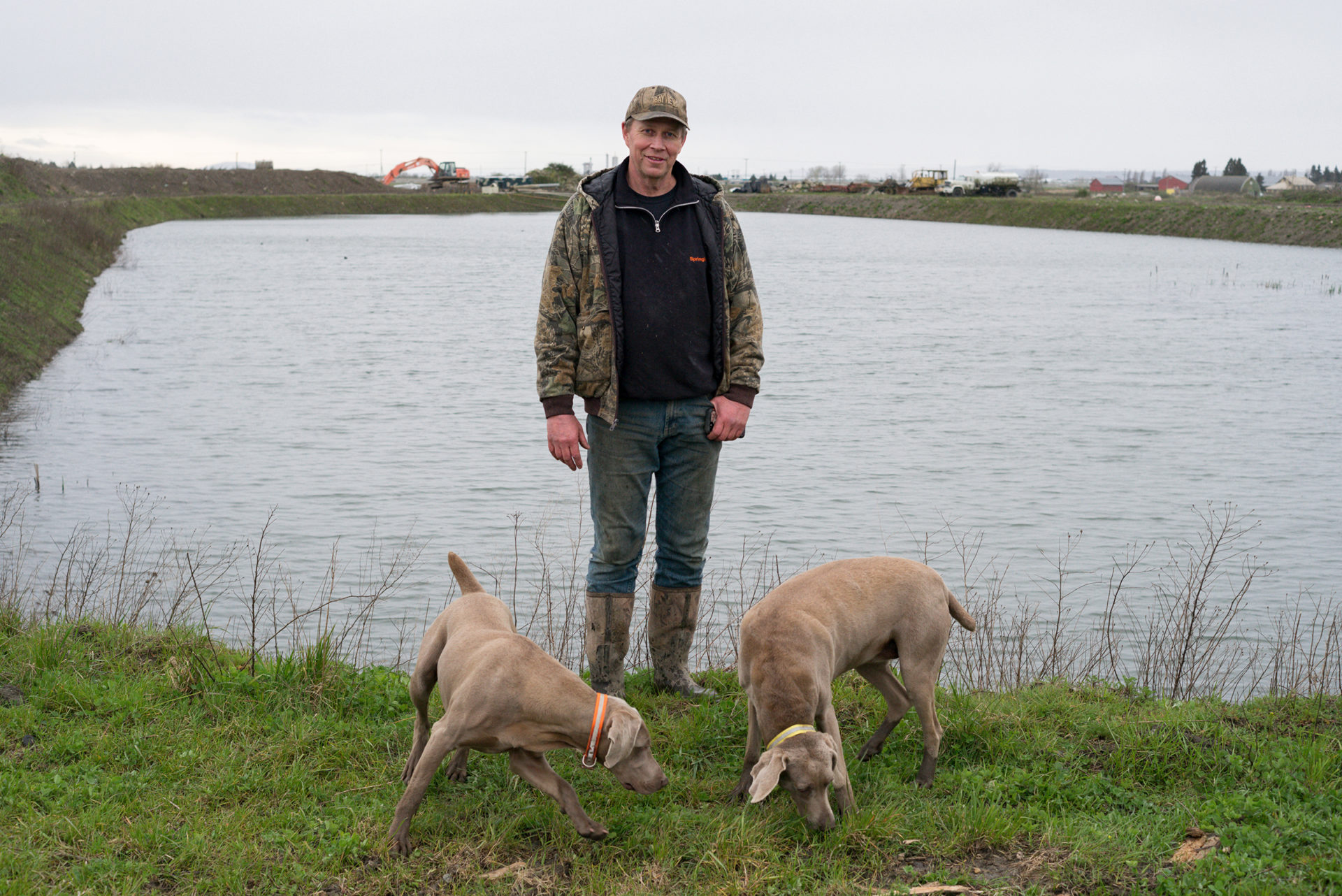
“I didn’t think I’d ever say it, but I’m done. This is ridiculous. This is 54 years of my life completely wasted,” he says, surveying the 80-acre property where he was raised.

The property now hangs in a state of limbo, eight years after his efforts to work with the local water table incurred the wrath of neighbours and the ALC.

Years of losing his potato crop to summer flooding prompted Malenstyn to take matters into his own hands and begin filling the property with a view to growing cranberries and leaving his son an arable property.

The water woes started more than 20 years ago when Delta began pumping water from the Fraser River into irrigation ditches along 104th Street. Malenstyn’s property is one of the lowest in Delta; some areas dip below sea level.

“I’ve had 89% of my [potato] crop lost. That was 2001, the year my son was born, and I worked three other jobs to support the farm. I didn’t see money till 2005 from Delta,” he says, referring to an out-of-court settlement.

Malenstyn adds that salinity from the Fraser River salt wedge and leaks in his neighbour’s septic tank flow into his ditch. To solve the problem, he created a four-metre-deep, above-ground reservoir, with plans to have his own closed-loop filtration system for his cranberry bogs (which need fresh water all-year round).

Malenstyn, who had accepted fill from Delta to help fix his water problem since 1996 without issue, began accepting fill in larger quantities from local developers in 2009 to complete the work.

But the new deliveries attracted greater scrutiny than in the past, thanks to concerns over illegal fill operations. With booming development in the Lower Mainland, it was often cheaper for companies to pay landowners to take fill than to transport it to designated fill sites. But the Agricultural Land Commission Act says landowners need to seek approval before accepting fill.

“There’s a lot of fill looking for a place to land,” says ALC director of policy and planning Martin Collins. “The reality is … the money you can get for [taking fill] can ruin a property forever for agriculture, yet pay for the property.”

In 2010, the ALC ordered Malenstyn to stop receiving fill because it didn’t see how it was for farm use. He gave the ALC a farm plan made with agrologist Danny Grant a month later and says he stopped receiving fill in 2011.

He built his reservoir and two cranberry cells (by stripping the land, putting fill down and then placing the original soil on top) before he was stopped again.

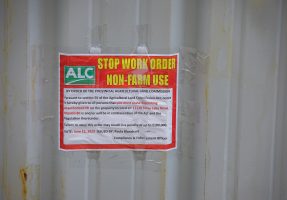
The ALC issued a stop-work and remediation order to Malenstyn in May 2017, instructing him to remove all the material, save his cranberry bogs, from the property and appropriately dispose of it at an “authorized disposal site.”

Malenstyn says he made enough from fill deliveries to cover most of the costs of converting his property to cranberry bogs. Yet after consulting a second agrologist, Gordon Butt, creating a farm plan, having WCB inspect the safety of his reservoir and hiring a lawyer for help, he appealed the order and was rejected in late January 2018.

The appeal panel of four representatives from the ALC suspected he was taking the fill for profit. Among other things, they charged him with the task of proving he was not guilty of this by revealing the income he made.

“The Appeal Panel considers that the motivation for the above ground reservoir may have been the income that could be received from fees,” the panel’s decision says.

Malenstyn did not, nor was he required, to share his income with the ALC according to his lawyer, Alastair Wade.

This wasn’t the only aspect of the appeal process that struck Wade as abnormal.

Wade specializes in litigation with nonjudicial bodies such as the ALC and says he had just two hours to present Malenstyn’s case, where the norm is “as much time as you need.” Nor was Malenstyn given a chance to respond to points the ALC raised in the final ruling.

“Under the Farm Practices Act, you have the right to make dikes and you have the right to make roads on your property and you have the right to farm it in accordance with appropriate farm practices. Mr. Malenstyn produced not one, but two different agrologists which supported his plan to make this a productive cranberry bog,” Wade says.

But what about seeking approval for taking fill?

“The appellant didn’t seem to think that he had to have any approval at all,” Collins says. “We have a decade or more of filling [on Malenstyn’s property]. [He’s] not really growing any substantive amount of cranberries and yet we have this infrastructure that’s beyond typical; in fact it’s the only one of its kind in the Fraser Valley.”

Malenstyn says his farm plan shows that he was using the fill for farm use and he can’t farm a “substantive amount” of cranberries because he’s unable to complete construction.

“In the end it’s a difficult call,” says Collins, referring to the ALC’s speculation about Malenstyn’s plans. “Ascribing motivations is very chancy. When we said ‘may,’ we don’t really know, but we just are going by normal farm practice and procedure that is followed by everybody else and he’s outside of those bounds.”

Wade says that ignores how farming works in the real world.

“The mere fact that some people don’t grow cranberries the same way as other people grow cranberries doesn’t make one right and one wrong,” he says. “It’s just a different way of doing it.”

Malenstyn now grows cow corn and sells pigs and fresh eggs, which together barely pay his bills.

And it’s certainly not enough to fund compliance with the ALC’s order, or take further steps to transform his property into productive farmland in one of the most fertile parts of BC.
Related Posts

You may be interested in these posts from the same category.

Reclassification sparks farm definition debate

ALC rejects Cowichan dike removal

Regulatory hurdles threaten farm income solutions

Landowners push back against rail trail plans

ALC members appointed

Islands Trust turns 50

Illegal dumping surges on Fraser Valley farmland

Premier boosts fill enforcement

ALR policy review shows room for improvement

Surrey ALR inclusion cheered

ALC rejects Teacup appeal

Whistleblowers at FIRB, ALC protected

Previous Post: « New farmers need to research livestock needs
Next Post: Strawberries kick berry season off to a good start »

Copyright © 2026 Country Life in BC · All Rights Reserved