• Menu
  • Skip to primary navigation
  • Skip to main content
  • Skip to primary sidebar

Country Life In BC Logo

The agricultural news source in British Columbia since 1915

  • Headlines
  • Calendar
  • Subscribe
  • Advertise
  • About
  • Archives
  • Contact
  • Search
  • Headlines
  • Calendar
  • Subscribe
  • Advertise
  • About
  • Archives
  • Contact
  • Search

Primary Sidebar

Originally published:

DECEMBER 2025
Vol. 111 Issue 11

Subscribe Now!

Sign up for free weekly FARM NEWS UPDATES

Select list(s) to subscribe to


By submitting this form, you are consenting to receive marketing emails from: Country Life in BC. You can revoke your consent to receive emails at any time by using the SafeUnsubscribe® link, found at the bottom of every email. Emails are serviced by Constant Contact
Your information will not be
shared or sold ever

Stories In This Edition

Title battle concerns ranchers

All hands on deck

Task force recommends ALR review

Delta grower inspires salad start-up

Editorial: We made it

Back 40: Time for a time change once and for all

Viewpoint: From desk to dirt: a writer’s farming journey

Breathing new life into historic ranches

Province lacks reconciliation roadmap

Oh, Christmas tree

Ag Brief: Federal budget kills Living Labs

Ag Brief: Food left off interprovincial trade deal

Ag Brief: Dry start to winter

Plan early, discuss often for farm succession

Dairy pushes forward with unification plans

Long growing season

Conservation program gets rebranded

Winter’s on its way

New growth envisioned for co-op’s old plant

Honey producers push back against headwinds

Beekeeper honoured with national award

Adaptive grazing fastest way to improve soil

Corn trials deliver impressive results

North Okanagan rail trail on track, but issues remain

Ready for winter

New guide offers food hubs tips to engage farmers

Farm news: Two-market weekends, too much excitement

Townhall looks to the future of agrivoltaics

Farmers ball celebrates legacy, community

BCHPA seeks risk assessments for packaged bees

Woodshed: Picnic plans raise flags for Junkyward Frank

Bursary takes edge off financial pressures

Jude’s Kitchen: Flatten your bird & BBQ it this Christmas

More Headlines

Follow us on Facebook

Comments Box SVG iconsUsed for the like, share, comment, and reaction icons

6 days ago

... See MoreSee Less

View Comments
  • Likes: 4
  • Shares: 0
  • Comments: 0

Comment on Facebook

6 days ago

On the last day of the BC Organic Conference, Thursday, Molly Thurston of Pearl Agricultural Consulting helped growers learn how to manage bugs such as codling moth, wireworm, and rootworm in organic growing systems. Her talk alongside Renee Prasad included hands-on activities in which participants checked out various traps and examined pests under microscopes. Be sure to look for more upcoming ag events on our online calendar at www.countrylifeinbc.com/calendar/

#BCAg
... See MoreSee Less

On the last day of the BC Organic Conference, Thursday, Molly Thurston of Pearl Agricultural Consulting helped growers learn how to manage bugs such as codling moth, wireworm, and rootworm in organic growing systems. Her talk alongside Renee Prasad included hands-on activities in which participants checked out various traps and examined pests under microscopes. Be sure to look for more upcoming ag events on our online calendar at www.countrylifeinbc.com/calendar/

#BCAg
View Comments
  • Likes: 15
  • Shares: 0
  • Comments: 0

Comment on Facebook

1 week ago

Well-known organic farmer and podcaster Jordan Marr gets interviewed by Country Life in BC’s own columnist and potato mavin Anna Helmer during the opening session of the BC Organic Conference at Harrison Hot Springs yesterday. Sessions run today (Wednesday) and Thursday and include organic and regenerative growing practices and expanding and advocating for the organic sector, all under the background of the newly launched Organic BC banner.

#BCAg
... See MoreSee Less

Well-known organic farmer and podcaster Jordan Marr gets interviewed by Country Life in BC’s own columnist and potato mavin Anna Helmer during the opening session of the BC Organic Conference at Harrison Hot Springs yesterday. Sessions run today (Wednesday) and Thursday and include organic and regenerative growing practices and expanding and advocating for the organic sector, all under the background of the newly launched Organic BC banner.

#BCAg
View Comments
  • Likes: 37
  • Shares: 2
  • Comments: 1

Comment on Facebook

Interested in finding out more about this

3 weeks ago

Today, we remember those who sacrificed their lives or their well-being for our freedom. Lest we forget. ... See MoreSee Less

Today, we remember those who sacrificed their lives or their well-being for our freedom. Lest we forget.
View Comments
  • Likes: 8
  • Shares: 0
  • Comments: 0

Comment on Facebook

1 month ago

FarmFolk CItyFolk is hosting its biennial BC Seed Gathering in Harrison Hot Springs November 27 and 28. Farmers, gardeners and seed advocates are invited to learn more about seed through topics like growing perennial vegetables for seed, advances in seed breeding for crop resilience, seed production as a whole and much more. David Catzel, BC Seed Security program manager with FF/CF will talk about how the Citizen Seed Trail program is helping advance seed development in BC. Expect newcomers, experts and seed-curious individuals to talk about how seed saving is a necessity for food security. ... See MoreSee Less

Link thumbnail

BC Seed Gathering - FarmFolk CityFolk

farmfolkcityfolk.ca

Save the date for our upcoming 2023 BC Seed Gathering happening this November 3rd and 4th at the Richmond Kwantlen Polytechnic University campus.
View Comments
  • Likes: 1
  • Shares: 0
  • Comments: 0

Comment on Facebook

Subscribe | Advertise

The agricultural news source in British Columbia since 1915
  • Email
  • Facebook

Breathing new life into historic ranches

Food security, reconciliation drive a host of recent deals

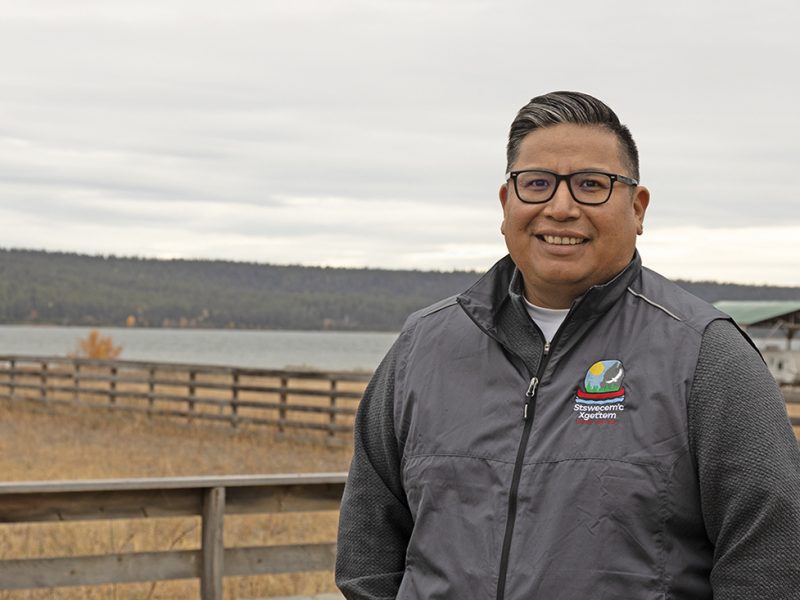
SXFN Kupki7 Hank Adams says his band is looking to diversify its Big Bar and Lac La Hache ranches. KELLY SINOSKI

December 2, 2025 byKelly Sinoski

CACHE CREEK – When the Hat Creek ranch came up for auction in August last year, Matt Pasco, chief of the Nlaka’pamux Nation Tribal Council (NNTC), was ready.

Dubbed the “Hat Creek Collection” by online auctioneer CLHBid.com, the opportunity included 74,716 acres of land offered as a single parcel. The sale included 2,387 deeded acres with the remaining acres split between grazing leases and licences, a Crown lease and a BC Hydro lease. The opening bid was $5.9 million and sold to NNTC’s economic branch, Kntam a shaytknmahh: We Help the People LP, for $8.52 million.

The ranch’s 450 head of cattle, hay and equipment cost an additional $3 million or so, according to Henry Braun, who had been a partner in the ranch lands with his late brother George, Ken Friesen and Alf Funk since 2008.

“I didn’t see that coming,” Braun says of the sale, noting that he had no idea who was bidding on the property. “We’re happy we sold it, but I didn’t know they had that kind of money.”

Pasco says his community has been preparing for the day when they could acquire the lands, part of his community’s ancestral territories. NNTC includes communities from Ashcroft through to Lytton.

Kntam a shaytknmahh also purchased the Ashcroft Ranch from Metro Vancouver in April this year for $28 million.

“We’ve been ranching for generations; this is not new to my family,” Pasco says. “We’ve quietly strategized for the opportunity to do it, and here it is. Our intention is to grow food for our community.”

The Hat Creek collection, comprised of five separate yard sites including 88 Ranch and Upper Hat Creek Ranch, was highly productive, Braun says, with three to four feet of black soil. He and his partners had run 450 cow-calf pairs and produced hay, which NNTC continues today. The Ashcroft Ranch is currently leased to Monette Farms, which has 800 cow-calf pairs, and Pasco says that won’t change.

He adds that he would like to grow potatoes on both ranches, along with vegetables and fruits, such as melons.

“Way back when, the Ashcroft area grew a lot of potatoes,” Pasco says. “We want to integrate that back into what we’re doing. I think we can sustain cattle plus grow some vegetables at the same time.”

The land sales are indicative of a growing trend in BC, which is seeing more Indigenous communities taking over BC cattle ranches. The Stswecem’c Xget’tem (Canoe Creek-Dog Creek) First Nation (SXFN) recently acquired the Easy Go Ranch in Lac La Hache, and the Okanagan Indian Band bought O’Keefe Ranch.

BC Cattlemen’s Association president Kevin Boon encourages the sale of ranches to anyone who will continue to work them, and doesn’t have a problem when new owners keep them in production.

“One of the First Nations chiefs said to me when I first came to BC that the first cowboys were Indians,” Boon says. “They have been raising cattle since cattle came to BC.”

Cariboo cattle rancher and former BC NDP MLA David Zirnhelt says many Indigenous ranchers owned cattle in the past but didn’t have enough land. As an MLA in the 1990s, he advocated for the idea of land banks – having the government buy private land for treaty negotiations. The federal government rejected the idea but accepted a ‘willing buyer, willing seller’ approach, which prevails today.

The industry waned in recent decades due to the hard work and the barriers of accessing the capital and land to operate, but interest is increasing.

“It’s positive, it creates opportunities,” Zirnhelt says. “The more food you can grow yourself, the more you can buy what you can’t raise yourself. In Secwepemc culture, their leaders talked a lot about their ranches, and their version of a ranch was a traditional territory that they used for all kinds of food and gathering.”

Under the modern treaty process, the BC Ministry of Indigenous Relations and Reconciliation (MIRR) has also bought several ranches for Northern Secwepemc te Qelmucw (NStQ) Indigenous communities in the Cariboo. These include the BC Cattle Co. for the SXFN, Bridge Creek Ranch for Tsq’escen’ (Canim Lake First Nation) and the Carpenter Mountain Ranch in 150 Mile for Xatśūll First Nation (Soda Creek Indian Band).

The lands are leased to First Nations with the intent to transfer them to the communities once an agreement is reached. The NStQ are in stage five of treaty process negotiations with the provincial and federal governments. As part of the treaty process, the province purchased the non-land assets required to operate the ranch businesses, such as livestock, equipment and/or hay inventory, depending on the ranch acquisition.

SXFN has plans to diversify its ranches, offering everything from tourism at its Big Bar Guest Ranch and Lac La Hache site to healing centres. BC Cattle Co. will continue to operate as a cattle ranch, with 600 cow-calf pairs.

SXFN Kupki7 Hank Adams says his First Nation is working with Thompson Rivers University’s regenerative agriculture program to install a floating vegetation system on one of the ponds and solar troughs, and using cultural burning to replenish overgrazed areas along the Fraser River. Plans are also in the works for a community garden and orchards, along with another greenhouse and cold storage. Plans call for training members as butchers so they can feed the community.

SFXN is also looking at training wild horses to help manage the land and reduce the impact on grasslands and rangelands.

“Historically, SXFN was known for growing the best wild potatoes in the area. Unfortunately, they plowed over them to make hayfields,” Adams says. “The community used to go all the way from the reserve to the Fraser River. That’s why it was important to get that ranch in the first place. We want to take care of ourselves. At the end of the day, it’s creating healthy beef in terms of food sovereignty and security.”

Related Posts

You may be interested in these posts from the same category.

Province lacks reconciliation roadmap: ranchers

Cowichan title decision creates uncertainty

Crown land conflicts reveal policy gaps

Beef herd drops

Feed available but stocks low

BC farmland values fall

BC Cherry holds AGM

Land Act changes deferred

Land Act firestorm

Dam violations face fines

Rangeland forage allocation studied

Communication critical to solve water issues

Previous Post: « Corn helps improve soil but fails grazing test
Next Post: $15,000 available for Shuswap projects »

Copyright © 2025 Country Life in BC · All Rights Reserved