• Menu
  • Skip to primary navigation
  • Skip to main content
  • Skip to primary sidebar

Country Life In BC Logo

The agricultural news source in British Columbia since 1915

  • Headlines
  • Calendar
  • Subscribe
  • Advertise
  • About
  • Archives
  • Contact
  • Search
  • Headlines
  • Calendar
  • Subscribe
  • Advertise
  • About
  • Archives
  • Contact
  • Search

Primary Sidebar

Originally published:

NOVEMBER 2021
Vol. 107 Issue 11

Subscribe Now!

Sign up for free weekly FARM NEWS UPDATES

Select list(s) to subscribe to


By submitting this form, you are consenting to receive marketing emails from: Country Life in BC. You can revoke your consent to receive emails at any time by using the SafeUnsubscribe® link, found at the bottom of every email. Emails are serviced by Constant Contact
Your information will not be
shared or sold ever

Stories In This Edition

Down to the crunch

Producer prices on the rise

Feeling burned

Groundwater users could lose rights next year

The right thing

Editorial: Freedom worth having

Back 40: The battle continues long after the war is over

Viewpoint: Stories bridge the gap between producers, consumers

Growers wrestle with irrigation upgrades

Wildfire 2021

Abbotsford updates farmland policies

Stormy skies

Ag Briefs: Douglas Lake “right to roam” challenge dismissed

Ag Briefs: Creston food hub opens

Ag Briefs: Food processors receive funding

Ag Briefs: Vanderspek appointed

Summerland grape specialists retire

Grapevine virus spread threatens BC industry

Caught in the act

Abbotsford sheep grower honoured

Tag readers help with livestock recordkeeping

RegenBC kicks off agritech network

Producers silent on Columbia River Treaty impacts

Cranberry fields forever

Manitoba farmers make dreams a reality

Enderby dairy is anything but conventional

Improvement to classification services explored

Up close and personal

Partnering with farmers to reduce food loss

Sidebar: Upcycled food

Slow and steady wins the day for irrigation

Research: Study takes soil health to the next level

Nelson farm builds soil and local community

Cash flow analysis is key to resilience

New app zeroes in on reducing lost produce

Sidebar: Food hub offers room to grow

Farm Story: To hoard or not to hoard: that is the question

Bursary benefits rising farm professionals

Woodshed: So much for a little peace and quiet

Saanichton Farm receives Century Farm award

Jude’s Kitchen: Fall Flavours

More Headlines

Follow us on Facebook

Comments Box SVG iconsUsed for the like, share, comment, and reaction icons

6 days ago

... See MoreSee Less

View Comments
  • Likes: 4
  • Shares: 0
  • Comments: 0

Comment on Facebook

7 days ago

On the last day of the BC Organic Conference, Thursday, Molly Thurston of Pearl Agricultural Consulting helped growers learn how to manage bugs such as codling moth, wireworm, and rootworm in organic growing systems. Her talk alongside Renee Prasad included hands-on activities in which participants checked out various traps and examined pests under microscopes. Be sure to look for more upcoming ag events on our online calendar at www.countrylifeinbc.com/calendar/

#BCAg
... See MoreSee Less

On the last day of the BC Organic Conference, Thursday, Molly Thurston of Pearl Agricultural Consulting helped growers learn how to manage bugs such as codling moth, wireworm, and rootworm in organic growing systems. Her talk alongside Renee Prasad included hands-on activities in which participants checked out various traps and examined pests under microscopes. Be sure to look for more upcoming ag events on our online calendar at www.countrylifeinbc.com/calendar/

#BCAg
View Comments
  • Likes: 15
  • Shares: 0
  • Comments: 0

Comment on Facebook

1 week ago

Well-known organic farmer and podcaster Jordan Marr gets interviewed by Country Life in BC’s own columnist and potato mavin Anna Helmer during the opening session of the BC Organic Conference at Harrison Hot Springs yesterday. Sessions run today (Wednesday) and Thursday and include organic and regenerative growing practices and expanding and advocating for the organic sector, all under the background of the newly launched Organic BC banner.

#BCAg
... See MoreSee Less

Well-known organic farmer and podcaster Jordan Marr gets interviewed by Country Life in BC’s own columnist and potato mavin Anna Helmer during the opening session of the BC Organic Conference at Harrison Hot Springs yesterday. Sessions run today (Wednesday) and Thursday and include organic and regenerative growing practices and expanding and advocating for the organic sector, all under the background of the newly launched Organic BC banner.

#BCAg
View Comments
  • Likes: 37
  • Shares: 2
  • Comments: 1

Comment on Facebook

Interested in finding out more about this

3 weeks ago

Today, we remember those who sacrificed their lives or their well-being for our freedom. Lest we forget. ... See MoreSee Less

Today, we remember those who sacrificed their lives or their well-being for our freedom. Lest we forget.
View Comments
  • Likes: 8
  • Shares: 0
  • Comments: 0

Comment on Facebook

1 month ago

FarmFolk CItyFolk is hosting its biennial BC Seed Gathering in Harrison Hot Springs November 27 and 28. Farmers, gardeners and seed advocates are invited to learn more about seed through topics like growing perennial vegetables for seed, advances in seed breeding for crop resilience, seed production as a whole and much more. David Catzel, BC Seed Security program manager with FF/CF will talk about how the Citizen Seed Trail program is helping advance seed development in BC. Expect newcomers, experts and seed-curious individuals to talk about how seed saving is a necessity for food security. ... See MoreSee Less

Link thumbnail

BC Seed Gathering - FarmFolk CityFolk

farmfolkcityfolk.ca

Save the date for our upcoming 2023 BC Seed Gathering happening this November 3rd and 4th at the Richmond Kwantlen Polytechnic University campus.
View Comments
  • Likes: 1
  • Shares: 0
  • Comments: 0

Comment on Facebook

Subscribe | Advertise

The agricultural news source in British Columbia since 1915
  • Email
  • Facebook

Groundwater users could lose rights next year

Unlicensed water could be reallocated to new users

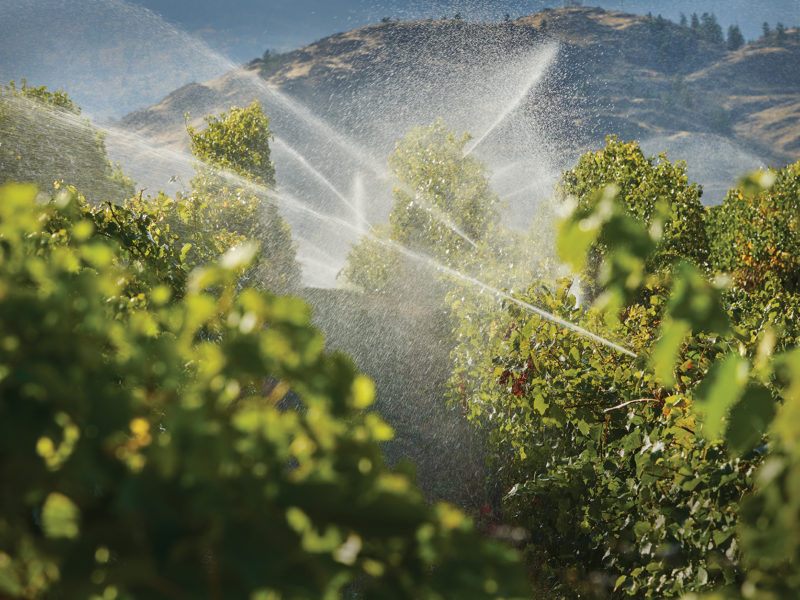
Okanagan Irrigation. A vineyard gets irrigated at dusk in the Okanagan Valley, British Columbia, Canada.

November 1, 2021 byPeter Mitham

VERNON – This summer’s dry weather resulted in a record number of restrictions on water use across southern BC, underscoring just how tapped out some basins are.

Salmon River remained at drought level 5 last month – the most severe under the province’s new six-tier drought rating system – even after the autumn rains arrived. The Upper Nicola was rated 4, only slightly better, with irreversible harm to aquatic life still possible.

With the province standing firm on a deadline of March 1, 2022 for existing non-domestic well owners to license their wells, a renewed push is taking place to make sure those wells are licensed. If they don’t, users in watersheds such as Bessette Creek in the North Okanagan, could find themselves out of luck.

“If you’re in an area like that, it’s going to be difficult to get a licence, because most of those streams are already fully recorded,” says Andrew Petersen, a water management specialist with the BC Ministry of Agriculture, Food and Fisheries who addressed the Abbotsford-based Centre for Organizational Governance in Agriculture on October 7. “You’d basically have to prove your groundwater well is not connected to the river to get your application through the door.”

The scenarios facing well owners in other areas of the province after March 1, 2022 are no less daunting. Users who have not applied for a licence will have effectively relinquished their historical rights, and the province will treat them as new users. This means their existing water rights will be reallocated to new applicants on a first come, first serve basis – the guiding principle of the first in time, first in right system BC has enjoyed since water rights were first regulated under the Gold Fields Act of 1858.

“You will lose your historic rights, you will lose your fee waiver, and depending on where you are, you may have a very difficult time getting that licence,” says Petersen, calling out the four watersheds where fish protection orders were issued this summer — the Bessette, West Kettle, Koksilah and Salmon. “They’re very drought-stricken. The chance of getting a new water use licence is going to be very, very low. So I’m really, really pushing hard to get producers to apply before deadline on that existing use.”

Yet the deadline doesn’t mean the taps will be turned off if users haven’t applied for a licence.

“It’s not going to be a mass send all the [compliance officers] out tomorrow to go find people. We’re told that’s not going to be happening,” says Petersen, noting that the BC Ministry of Forests, Lands, Natural Resource Operations and Rural Development has not hired more staff for enforcement.

This undermines the credibility of the new licensing regime, says Ted van der Gulik, president of the Partnership for Water Sustainability in BC.

During the recent provincial budget consultation, he urged government to allocate an extra $30 million per year for water management at FLNORD. This would include $11 million to hire staff to process licence applications, and $4.5 million for enforcement.

“The No. 1 thing is the province doesn’t have enough enforcement staff, and the province has not followed [up] on enforcement if you don’t have a licence,” he says. “If you’re not enforcing … guys that are flagrantly going against the act, and you’re not doing anything about it, why should I bother applying for a licence?”

While enforcement puts people out of business and is politically unpalatable, van der Gulik says sooner or later the province will have no choice.

One watershed he’s familiar with has seen new licence applications turned down based on the volume of current use, including one by a farmer who drilled a well expecting to be approved. The watershed currently has 270 registered wells, including more than 35 for irrigation. But just two have applied for licences.

“If I was that farmer, and I’ve got all this money invested in a well that I can’t use, I’m applying again on March 1, even though they turned me down on that previous application,” he says. “When I apply on March 1, the province cannot shut me down or turn my application away unless they shut down all the non-domestic users in that aquifer that have not applied, and so far it looks like there’s hundreds of them.”

While this situation may be extreme, it’s not uncommon.

According to Petersen, the province estimates that there are about 8,000 agricultural wells in the province. Of these, 2,700 have applied for groundwater licences. This works out to 34%, or more than triple the rate for all other sectors combined, which have filed just 1,300 licence applications. All told the province expects to licence 20,000 wells.

“Agriculture’s the shining star when it comes to the applications for existing groundwater. We really pushed hard, especially BC Cattlemen’s at the beginning,” says Petersen. “Agriculture’s done a very good job of trying to get out and get those applications in.”
 

Related Posts

You may be interested in these posts from the same category.

Southern Interior irrigators shut down

Island farmers fish for water solutions

Groundwater enforcement picks up

Water licence fight highlights need for change

Westwold producers challenge curtailment

No licence, no problem

Watershed security report

Groundwater deadline firm

Feeling the heat on water

Water licence angst

Grant funding for nutrient management projects

No extension for groundwater

Previous Post: « Producers silent on Columbia River Treaty impacts
Next Post: Grading standards shorten cucumbers »

Copyright © 2025 Country Life in BC · All Rights Reserved