• Menu
  • Skip to primary navigation
  • Skip to main content
  • Skip to primary sidebar

Country Life In BC Logo

The agricultural news source in British Columbia since 1915

  • Headlines
  • Calendar
  • Subscribe
  • Advertise
  • About
  • Archives
  • Contact
  • Search
  • Headlines
  • Calendar
  • Subscribe
  • Advertise
  • About
  • Archives
  • Contact
  • Search

Primary Sidebar

Current Issue:

MARCH 2026
Vol. 112 Issue 3

Subscribe Now!

Sign up for free weekly FARM NEWS UPDATES

Loading form…

Your information will not be
shared or sold ever

Follow us on Facebook

Comments Box SVG iconsUsed for the like, share, comment, and reaction icons

5 days ago

A BC Forest Practices Board investigation has found overgrazing has damaged grasslands in the Coutlee Range Unit near Merritt — and the range-use plan meant to prevent it was unenforceable. With complaints about overgrazing on the rise and grasslands covering just 1% of BC's land mass, the findings raise fresh questions about how the province manages one of its most vulnerable — and valuable — food-producing ecosyste#BCAg#BCAg ... See MoreSee Less

Link thumbnail

Board finds overgrazing rules unenforceable unmeasurable

www.countrylifeinbc.com

MERRITT – A BC Forest Practices Board investigation has found instances of non-compliance related to overgrazing have damaged open grasslands in the Mine pasture, part of the Coutlee Range Unit near...
View Comments
  • Likes: 6
  • Shares: 6
  • Comments: 6

Comment on Facebook

Several ranchers in recent years have gone into temporary non use on that range , so that means the grass should grow. But drought conditions/lack of rain and snow don’t allow that to happen . Dried up springs , creeks waterholes in various pastures add to over grazing where there is water , as livestock and everything else stay close to the water source . So even though less cattle are on it , over grazing appears. There is a large volume of horses on it 365 days/year which is wrong ! They pull grass right out of the ground when it’s just trying to grow ,, opens the door for weeds to grow in. That don’t help it. Aging infrastructure ( fences) laying on the ground, pipe line building , ( lack of commitment to fence maintenance) amongst all users contributes also to over grazing. Recreational atv users leaving gates open between pastures allows livestock to go back or ahead in pastures also expidites over grazing. Logging ( bcts) has no problem laying out cut locks on both sides of a fence , then it gets smashed down during logging and they don’t take responsibility to stand it back up or clean the cattle gaurds out when they are done , that happened 4 years ago on pasture 5 up there . I bet it is still not fixed . There are lots of contributing factors to the problem.

Tragedy of the commons.

I looked through the report. I saw nothing about the effects of noxious weeds on productive grasslands. This particular area is vulnerable because of the Ministry’a efforts to diversify the use of the Grasslands.

This pasture is under tremendous pressure not only from cattle but from irresponsible local residents who treat it as a landfill dumping all manner of household debris here. And don't even get me started on the mud bogging and camping in sensitive riparian areas. The feral horses are in this pasture 365 days a year just hammering it. Would sure be nice to see some enforcement action on people who are intentionally ripping up the grasslands and riparian areas. Cattle could be a valuable resource for rebuilding soils and native grasses in this area with the help of electric fencing and/or e-collars. The humans will be harder to manage.

The Forest and Range Practices Act was written by lawyers for global forest licencee shareholders. Results-based = unenforceable.

Also, can we talk about the impact of a pipeline being built through the middle of this field for multiple years?

View more comments

1 week ago

East Kootenay rancher Randy Reay is digging a new well after two natural water sources dried up on his Crown tenures. A new Living Lakes Canada assessment found 15% of mapped aquifers in the region are high-priority for monitoring, yet 80% of those go unmonitored. With over 48% of BC's provincial observation wells reporting below-normal groundwater levels, ranchers and researchers are sounding the alarm on water security. The story is in our March edition, and we've posted it to our website thi#BCAgk.

#BCAg
... See MoreSee Less

Link thumbnail

Water woes: groundwater under pressure across BC

www.countrylifeinbc.com

JAFFRAY – As a young boy growing up in the Kootenay-Boundary region, Randy Reay never expected to run out of water. But this year, in mid-February, his fields are bare. There is no snow halfway up t...
View Comments
  • Likes: 8
  • Shares: 7
  • Comments: 1

Comment on Facebook

Jaffrey is in the east Kootenays not kooteney boundary

2 weeks ago

BC farmers are bracing for prolonged higher input costs as war in the Middle East drives up fuel and fertilizer prices. Nitrogen fertilizer costs were already climbing before the Iran conflict began, with prices still roughly 60% above pre-pandemic levels. Farm Credit Canada warns that unlike 2022, strong commodity prices may not offset rising costs this time. Local suppliers expect supply challenges and further price increases ahead.

#BCAg
... See MoreSee Less

Link thumbnail

Fertilizer prices on the rise

www.countrylifeinbc.com

War in the Middle East has delivered a generational shock to energy prices, meaning BC farmers can expect a prolonged period of higher costs not just for fuel but also for fertilizer.
View Comments
  • Likes: 2
  • Shares: 1
  • Comments: 0

Comment on Facebook

2 weeks ago

... See MoreSee Less

View Comments
  • Likes: 1
  • Shares: 0
  • Comments: 0

Comment on Facebook

2 weeks ago

Cameron Stockdale is the new executive director of provincial farm safety organization AgSafeBC. Find out more in this week's Farm News Update from Country Life in B#BCAg#BCAg ... See MoreSee Less

Link thumbnail

New leadership at AgSafe BC

www.countrylifeinbc.com

Cameron Stockdale is the new executive director of provincial farm safety organization AgSafeBC, succeeding Wendy Bennett. Bennett left AgSafeBC in September 2025, following 12 years with the…
View Comments
  • Likes: 5
  • Shares: 1
  • Comments: 0

Comment on Facebook

Subscribe | Advertise

The agricultural news source in British Columbia since 1915
  • Email
  • Facebook

Inaugural viticulturist of the year chosen

Grapegrower Karnail Singh Sidhu singled out

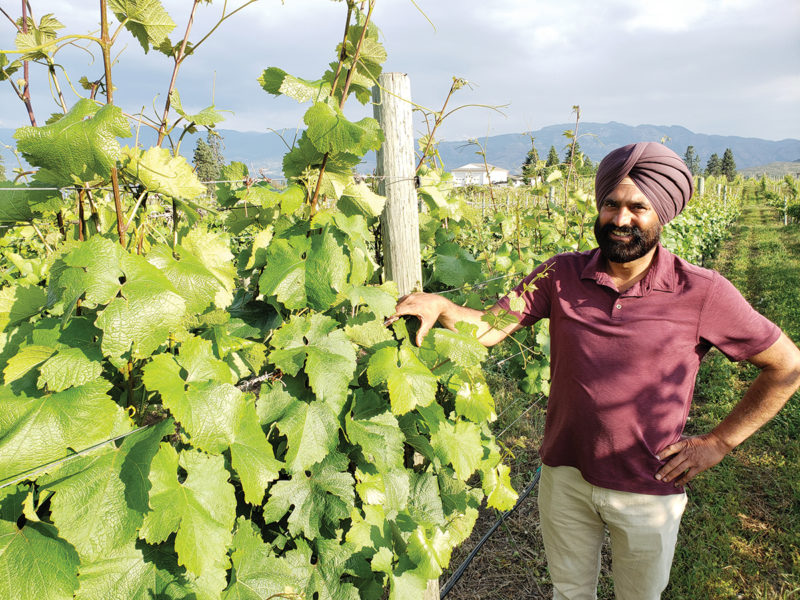
Karnail Singh Sidhu of Kalala Organic Estate Winery in West Kelowna emigrated from India in 1993 and has built an award-winning reputation with low-input viticulture and top-notch wines. This summer he was named first recipient of the BC Grapegrowers' Association's new Viticulturist of the Year award. His peers recognized his good practices, hard work and leadership that have contributed to the BC wine industry's success. PHOTO / MYRNA STARK LEADER

August 1, 2020 byMyrna Stark Leader

WEST KELOWNA – Of the approximately 120 honours viticulturist and winemaker Karnail Singh Sidhu has received since opening Kalala Organic Estate Winery in 2008, receiving the BC Grapegrowers Association’s inaugural Viticulturist of the Year award is the most satisfying.

“Ninety percent of winemaking is done in the vineyard,” says Sidhu. “If a wine loses [a contest], they blame the grapes and grower, but there are few awards that recognize the work it takes to create great grapes.”

BCGA created the award to both recognize growers who set the pace for the rest of the industry and raise their profile in the eyes of the public so they know the work that goes into their favourite wines.

“BCGA has talked about doing an award for several years,” says BCGA administrator Tyrion Miskell, who credits the arrival of Blasted Church Vineyards vineyard manager John Bayley, now BCGA president, with getting the initiative off the ground.

Bayley says the award was established “to commend those in our industry who rarely get the public recognition, yet provide the grapes needed for the fantastic wines we produce.”

Recipients of the peer-judged award are selected by a BCGA board member, an industry member and a government researcher during vineyard visits.

Sidhu was one of five nominees for the first award. His win recognizes 20 years of hard work.

“Karnail cares about his land, his grapes and his community and sets a great example for other growers,” says Bayley, one of this year’s judges. “His approach to his farming practices and to his colleagues were a significant reason for his winning as the judges saw these actions as integral to forwarding the industry.”

Started as berry picker

Sidhu arrived in Canada from Punjab in 1993 at the age of 25 with his parents, brother and sister and $40. While he trained as an electrical engineer in India, his qualifications weren’t recognized in Canada. He found work first as a berry picker then as a vineyard worker, eventually landing his first full-time job at Summerhill Pyramid Winery in Kelowna. His work ethic attracted the attention of Summerhill owner Stephen Cipes, who paid for his viticulture training and promoted him to vineyard manager.

The decade he spent at Summerhill also taught Sidhu the art of winemaking and business skills. He also gained mentors. He affectionately refers to former Summerhill winemaker Alan Marks as his older brother. The two continue to work together today.

Kalala’s research and development is aided by Ashish Dave, CEO of FloraMaxx Technologies Ltd. in Kelowna. Dave, a leading-edge research and production scientist in plant biotechnology, has been key in optimizing pruning practices and irrigation management at Kalala, as well as evaluating plant extracts and nutrients for improved grapevine vigour, yield and juice quality.

Marks and Dave aren’t the only ones who’ve been part of Sidhu’s business journey.

In 1995, he was managing grapes for the owner of the land where Kalala’s tasting room now sits. Knowing he wanted his own business, Sidhu planned to purchase the property when it came up for sale in 2005 but his financing was delayed. It sold instead to the Novak family of Prince George, owners of Dunkley Lumber Ltd. The former owner facilitated introductions and the Novaks ended up leasing the vineyard and residence to Sidhu.

Sidhu now manages 63 acres of vineyard across the Okanagan as well as seven acres of orchard and market gardens. Approximately 37 acres are owned and 33 acres are leased, including his home property.

The winery, opened in 2008, produces about 6,000 cases a year. (Sidhu is also the winemaker, although he doesn’t drink.) Approximately 95% of the winery’s production is sold in BC. Sidhu also sells a small amount of bulk wine as well as some grapes to other wineries.

The way nature intended

Sidhu attributes part of reason for receiving the award to the health of his vineyards. He grows organically because “that’s the way nature intended agriculture,” a legacy of his father who farmed wheat, rice, cotton and sugar cane without chemicals.

“I remember when they were using DDT in India to help kill mosquitoes to battle malaria. Even though it was the law, my dad refused to have our home sprayed. He thought it was dangerous,” explains Sidhu, who says the secret to a clean crop is avoiding issues by catching potential problems early. This is especially important in organic agriculture because of the limited pest and disease treatment options available to certified organic growers.

“I tell all my tractor drivers they have the perfect opportunity to see all the plants in the vineyard so they need to keep their eyes open and if they see any changes or anything different, to let me know,” he says.

He’s also a believer of ongoing learning. He conducts his own trials and is a partner on research projects with UBC Okanagan, Simon Fraser University and the Summerland Research and Development Centre. He regularly attends conferences and workshops, and gladly shares what he knows with others.

“If people ask me, I’ll tell them. You don’t do yourself any favour hiding information. You learn from people’s questions,” he says.

Despite his success, he’s also known disappointment. He lost a property in the Similkameen because crop projections weren’t realized and the bank stepped in. More recently, all but 10 vines in a new Vidal block died. He’s unsure if the soil quality or weather conditions in the block were responsible. However, he’s propagating the surviving vines to replant the block, confident their genetics will make a winning crop

“If you say you can’t do it, you can’t do it,” he says. “I jump into it. If we fail, we learn.”

He’s also willing to help others learn. A former employee recently embarked on distilling training at Niagara College after an internship and more than two years working at Kalala. When she came in 2015 as an intern, she was tasked with producing Kalala’s top-end white, red and ice wines. She was surprised and nervous, but with guidance, she did it, completed her course and came back to work at Kalala until this past December.

“She did a wonderful job and she knew it. She told me she learned way more here than students who worked at some of the bigger wineries,” he says. “I like to instill confidence in people. … People like her are the future of this industry.”

Family business

Sidhu’s entire family is involved in the business. His wife Narinder serves as controller and oversees sales and marketing, and their two daughters – now 21 and 14 – assist in various capacities. The two girls spent Father’s Day helping lay irrigation pipe.

Sidhu is not sure if they will continue the business but that’s not stopping him from thinking about the future, including the possibility of expansion.

He’s also not about to stop learning how to improve what he’s already doing. The award from the BCGA comes with a $2,000 prize to attend an educational event anywhere in the world.

With files from Tom Walker
Related Posts

You may be interested in these posts from the same category.

Apple marketing commission rejected

On the rebound

Industry champion named BC’s best grape grower

Moon shines among BC grape growers

Grape growers assess damage

Pruning priorities different for FV grapegrowers

Previous Post: « Small-lot farmers call for greater Infrastructure
Next Post: Closures underscore need for licensing reform »

Copyright © 2026 Country Life in BC · All Rights Reserved