
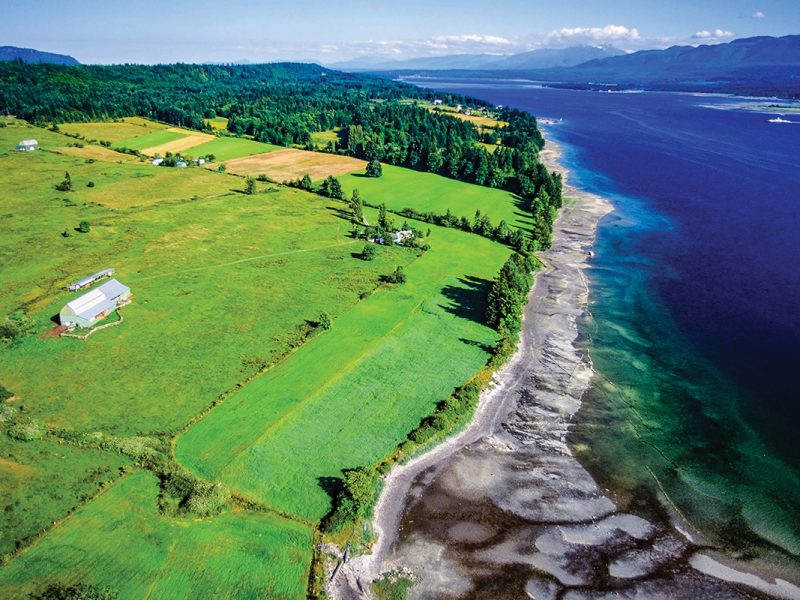
PENDER ISLAND – A new draft Islands Trust policy statement that removes a key Agricultural Land Reserve provision and no longer recognizes agriculture as a “traditional and valuable activity” is sparking concern among some in the Gulf Islands farming community.
The effort to update the current policy statement – which has been largely unchanged since 1994 – was launched in September 2019, deferred by trustees in July 2021, and is set to be finally completed in fall 2026 after a final round of consultations.
The latest draft of the policy statement, released in July, raises red flags for Pender Island Farmers Institute president Barbara Johnstone Grimmer.
Grimmer is “disappointed but not surprised” by the removal of the “traditional and valuable” designation for agriculture in the new policy statement.
She says it’s the latest instance of a much larger pattern of the trust’s disregard for the rural character of the islands.
“Islands Trust was based on ‘preserve and protect.’ For a lot of people, that meant preserving the rural lifestyle, what we do as rural people, which is largely farming. And it’s slid into more like preserving the environment,” says Grimmer. “They’re failing in their mandate, and I don’t think this trust policy statement helps.”
Grimmer emphasizes that, to her knowledge, there has been “no direct request” from the trust to gather perspectives on the draft policy statement from the local agricultural community.
In response to an inquiry by Country Life in BC, Islands Trust explained that the “traditional and valuable” designation for agriculture was removed as part of a decision to replace specific commitments in policy statement subsections with one page of broad “guiding principles.”
The decision, taken in 2022, led to a set of guiding principles found in Part 2.1 of the draft Islands Trust policy statement. The seven principles range from “acknowledge and respect Indigenous rights” to “foster sustainable, inclusive,and resilient communities,” but none mention agriculture.
Another aspect of the draft policy statement Grimmer finds troubling is that the trust will no longer endorse applications from property owners for new parcels of land to be added to the Agricultural Land Reserve (ALR).
“We’re actually saved by the Agricultural Land Reserve, which allows us the right to farm,” she argues.
Grimmer says that the stock of ALR land in the Gulf Islands is already being degraded by land being swapped out and developed. She wants to see the ALR both protected and expanded.
“We don’t have enough ALR land as it is. We find when it is taken out, it becomes more developed, which should be against what the Islands Trust wants,” she says.
The ALR angle is also a concern for farmer and Salt Spring Island Farmland Trust board member Valerie Perkins.
“While we applaud the commitment to protecting existing ALR land for future food production, there is no mention of making additions to the ALR in the policy statement,” explains Perkins.
Perkins argues that the housing construction emphasized in the policy statement should be matched with increased agricultural capacity.
“The Islands Trust recommends developing clusters of higher-density housing, but these need to be supported by increased food production. There are pockets of rich land outside the ALR that should be set aside to allow for the type of regenerative agriculture that we need to survive and thrive in coming years,” she says.
Preserve and protect
The Islands Trust was founded in 1974 to “preserve and protect” the water and islands between southern Vancouver Island and the mainland by limiting development from spilling over from the nearby urban centres of Vancouver and Victoria.
For John Money, who served on the trust council for 21 years until 2010, the latest draft policy statement is more proof that the trust has lost its way and veered towards imposing a narrow vision of “protectionism” that squeezes out agriculture and industry to the detriment of community wellbeing.
Money argues that the trust’s vision disregards the realities of farming, which involves altering land.
“Let’s say you’ve got a piece of land that could be turned to agriculture, but right now it’s got bush and trees. You’ve got to cut that down, clear it and cultivate it,” he says. “They don’t want that. They want farms to just be pretty greenbelts and return to nature.”
Money argues that there is a “drawbridge effect,” whereby the trust sidelines agriculture and stymies economic activity to preserve an idyllic image of what the islands should be, which leads to islands with a distorted age structure and very little industry.
“You’ve got to preserve the community, too. A healthy community needs a balance of young people and working people and some children, and some people that will help older people,” argues Money.
He’s also concerned that the policy statement is being imposed without sufficient consultation, which he sees as a reflection of a broader top-down approach from the trust.
“Planners are trying to make a cookie-cutter, a one-fits-all. The way the Gulf Islands are made up, all these different communities, you can’t have a cookie-cutter because each community has its own flavour,” he says.
Upon reviewing the draft policy statement, Money found that it was not accommodating of the different character of each island in the trust area.
“A policy statement should be full of words like ‘should’ and ‘it would be preferred.’ And because you’re dealing with at least 13 communities … each one being different, you can’t say ‘shall’ – you should say ‘should,’” he says.
Money argues that the lengthy sections in the draft policy statement devoted to reconciliation with local First Nations reveal a lopsided focus on the part of the trust.
“There’s a preoccupation with reconciliation and the environment, while completely forgetting the most important thing – all the landowners and the taxpayers who are financing it,” says Money.
The BC Ministry of Agriculture and Food is taking a hands-off approach, saying members of the public can communicate any concerns about the draft policy statement to the Islands Trust.
“It is our understanding that the public consultation for the draft policy statement is open until February 2026, so anyone with concerns can fill out the online survey or reach out directly to the Islands Trust council,” the ministry says in a statement to Country Life in BC.
All content on this website is copyrighted, and cannot be republished or reproduced without permission.
 Country Life in BC reporting honoured