• Menu
  • Skip to primary navigation
  • Skip to main content
  • Skip to primary sidebar

Country Life In BC Logo

The agricultural news source in British Columbia since 1915

  • Headlines
  • Calendar
  • Subscribe
  • Advertise
  • About
  • Archives
  • Contact
  • Search
  • Headlines
  • Calendar
  • Subscribe
  • Advertise
  • About
  • Archives
  • Contact
  • Search

Primary Sidebar

Originally published:

APRIL 2023
Vol. 109 Issue 4

Subscribe Now!

Sign up for free weekly FARM NEWS UPDATES

Loading form…

Your information will not be
shared or sold ever

Stories In This Edition

Back to business
$200 million draws fire
Farmland values ease
Delta farmland gets new lease on life
Editorial: Genuine connection
Back 40: Different worldviews, common ground
Viewpoint: Unlocking an unsustainable trajectory
Crossroads ahead for BC farmland
Ag industry hub sparks regional interest in OK
Show offs
Ag Briefs: New “underused” home tax has a wide impact
Ag Briefs: Richard Ranch hosts bull sale
Ag Briefs: Canadian Foodgrains Bank supproted
Ag Briefs: Poultry leaders recognized
Province steps up surveillance after sting operation
Watershed strategy coulg hang ag out to dry
Flood victims struggle with recovery deadline
Sidebar: Disaster Financial Assistance funds inconsequential for producers
Rising ferry fares sink producer profits
Sidebar: Ferry traffic another hurdle for island producers
Fruit growers keep calm, carry on at convention
Signs of spring
Producers at a loss with elk damages
New AI insights shared at poultry conference
Birds of a feather
Sidebar: Vaccination under discussion
Potato growers buoyed by strong markets
Rising cost of dairy production drives agenda
Export markets focus of upbeat cherry meeting
Sidebar: Provincial survey tracks spread of Little Cherry Disease
Cranberry crop dips in 2022 but growers optimistic
New rules for pesticide applications
Sidebar: Spraying tips
Rodenticide restrictions now permanent
Homemade food rules are too restrictive
Sunflowers are multi-purpose helpers
Boosting value with great apples
Farm Story: Heavy lifting not a retirement plan
New soil assessment tool in development
Woodshed Chronicless: Just when things start going right, stuff happens
BC breeder wins national Jersey award
Jude’s Kitchen: Celebratory foods for friends and family

More Headlines

Follow us on Facebook

Comments Box SVG iconsUsed for the like, share, comment, and reaction icons

5 days ago

A BC Forest Practices Board investigation has found overgrazing has damaged grasslands in the Coutlee Range Unit near Merritt — and the range-use plan meant to prevent it was unenforceable. With complaints about overgrazing on the rise and grasslands covering just 1% of BC's land mass, the findings raise fresh questions about how the province manages one of its most vulnerable — and valuable — food-producing ecosyste#BCAg#BCAg ... See MoreSee Less

Link thumbnail

Board finds overgrazing rules unenforceable unmeasurable

www.countrylifeinbc.com

MERRITT – A BC Forest Practices Board investigation has found instances of non-compliance related to overgrazing have damaged open grasslands in the Mine pasture, part of the Coutlee Range Unit near...
View Comments
  • Likes: 6
  • Shares: 6
  • Comments: 6

Comment on Facebook

Several ranchers in recent years have gone into temporary non use on that range , so that means the grass should grow. But drought conditions/lack of rain and snow don’t allow that to happen . Dried up springs , creeks waterholes in various pastures add to over grazing where there is water , as livestock and everything else stay close to the water source . So even though less cattle are on it , over grazing appears. There is a large volume of horses on it 365 days/year which is wrong ! They pull grass right out of the ground when it’s just trying to grow ,, opens the door for weeds to grow in. That don’t help it. Aging infrastructure ( fences) laying on the ground, pipe line building , ( lack of commitment to fence maintenance) amongst all users contributes also to over grazing. Recreational atv users leaving gates open between pastures allows livestock to go back or ahead in pastures also expidites over grazing. Logging ( bcts) has no problem laying out cut locks on both sides of a fence , then it gets smashed down during logging and they don’t take responsibility to stand it back up or clean the cattle gaurds out when they are done , that happened 4 years ago on pasture 5 up there . I bet it is still not fixed . There are lots of contributing factors to the problem.

Tragedy of the commons.

I looked through the report. I saw nothing about the effects of noxious weeds on productive grasslands. This particular area is vulnerable because of the Ministry’a efforts to diversify the use of the Grasslands.

This pasture is under tremendous pressure not only from cattle but from irresponsible local residents who treat it as a landfill dumping all manner of household debris here. And don't even get me started on the mud bogging and camping in sensitive riparian areas. The feral horses are in this pasture 365 days a year just hammering it. Would sure be nice to see some enforcement action on people who are intentionally ripping up the grasslands and riparian areas. Cattle could be a valuable resource for rebuilding soils and native grasses in this area with the help of electric fencing and/or e-collars. The humans will be harder to manage.

The Forest and Range Practices Act was written by lawyers for global forest licencee shareholders. Results-based = unenforceable.

Also, can we talk about the impact of a pipeline being built through the middle of this field for multiple years?

View more comments

1 week ago

East Kootenay rancher Randy Reay is digging a new well after two natural water sources dried up on his Crown tenures. A new Living Lakes Canada assessment found 15% of mapped aquifers in the region are high-priority for monitoring, yet 80% of those go unmonitored. With over 48% of BC's provincial observation wells reporting below-normal groundwater levels, ranchers and researchers are sounding the alarm on water security. The story is in our March edition, and we've posted it to our website thi#BCAgk.

#BCAg
... See MoreSee Less

Link thumbnail

Water woes: groundwater under pressure across BC

www.countrylifeinbc.com

JAFFRAY – As a young boy growing up in the Kootenay-Boundary region, Randy Reay never expected to run out of water. But this year, in mid-February, his fields are bare. There is no snow halfway up t...
View Comments
  • Likes: 8
  • Shares: 7
  • Comments: 1

Comment on Facebook

Jaffrey is in the east Kootenays not kooteney boundary

2 weeks ago

BC farmers are bracing for prolonged higher input costs as war in the Middle East drives up fuel and fertilizer prices. Nitrogen fertilizer costs were already climbing before the Iran conflict began, with prices still roughly 60% above pre-pandemic levels. Farm Credit Canada warns that unlike 2022, strong commodity prices may not offset rising costs this time. Local suppliers expect supply challenges and further price increases ahead.

#BCAg
... See MoreSee Less

Link thumbnail

Fertilizer prices on the rise

www.countrylifeinbc.com

War in the Middle East has delivered a generational shock to energy prices, meaning BC farmers can expect a prolonged period of higher costs not just for fuel but also for fertilizer.
View Comments
  • Likes: 2
  • Shares: 1
  • Comments: 0

Comment on Facebook

2 weeks ago

... See MoreSee Less

View Comments
  • Likes: 1
  • Shares: 0
  • Comments: 0

Comment on Facebook

2 weeks ago

Cameron Stockdale is the new executive director of provincial farm safety organization AgSafeBC. Find out more in this week's Farm News Update from Country Life in B#BCAg#BCAg ... See MoreSee Less

Link thumbnail

New leadership at AgSafe BC

www.countrylifeinbc.com

Cameron Stockdale is the new executive director of provincial farm safety organization AgSafeBC, succeeding Wendy Bennett. Bennett left AgSafeBC in September 2025, following 12 years with the…
View Comments
  • Likes: 5
  • Shares: 1
  • Comments: 0

Comment on Facebook

Subscribe | Advertise

The agricultural news source in British Columbia since 1915
  • Email
  • Facebook

New rules for pesticide applications

Tank-mixing prohibited unless specifically allowed; new regulations address drift

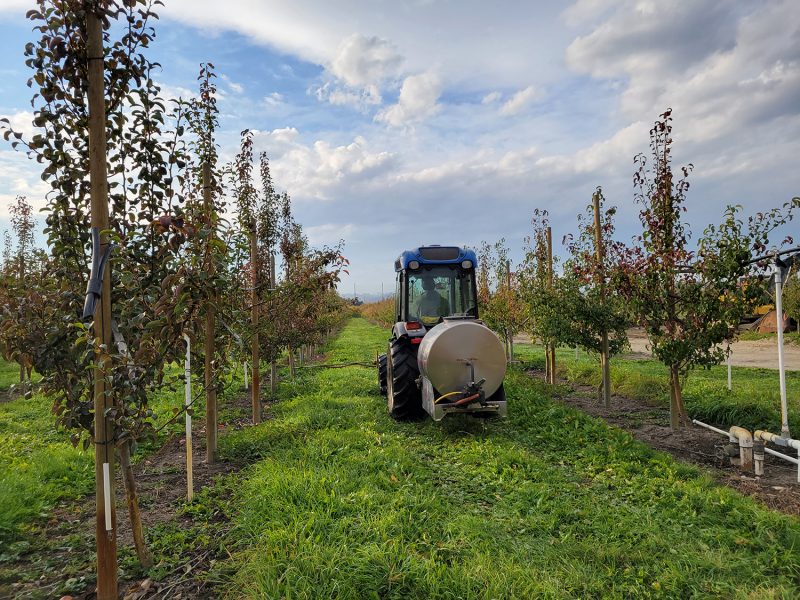
New regulations under the federal Pest Control Products Act now restrict the practice of tank-mixing to only products that are labelled specifically for mixing. Photo | Myrna Stark Leader

April 1, 2023 byTom Walker

KELOWNA – New regulations under the federal Pest Control Products Act now restrict the practice of tank-mixing to only products that are labelled specifically for mixing.

“Under the old regulations, products could be tank-mixed if they were both labelled as registered to be used on a crop and did not specify otherwise,” provincial pesticide specialist Ken Sapsford told BC Cherry Association members on February 24.

However, the PCPA prohibits the use of pest control products in a way that is inconsistent with the label.

The Pest Management Regulatory Agency (PMRA) has come out with a guidance document that requires new label statements for products that must read, “This product may be tank-mixed with registered pest control products whose labels also allow for mixing providing the entirety of both labels.”

“As a result, if a label contains no guidance related to tank-mixing, then tank mixes are not permitted,” Sapsford says.

Sapsford says the PMRA has given product registrants two years to update their labels.

“PMRA is not going to be doing any compliance and enforcement on this for the next two years – the 2025 growing season – until labels are updated,” Sapsford says.

Sapsford also gave an update on regulations for pesticide drift developed by the BC Ministry of Environment and Climate Change Strategy.

“Drift is one of the most important things we are working with, especially here in the valley where we have such an urban-rural interface,” Sapsford notes. “We have neighbours and schools right next to our orchards and we have to be sure we are doing things properly.”

In addition to ensuring contaminated run-off does not enter a watercourse or groundwater, the provincial Code of Practice for Agricultural Environmental Management requires pesticide applicators take all “reasonably necessary” precautions to prevent pesticide drift from entering a watercourse or groundwater as well as “all precautions that are reasonably necessary to prevent an unreasonable volume of pesticide spray drift from crossing a property boundary are taken, unless the person in possession of the property into which the drift crosses allows otherwise.”

Sapsford personally worked to ensure the wording served farmers’ interests.

“I was on a committee for more than a year to make sure they put that ‘unreasonable volume’ in there,” Sapsford says. “We know that zero spray drift is not possible. But we now must be sure we are doing everything possible to avoid that drift.”

Provincial compliance officers may respond to complaints from neighbours.

“If they find you have not taken the proper reasonable precautions, there could be a fine associated with that,” Sapsford says.

There is also a new emphasis on record-keeping.

“Keeping records is nothing new, but one of the things we need to add on to our records is the date and time and location of our spraying and also the temperature, wind direction and wind speed,” says Sapsford, explaining that they’re for the applicator’s protection.

“If you have good records showing that there is no way the drift could have gone in a certain direction, if a compliance officer comes out, you have got records to show that you have done everything possible,” he says.

Sapsford reviewed spray drift management techniques that can help growers.

“Identify sensitive areas and be careful to time your sprays for a favourable wind,” he advises. “You can consider planting hedges at the edge of your property to minimize drift.”

Sapsford also urges growers to make the best use of their equipment.

“Make sure your operator is trained properly and your sprayer is calibrated and the speed adjusted to suit your orchard rows,” he says.

Related Posts

You may be interested in these posts from the same category.

Cherry growers focus on labour

Cherries replant funding opens

BC Cherry holds AGM

Cherry growers weigh trade complaint

Cherry promotion promising

Orchard sector pilots new job-matching website

Cherry virus survey proposed

Cherry growers continue to focus on export markets

Growers anxious about labour

Vegetable growers lose key product

Higher rates for air freight

Previous Post: « Industry looks to move needle on labour shortage

Next Post: Snowpack sends mixed signals »

Copyright © 2026 Country Life in BC · All Rights Reserved