• Menu
  • Skip to primary navigation
  • Skip to main content
  • Skip to primary sidebar

Country Life In BC Logo

The agricultural news source in British Columbia since 1915

  • Headlines
  • Calendar
  • Subscribe
  • Advertise
  • About
  • Archives
  • Contact
  • Search
  • Headlines
  • Calendar
  • Subscribe
  • Advertise
  • About
  • Archives
  • Contact
  • Search

Primary Sidebar

Originally published:

JULY 2020
Vol. 106 Issue 7

Subscribe Now!

Sign up for free weekly FARM NEWS UPDATES

Select list(s) to subscribe to


By submitting this form, you are consenting to receive marketing emails from: Country Life in BC. You can revoke your consent to receive emails at any time by using the SafeUnsubscribe® link, found at the bottom of every email. Emails are serviced by Constant Contact
Your information will not be
shared or sold ever

Stories In This Edition

Province expands slaughter licences
Mexico launches SAWP review
Blue streak
Ranchers troubled by inconsistencies in well licencing
Editorial: All together
Back 40: Canada Day is a time to celebrate diversity
Viewpoint: BC producers keep our local food system strong
Farmland advocates pan agritech plans
Follow the arrow
Letters: Biosolids project misguided
Small on-farm dairy processors raise concerns
Zoning bylaw limits urban farmers
Kelowna readies exclusion bid
Global market puts emphasis on top-quality fruit
Sidebar: Time to renew
Leaming confident fruit industry can rejuvenate
Book Club
Review of vegetable commission forges ahead
Ag Briefs: Record funding pledged for coupon program
Ag Brief: Province boosts online grants
Ag Brief: Organic matter regulation delayed
Kelowna couple sprouts successful business
Greens growers see need for support
Cattlemen host virtual annual meeting
Sidebar: Cattlemen change gears
Pandemic less challenging for small farms
Rainy day thoughts for pesticide applications
Drones hone in on crop water requirements
BC farms adapt chicken tractors to local conditions
Breeders pin a value on traits
Prototype is a Roomba for weed control
Research: Exploring the complexities of soil structure
Viewpoint: Isolation brings the world closer
Buds
Farm Story: Weeds make perfection an impossible dream
Cidermakers give fresh purpose to island orchards
Woodshed: Frank makes Susan’s deliberation easy
Veggie Days adapts to event restrictions
Jude’s Kitchen: Summer food in colour

More Headlines

Follow us on Facebook

Comments Box SVG iconsUsed for the like, share, comment, and reaction icons

6 days ago

... See MoreSee Less

View Comments
  • Likes: 4
  • Shares: 0
  • Comments: 0

Comment on Facebook

7 days ago

On the last day of the BC Organic Conference, Thursday, Molly Thurston of Pearl Agricultural Consulting helped growers learn how to manage bugs such as codling moth, wireworm, and rootworm in organic growing systems. Her talk alongside Renee Prasad included hands-on activities in which participants checked out various traps and examined pests under microscopes. Be sure to look for more upcoming ag events on our online calendar at www.countrylifeinbc.com/calendar/

#BCAg
... See MoreSee Less

On the last day of the BC Organic Conference, Thursday, Molly Thurston of Pearl Agricultural Consulting helped growers learn how to manage bugs such as codling moth, wireworm, and rootworm in organic growing systems. Her talk alongside Renee Prasad included hands-on activities in which participants checked out various traps and examined pests under microscopes. Be sure to look for more upcoming ag events on our online calendar at www.countrylifeinbc.com/calendar/

#BCAg
View Comments
  • Likes: 15
  • Shares: 0
  • Comments: 0

Comment on Facebook

1 week ago

Well-known organic farmer and podcaster Jordan Marr gets interviewed by Country Life in BC’s own columnist and potato mavin Anna Helmer during the opening session of the BC Organic Conference at Harrison Hot Springs yesterday. Sessions run today (Wednesday) and Thursday and include organic and regenerative growing practices and expanding and advocating for the organic sector, all under the background of the newly launched Organic BC banner.

#BCAg
... See MoreSee Less

Well-known organic farmer and podcaster Jordan Marr gets interviewed by Country Life in BC’s own columnist and potato mavin Anna Helmer during the opening session of the BC Organic Conference at Harrison Hot Springs yesterday. Sessions run today (Wednesday) and Thursday and include organic and regenerative growing practices and expanding and advocating for the organic sector, all under the background of the newly launched Organic BC banner.

#BCAg
View Comments
  • Likes: 37
  • Shares: 2
  • Comments: 1

Comment on Facebook

Interested in finding out more about this

3 weeks ago

Today, we remember those who sacrificed their lives or their well-being for our freedom. Lest we forget. ... See MoreSee Less

Today, we remember those who sacrificed their lives or their well-being for our freedom. Lest we forget.
View Comments
  • Likes: 8
  • Shares: 0
  • Comments: 0

Comment on Facebook

1 month ago

FarmFolk CItyFolk is hosting its biennial BC Seed Gathering in Harrison Hot Springs November 27 and 28. Farmers, gardeners and seed advocates are invited to learn more about seed through topics like growing perennial vegetables for seed, advances in seed breeding for crop resilience, seed production as a whole and much more. David Catzel, BC Seed Security program manager with FF/CF will talk about how the Citizen Seed Trail program is helping advance seed development in BC. Expect newcomers, experts and seed-curious individuals to talk about how seed saving is a necessity for food security. ... See MoreSee Less

Link thumbnail

BC Seed Gathering - FarmFolk CityFolk

farmfolkcityfolk.ca

Save the date for our upcoming 2023 BC Seed Gathering happening this November 3rd and 4th at the Richmond Kwantlen Polytechnic University campus.
View Comments
  • Likes: 1
  • Shares: 0
  • Comments: 0

Comment on Facebook

Subscribe | Advertise

The agricultural news source in British Columbia since 1915
  • Email
  • Facebook

Ranchers troubled by inconsistencies in well licensing

Government fails to communicate options to well owners

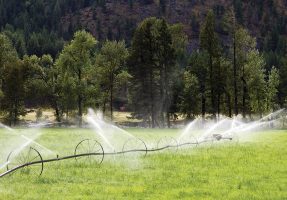
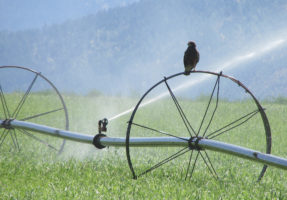
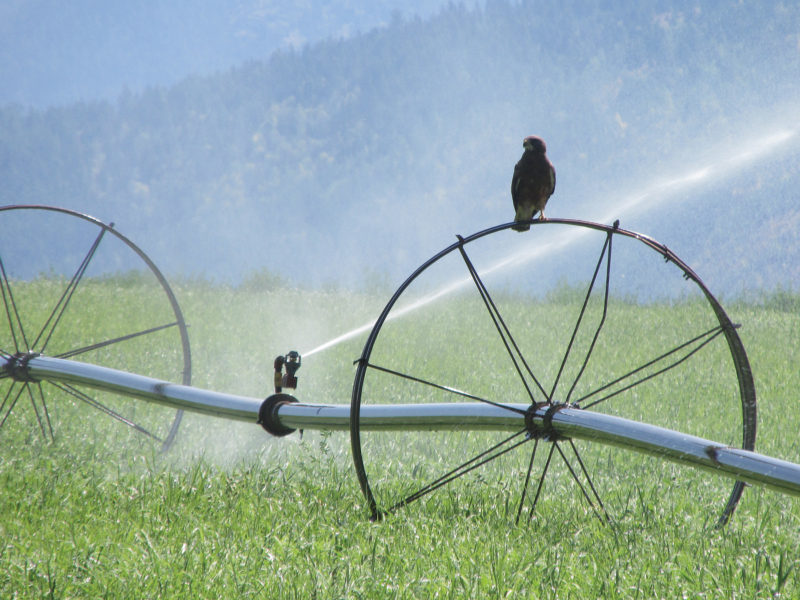
A hawk takes a refreshing break from hunting and the heat, perched on an irrigation system in a farmer's field in Coldstream. PHOTO / FILE

July 7, 2020 byPeter Mitham

BEAVERDELL – An analysis of nearly 500 groundwater licences the province has issued under the Water Sustainability Act reveals sharp inconsistencies in what’s being required of owners.

Sandra Ryan and partner Bill Di Pasquale are small-scale forage producers in Beaverdell. They registered their well and this past March received a conditional groundwater licence for a withdrawal of about 67,640 cubic metres a year.

However, they were surprised to discover among the conditions of the licence a requirement to “install a flow meter or other measuring device” and “retain the flow/measurement records for inspection upon request.”

“When we applied for the licence (as an existing user), there was absolutely no notice that this would be a condition to subsequently use the water. We, along with everyone else, were only told there would be retroactive water rental fee(s),” says Ryan, whose preliminary research showed that a flow meter would be “prohibitively costly.”

“A four-inch recording meter, flanges and other installation materials is in the range of $4,000. This does not include hiring a mechanical contractor to do the installation. So, at a bare minimum, this is a $5,000-plus venture.”

Ryan, who studied law, began to investigate the matter. Reviewing 475 of the 1,080 groundwater licences issued through the end of May to existing well users since the Water Sustainability Act took effect in 2016, she found that not all users are required to install a meter. While well owners in the Victoria and Nanaimo water districts are the least likely to be asked to install a meter, she discovered a case in the Vernon water district where two licences with identical parameters were issued. One owner required to have a flow meter and the other was not.

According to the BC Ministry of Forests, Lands, Natural Resource Operations and Rural Development, the conditions are at the discretion of the “statutory decision makers,” which in this case is usually the assistant water manager overseeing a given district.

“[They] have the discretion to add terms and conditions to the water licences, such as installing a flow meter. Once these terms and conditions have been met, then a final licence may be issued,” says FLNORD, which administers the application and licensing process.

Ryan also noted that one decision maker, who made 44 decisions of the 475 licences examined, always required the licensee to install a meter, irrespective of use or quantity. The minimum fee for a non-domestic water user is $50 a year, which amounts to a draw of up to 60,000 cubic metres a year. The decision maker required one licensee to install a flow meter for a licensed use of just 266 cubic metres a year.

“I fail to see how requiring a licensee to install a flow meter when they use 266 cubic metres of water/year for their livestock makes any sense whatsoever,” she said in a letter outlining her concerns to Ted White, comptroller of water rights for the province.

White replied, reiterating that any conditions attached to a licence, including the installation of a flow meter, was at the discretion of the assistant water manager. However, he said the province is open to making improvements.

“The Province is listening to user feedback on the system and is taking steps to make the process more user friendly and where it is challenging, FrontCounterBC staff are available to help,” he said.

Ryan has taken her concerns to the province’s environmental appeal board, a quasi-judicial body.

This is one option for licensees, says Mike Wei, an independent consultant who served as the province’s technical expert during development and implementation of the Water Sustainability Act and Groundwater Protection Regulation.

One reason for the inconsistencies between water districts is the discretion decision makers have, and the lack of a single standard for when to impose conditions or how to measure water use.

“There is no policy, that I am aware, regarding measuring and reporting and when to put it on a condition or not, and what is the acceptable measuring method. So each decision maker is kind of on their own,” he says.

One of the things his team looked at was alternative methods of estimating water use.

“Can you record time pump on, time pump off, and do that and, given how much you’re pumping, just calculate how much it is without buying additional infrastructure?”

This is an idea that appeals to the BC Cattlemen’s Association, which has taken a strong stand against water meters in discussions with government.

“We feel that there are other, less costly ways, to estimate that use,” says association assistant general manager Elaine Stovin, noting the province has no regulations governing measuring and reporting requirements. “What we’re saying is you don’t need a water meter to do that. You need a good relationship with the producer; you need to make a simple way for them to report that use.”

Good relationships will also encourage producers to embrace the new groundwater management regime, the intent of which Ryan generally supports. Requiring producers to measure water at some cost to themselves, and then not providing grants to assist with modernizing and upgrading equipment to achieve the goal of more efficient water use, doesn’t wash with her.

While some water districts have done a good job at letting producers know their options, Stovin says that’s clearly not the experience of most producers.
Related Posts

You may be interested in these posts from the same category.

Southern Interior irrigators shut down

Island farmers fish for water solutions

Groundwater enforcement picks up

Water licence fight highlights need for change

Westwold producers challenge curtailment

No licence, no problem

Watershed security report

Groundwater deadline firm

Groundwater users could lose rights next year

Feeling the heat on water

Water licence angst

Grant funding for nutrient management projects

Previous Post: « Province expands slaughter licences
Next Post: Woodjam Ranch honoured »

Copyright © 2025 Country Life in BC · All Rights Reserved