• Menu
  • Skip to primary navigation
  • Skip to main content
  • Skip to primary sidebar

Country Life In BC Logo

The agricultural news source in British Columbia since 1915

  • Headlines
  • Calendar
  • Subscribe
  • Advertise
  • About
  • Archives
  • Contact
  • Search
  • Headlines
  • Calendar
  • Subscribe
  • Advertise
  • About
  • Archives
  • Contact
  • Search

Primary Sidebar

Originally published:

March 2019
Vol. 105 Issue 3

Subscribe Now!

Sign up for free weekly FARM NEWS UPDATES

Select list(s) to subscribe to


By submitting this form, you are consenting to receive marketing emails from: Country Life in BC. You can revoke your consent to receive emails at any time by using the SafeUnsubscribe® link, found at the bottom of every email. Emails are serviced by Constant Contact
Your information will not be
shared or sold ever

Stories In This Edition

Ten-year plan

Simon Answerth

Province boosts ag spending

It’s a draw!

Well registrations lag in advance of final deadline

Editorial: Vice grip

Back Forty: Snow days make good days for seed selection

Viewpoint: Farmers need to prepare for annual snow melt

Smooth start to season as foreign workers arrive

Sidebar: Province mulls piece rates

Late winter has some Okanagan growers on edge

Ag show attracts near-record attendance

Ag Briefs: Traceability funding available for producers

Ag Briefs: Cattlemen’s launches webinar series

Ag Briefs: Grant winner announced

Labour remains a priority for fruit growers

Dairy, aquaculture take home awards at gala

Farmers need to prepare for uncertainty

Ag critic listens to concerns at farmers’ institute

Growers are responsible for workers’ safety

Robotic milkers sized up during dairy tour

Safe, high-quality silage depends on preparation

Young farmers crack open new vending concept

Diversification makes orchard a landmark

Going green boosts ranch’s credibility

Ranchers need to match forage with herd needs

Tru-Grit

Reducing waste will save money on winter feed

Producers question new Indigenous rights law

Hosting TRU students a way to give back

Livestock co-op provides selling, buying options

Sidebar: Market set to stay steady

Research: Bluetongue outbreaks expected to increase

Filling a niche for gourmet mushrooms

Regulations, housing key issues in Langley

Sheep producers seeing value in genetic program

Above and beyond

Vegetation fundamental to farms, landscape

Studies continue on forage, corn crop pests

4-H BC leader singled out

Growers go with the grain of beer revival

Agri-tourism has plenty of room for growth

Rose stem girdler poses threat to cranberries

Site prep critical for healthy hazelnut orchards

Sidebar: BC renewal program opens up

Wannabe: Renewal comes with a new generation of farmers

Mentorship gives Kelowna grower a headstart

Woodshed: Deborah and Doug McLeod turn up the heat

A good place to meet up

Jude’s Kitchen: Celebrate spring by eating outside

More Headlines

Follow us on Facebook

Comments Box SVG iconsUsed for the like, share, comment, and reaction icons

7 days ago

... See MoreSee Less

View Comments
  • Likes: 4
  • Shares: 0
  • Comments: 0

Comment on Facebook

7 days ago

On the last day of the BC Organic Conference, Thursday, Molly Thurston of Pearl Agricultural Consulting helped growers learn how to manage bugs such as codling moth, wireworm, and rootworm in organic growing systems. Her talk alongside Renee Prasad included hands-on activities in which participants checked out various traps and examined pests under microscopes. Be sure to look for more upcoming ag events on our online calendar at www.countrylifeinbc.com/calendar/

#BCAg
... See MoreSee Less

On the last day of the BC Organic Conference, Thursday, Molly Thurston of Pearl Agricultural Consulting helped growers learn how to manage bugs such as codling moth, wireworm, and rootworm in organic growing systems. Her talk alongside Renee Prasad included hands-on activities in which participants checked out various traps and examined pests under microscopes. Be sure to look for more upcoming ag events on our online calendar at www.countrylifeinbc.com/calendar/

#BCAg
View Comments
  • Likes: 15
  • Shares: 0
  • Comments: 0

Comment on Facebook

1 week ago

Well-known organic farmer and podcaster Jordan Marr gets interviewed by Country Life in BC’s own columnist and potato mavin Anna Helmer during the opening session of the BC Organic Conference at Harrison Hot Springs yesterday. Sessions run today (Wednesday) and Thursday and include organic and regenerative growing practices and expanding and advocating for the organic sector, all under the background of the newly launched Organic BC banner.

#BCAg
... See MoreSee Less

Well-known organic farmer and podcaster Jordan Marr gets interviewed by Country Life in BC’s own columnist and potato mavin Anna Helmer during the opening session of the BC Organic Conference at Harrison Hot Springs yesterday. Sessions run today (Wednesday) and Thursday and include organic and regenerative growing practices and expanding and advocating for the organic sector, all under the background of the newly launched Organic BC banner.

#BCAg
View Comments
  • Likes: 37
  • Shares: 2
  • Comments: 1

Comment on Facebook

Interested in finding out more about this

3 weeks ago

Today, we remember those who sacrificed their lives or their well-being for our freedom. Lest we forget. ... See MoreSee Less

Today, we remember those who sacrificed their lives or their well-being for our freedom. Lest we forget.
View Comments
  • Likes: 8
  • Shares: 0
  • Comments: 0

Comment on Facebook

1 month ago

FarmFolk CItyFolk is hosting its biennial BC Seed Gathering in Harrison Hot Springs November 27 and 28. Farmers, gardeners and seed advocates are invited to learn more about seed through topics like growing perennial vegetables for seed, advances in seed breeding for crop resilience, seed production as a whole and much more. David Catzel, BC Seed Security program manager with FF/CF will talk about how the Citizen Seed Trail program is helping advance seed development in BC. Expect newcomers, experts and seed-curious individuals to talk about how seed saving is a necessity for food security. ... See MoreSee Less

Link thumbnail

BC Seed Gathering - FarmFolk CityFolk

farmfolkcityfolk.ca

Save the date for our upcoming 2023 BC Seed Gathering happening this November 3rd and 4th at the Richmond Kwantlen Polytechnic University campus.
View Comments
  • Likes: 1
  • Shares: 0
  • Comments: 0

Comment on Facebook

Subscribe | Advertise

The agricultural news source in British Columbia since 1915
  • Email
  • Facebook

Reducing waste will save money on winter feed

Put your money in the bank

Cow

February 26, 2019 byTom Walker

VERNON – Mike Witt, owner of Witt Precision Ag in Lavington, says the first step to cutting feed costs in winter is to cut waste. Producers need to do their best to combat silage shrink.

“Silage management and your feed-out management are the two low-hanging fruits,” he says. “You are going to lose nutrients as well as volume if you are not taking care when you store your feed.”

The second consideration is feeding waste.

“Are you using feeders or bunks; are you grouping your cows together based on their feed needs; are you watching out for overfeeding?” asks Witt. “You may be leaving wasted hay on the ground for organic matter but that’s a pretty expensive soil supplement.”

Witt gave ranchers a number of hypothetical examples to consider. He was able to compare ingredients by looking at their energy values and suggest some combinations that might save a producer money.

If a rancher had only produced lower-quality hay at 8% crude protein (CP) and 52% TDN, that would be sufficient for cows of good condition only through their second trimester of pregnancy, Witt suggests.

“For a cow in her third trimester, it would be borderline,” he says. “After calving, it would definitely be short of both protein and energy.”

Witt suggests mixing up the feed combination, blending high-quality hay with barley.

“That would give you the best price and nutrition combination to feed after calving.”

Alternatively, a hay and supplement combination could work, too.

In a second example, Witt looked at a rancher with high quality hay of 19% CP and 61% TDN. The herd’s nutritional needs are actually exceeded by feeding this hay and at a high market price of $225 a ton, the rancher could be throwing money away.

“This might be an opportunity to sell that hay, purchase some cheaper feed ingredients and put money in your pocket,” says Witt.

Witt’s suggestions included purchasing some straw to mix with the high-quality hay, limit feeding the cows so they are only getting the minimum feed requirements with little waste, or selling most of the high-quality hay, purchasing cheaper but adequate hay at say14% CP and 57% TDN. Ranchers would only need to supplement this hay with some barley after calving, which could net savings of around $100 per cow.

What about a producer who has good quality hay – say 15% CP and 57% TDN?

The combination would meet third trimester needs, but would be marginal after calving.

Witt briefly discussed some other options ranchers might consider.

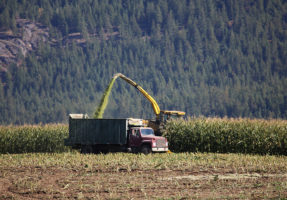
A mix of cereal silage and alfalfa silage would be around $30 less, for example, while corn silage, cereal silage and straw would be $40 less. Combining corn silage, cereal silage and good quality hay could see a cost savings of over $80 per animal.

“It’s all about finding a balance between what you grow and what your cows need,” says Witt. “You may find yourself changing your forage production.”
 

Related Posts

You may be interested in these posts from the same category.

Seed-saving at risk

Forage action plan nears completion

Alfalfa winterkill puts chill on Nechako Valley

Previous Post: « Province gives well owners three more years to register

Next Post: Young farmers crack open new vending concept Kristin Poortvliet»

Copyright © 2025 Country Life in BC · All Rights Reserved