
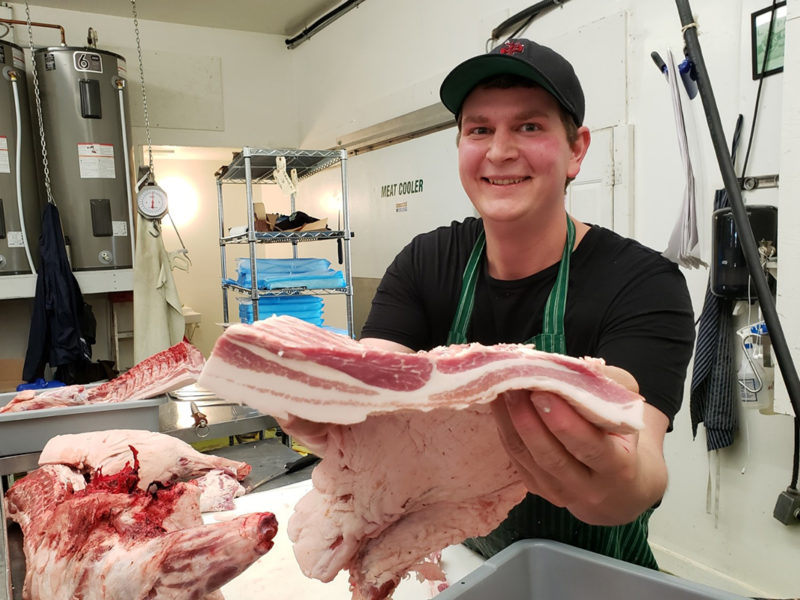
MCBRIDE – Hopes are high that a government-inspected Class E mobile abattoir may soon move to the prototype stage.
The proposal is driven by McBride custom butcher Mark Roth, who says the Class E licensing system needs work to better serve small-scale farmers.
The construction of a
Class A abattoir in McBride in 2011 was what led Roth to become a butcher. He dropped his plans to work at the new plant after a stint of on-farm butchering and cutting and wrapping at his small butcher shop.
“I realized I really like that a lot better,” he explains. “I completely fell in love with that process. It’s just so much kinder.”
Roth says abattoirs do a good job but the process of corralling, transporting, chuting, head squeezing and butchering at an unfamiliar facility is not the way most small-scale farmers want to harvest their animals.
“In our valley, it’s been proved time and again that the abattoir model doesn’t fit with small farmers,” he says, noting that the McBride facility has yet to operate successfully for any length of time. It’s currently closed.
“It was handy for a few people, this abattoir, but it didn’t fit the needs of the whole valley. So there wasn’t really a business to be had because they were only getting a small portion of the business.”
Roth and his father Darrell, who runs a small-scale cattle farm with a Class E licence, developed the idea for an inspected abattoir that could be viable for remote locations.
Mobile abattoirs are not a new idea. Roth says they have not been financially successful because the units were much too large and the docking station requirements are beyond what most farmers are willing to do to slaughter a handful of animals each year.
His solution is a 16-foot refrigerated truck pulling an 18-foot skinning trailer that would eliminate the docking station requirements and carry enough potable water for the slaughter of four animal units.
The long-term aim is to provide remote inspection via video but current legislation does not allow that scenario.
In the meantime, Roth proposes to have a government meat inspector in the unit so the meat being harvested can then be sold to restaurants and grocery stores.
Currently, a Class E licence only allows for on-farm slaughter of up to 10 animal units for direct sale to consumers.
“What I’m trying to do with this inspected farm harvest unit is to bring the inspection to the farm,” he says. “I think the beauty of these units is they bring inspected slaughter to people who don’t have the infrastructure – like business people who don’t have the infrastructure.”
Roth received a boost when he shared his idea with BC agriculture minister Lana Popham when she visited McBride in 2018.
“She was just unbelievably supportive,” he says. “She’s allowed me to work with the top three guys in meat inspection to see if we can make something work.”
Roth is working closely with senior staff in the ministry’s food safety and inspection branch, including operations manager Klaus Noegel, veterinarian Ken Robeleski and executive director Gavin Last.
“We have been providing support for Mark to understand and meet licensing requirements and to work with him on innovative ideas to meet those requirements,” Last explains.
Last says seven mobile abattoirs have operated in BC in recent years but none are currently operating. He says the province is interested in new ideas around mobile abattoirs, including remote inspection via video.
“We’re looking at it. We’re certainly interested in it and want to learn more about all kinds of alternative methods for inspection so that we could offer a service that’s meeting the needs of everybody in the province, which is challenging given the geography and where the populations are and where they have their farms,” Last says.
Trailer manufacturer Bill Barnes added his ample knowledge and experience to creating a design for the mobile unit.
Barnes says interest from both levels of government in developing a replicable prototype makes him hopeful that federal funding will be available soon to see the project to fruition.
“There are certain things that have to change within the industry in order to make this a very frugal operation…for whoever’s going to take it over and for the government once it’s running, once the equipment’s out there,” Barnes adds.
Once a prototype is complete at Barnes’ Prince George facility, Shur Foot Industries Inc., Roth plans to operate the unit.
Roth suggests the new mobile abattoir could also provide an additional revenue stream for A and B abattoirs. The unit could be a stand-alone business operating out of such a facility or mobile operators could rent the cut and wrap portions of Class A/B plants during slow periods. It would also provide options for small-scale farmers to build their herds and develop new markets for their meat, thus creating more work for custom butchers.
Middle ground
“We think that place between ‘personal use only’ and industrial scale class A/B is a huge market if we can find a way to access it,” he notes. “One inspected farm harvest unit could supply several small butcher shops with carcasses to cut and wrap over a much larger area than a stationary abattoir and lowers the infrastructure barrier for both small scale farmers and small scale meat shops who do not have slaughter capabilities.”
Roth says his on-farm slaughter service is the same regardless of whether or not he holds a Class E licence.
“So to call it a ‘class anything’ and pretend that that gives it some sort of guarantee that it’s healthy or government-approved is kind of crazy. It’s a pretty meaningless licence,” he explains. “At the end of the day, if you have a dishonest farmer, they can do dishonest things without getting caught. That’s the problem with Class E.”

 Poultry and hops a winning combination