• Menu
  • Skip to primary navigation
  • Skip to main content
  • Skip to primary sidebar

Country Life In BC Logo

The agricultural news source in British Columbia since 1915

  • Headlines
  • Calendar
  • Subscribe
  • Advertise
  • About
  • Archives
  • Contact
  • Search
  • Headlines
  • Calendar
  • Subscribe
  • Advertise
  • About
  • Archives
  • Contact
  • Search

Primary Sidebar

Originally published:

August 2018
Vol. 104 Issue 8

Subscribe Now!

Sign up for free weekly FARM NEWS UPDATES

Select list(s) to subscribe to


By submitting this form, you are consenting to receive marketing emails from: Country Life in BC. You can revoke your consent to receive emails at any time by using the SafeUnsubscribe® link, found at the bottom of every email. Emails are serviced by Constant Contact
Your information will not be
shared or sold ever

Stories In This Edition

Shaved, showered and shampooed

New regs rolled out for pot growers

Egg farm decommissioned

Richmond cranberry grower honoured

Editorial: Ground for reform

Back Forty: Facing a tenuous future of feeding the world

OpEd: Wildlife federation’s audit request full of holes

Armyworm posing little risk this season

Letters: Dairy feeling price pressures

Abbotsford waits for clarity on ALR guidelines

Chicken quote to increase 20% by 2020

Dairy incentive days this fall

Aquilini seeks exclusion for former nursery

Business risks looms large at national meeting

Maple Ridge denies exclusion bid for dairy

Fire damage won’t delay blueberry shipments

Good weather marks return to normal conditions

Cherries set for near-record crop this season

Laser system has potential for bird control in crops

Hazelnut growers get replant funding

Gulf Islands farmers want rules respected

Young Agrarians push small-scale premium

Value pinned on local ecosystem services

Cash crunch threatens BC berry growers

Hop sector brewing a bright future

IPM for SWD a tall order, says crop consultant

Audit request takes aim at cattle ranchers

Forage action plan nears completion

Site C fund directors get to work

Abattoir recommendations delayed till fall

Research: Smart flowers have the tools to attract clever bees

Science should underpin colony management

Abbotsford tour puts spotlight on innovation

Summer fun at Stock Show

Business smarts needed for farm success

Wannabe: Signs of hope’s fulfilment

New day for Century Growers

Woodshed: Role playing turns up heat for Deborah

Seasonal pastime

Community is key crop for Kelowna farmers

Jude’s Kitchen: Crisp and cool entertaining

More Headlines

Follow us on Facebook

Comments Box SVG iconsUsed for the like, share, comment, and reaction icons

7 days ago

... See MoreSee Less

View Comments
  • Likes: 4
  • Shares: 0
  • Comments: 0

Comment on Facebook

7 days ago

On the last day of the BC Organic Conference, Thursday, Molly Thurston of Pearl Agricultural Consulting helped growers learn how to manage bugs such as codling moth, wireworm, and rootworm in organic growing systems. Her talk alongside Renee Prasad included hands-on activities in which participants checked out various traps and examined pests under microscopes. Be sure to look for more upcoming ag events on our online calendar at www.countrylifeinbc.com/calendar/

#BCAg
... See MoreSee Less

On the last day of the BC Organic Conference, Thursday, Molly Thurston of Pearl Agricultural Consulting helped growers learn how to manage bugs such as codling moth, wireworm, and rootworm in organic growing systems. Her talk alongside Renee Prasad included hands-on activities in which participants checked out various traps and examined pests under microscopes. Be sure to look for more upcoming ag events on our online calendar at www.countrylifeinbc.com/calendar/

#BCAg
View Comments
  • Likes: 15
  • Shares: 0
  • Comments: 0

Comment on Facebook

1 week ago

Well-known organic farmer and podcaster Jordan Marr gets interviewed by Country Life in BC’s own columnist and potato mavin Anna Helmer during the opening session of the BC Organic Conference at Harrison Hot Springs yesterday. Sessions run today (Wednesday) and Thursday and include organic and regenerative growing practices and expanding and advocating for the organic sector, all under the background of the newly launched Organic BC banner.

#BCAg
... See MoreSee Less

Well-known organic farmer and podcaster Jordan Marr gets interviewed by Country Life in BC’s own columnist and potato mavin Anna Helmer during the opening session of the BC Organic Conference at Harrison Hot Springs yesterday. Sessions run today (Wednesday) and Thursday and include organic and regenerative growing practices and expanding and advocating for the organic sector, all under the background of the newly launched Organic BC banner.

#BCAg
View Comments
  • Likes: 37
  • Shares: 2
  • Comments: 1

Comment on Facebook

Interested in finding out more about this

3 weeks ago

Today, we remember those who sacrificed their lives or their well-being for our freedom. Lest we forget. ... See MoreSee Less

Today, we remember those who sacrificed their lives or their well-being for our freedom. Lest we forget.
View Comments
  • Likes: 8
  • Shares: 0
  • Comments: 0

Comment on Facebook

1 month ago

FarmFolk CItyFolk is hosting its biennial BC Seed Gathering in Harrison Hot Springs November 27 and 28. Farmers, gardeners and seed advocates are invited to learn more about seed through topics like growing perennial vegetables for seed, advances in seed breeding for crop resilience, seed production as a whole and much more. David Catzel, BC Seed Security program manager with FF/CF will talk about how the Citizen Seed Trail program is helping advance seed development in BC. Expect newcomers, experts and seed-curious individuals to talk about how seed saving is a necessity for food security. ... See MoreSee Less

Link thumbnail

BC Seed Gathering - FarmFolk CityFolk

farmfolkcityfolk.ca

Save the date for our upcoming 2023 BC Seed Gathering happening this November 3rd and 4th at the Richmond Kwantlen Polytechnic University campus.
View Comments
  • Likes: 1
  • Shares: 0
  • Comments: 0

Comment on Facebook

Subscribe | Advertise

The agricultural news source in British Columbia since 1915
  • Email
  • Facebook

Armyworm posing little risk this season

Insect ravaged Island, coastal forage crops last year

July 29, 2018 bySean Hitrec

PORT ALBERNI – Researchers continue to look for answers to last year’s unusual armyworm outbreak on Vancouver Island and in the Fraser Valley while affected farmers remain vigilant against the pest.

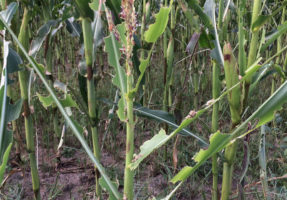
Seemingly out of nowhere, the very hungry caterpillars started chowing down on forage crops across southwestern BC last summer. In its moth form, true armyworm (Mythimna unipuncta) reportedly drifted north from the US in historically large numbers. The larvae devastated healthy grass and corn crops while experts scrambled to find out what was going on. After a year, the threat seems to have died down and research into the phenomenon has begun.

“What we think is happening is that the growing conditions are really good in Northern California [an area that hosts the insect year-round] where they’ve had more rain over the last handful of years following a long drought,” says Tracy Hueppelsheuser, an entomologist with the plant health unit of the BC Ministry of Agriculture. “That means there’s lots of adult [moths] present to blow on the winds to new locations.”

The resulting damage to grass and corn varied across affected areas.

“I know that some fields were 100% write-offs and I know that other fields had a much lower percentage of impact,” she says.

Hueppelsheuser has continued to monitor insect traps in the affected areas. She’s determined they likely did not survive the winter because the traps were empty from December until this spring. Armyworm are not able to diapause – or rest – when the temperature gets colder. This limits their ability to overwinter, and the empty traps indicate the population died out.

When armyworm moths did show up this year in late spring, Hueppelsheuser says the numbers were too low to cause alarm. Not much is known about their migrations to BC other than they seem to drift up here from time to time on wind currents.

“When we went back and looked at museum records, there were moths in the museum collections over the last hundred or so years. That shows the moth does come up here sometimes,” she says. “It doesn’t usually show up in great numbers, so it’s not that it’s new to British Columbia, it’s just we’ve never seen so many that anyone can recall.”

While the insect has more than one generation per growing season in BC, she says the population is low enough that the first generation this year is no cause for alarm.

“Based on trap catches, it looks like the first generation is very low and we shouldn’t be having problems,” she says. “[But] there’s a second generation and we’ll be wanting to watch for flight this August.”

The second generation started to damage crops in the middle of August last year, so she urges farmers to continue to keep their eyes open.

Alberni recovering

Meanwhile, farmers in the Alberni Valley are still recovering from the march of the armyworm last summer. The loss of forage caused some to cull their herds, while others had to import feed from off-island sources.

George Haack has been farming the valley since 1969 and normally has enough hay to sell on the side after feeding his beef cattle. He said he lost around 500 round bales in total last year.

“They didn’t do mine until third cut in September,” he says. “Basically, all of the sudden the grass was disappearing and so I just went out and cut it all down, baled it and bagged it. I only got 50-odd [round] bales when I normally get 300.”

Haack culled his herd over the winter and is down to 32 from 130 head last year. He took it as a sign he needed to change pace.

“I’ve always had a job on the side to pay for my bad habit of farming, and it’s not just a little farm,” he says. (He farms 120 acres.) “I’m 61 now and I haven’t had a holiday since ’92. The wife and I were talking, and we were just going to downsize anyways and make it a little bit easier on ourselves.”

Others paid to keep their herds alive.

It cost Terry Shannon $150,000 to maintain his herd of 400 grass-fed dairy cows over the winter. His 500 acres of grassland is enough to support his entire herd, but the armyworms took over.

“I had to buy over 400 tons of hay,” he says. “At this time last year already, I was feeding about three tons of hay a day just because we didn’t have any real grass growth of any significance after about the last week of June.”

If this wasn’t bad enough, the insect’s picky eating habits upset the balance of plants in his fields.

“On third cut, all the regrowth was pretty much clover and [as a result] I ended up losing a couple animals with bloat, which I never pexperienced before,” he says.

This year, Shannon’s fields are in repair. He has already overseeded 120 acres and has around 50 acres left to seed of what he calls “total grass kill.”

While last year’s infestation may have been unusual, Hueppelsheuser says it can happen again. Where and when is tough to predict, however. She says the best growers can do is check with local farming associations and keep an eye on their fields.

“There’s nothing you can do to prevent [an outbreak]. If the conditions are good for growing grass, they’re going to be really good for armyworm,” she says. “The females look for lush, green growth in order to lay eggs and if the conditions are good, they’ll lay more eggs and the larvae will grow faster.”

If armyworm does reappear this summer in large numbers, Hueppelsheuser says there are ways to mitigate the damage. Quickly cutting the grass or grazing animals in fields will help because armyworm prefers fresh, uncut grass. Natural predators of armyworm are parasitic wasps, parasitic flies and predatory beetles as well as birds. Pesticides also work.

Hueppelsheuser’s team has joined with researchers in California, Oregon, Washington and Eastern North America in an attempt find out exactly where in the US they come from and what wind currents they use to travel around Western North America.
Related Posts

You may be interested in these posts from the same category.

Armyworm pressure low

Island farmers grapple with armyworm infestation

Previous Post: « Wildlife federation’s audit request full of holes
Next Post: Cariboo farm thrives with mentorship »

Copyright © 2025 Country Life in BC · All Rights Reserved