
DAWSON CREEK – Recent investigations are calling for more oversight over range use practices surrounding First Nations cultural sites and the spread of invasive plants. However, some in BC’s ranching sector argue that these problems are symptoms of a deeper issue: successive provincial governments putting ranching on the back burner when it comes to policy priorities.
In a March 18 news release, the Forest Practices Board (FPB) called for stronger protections of First Nations cultural sites vulnerable to impacts from grazing practices.
The FPB is BC’s “independent watchdog for sound forest and range practices.” It regularly conducts investigations into range use practices to ensure provincial rules are being followed.
FPB had investigated two range agreement holders: Valerie and Walter Hedges, and Crystal Springs Ranch, owned by Georg and Sarah Weitzel.
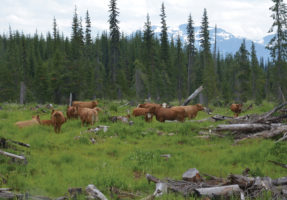
The investigations followed a complaint from the Halfway River First Nation (HRFN) that cattle were using mineral licks which the HRFN considers “culturally significant sites.”
These licks, which occur naturally in the HRFN’s traditional hunting grounds, are of great importance because local wildlife – especially elk – rely on them for essential nutrients.
HRFN is concerned that livestock are displacing wildlife from the licks and the surrounding area.
BC Cattlemen’s Association general manager Kevin Boon says the situation is not the result of careless range use practices but a history of insufficient provincial consideration of the impact of overlapping land tenures.
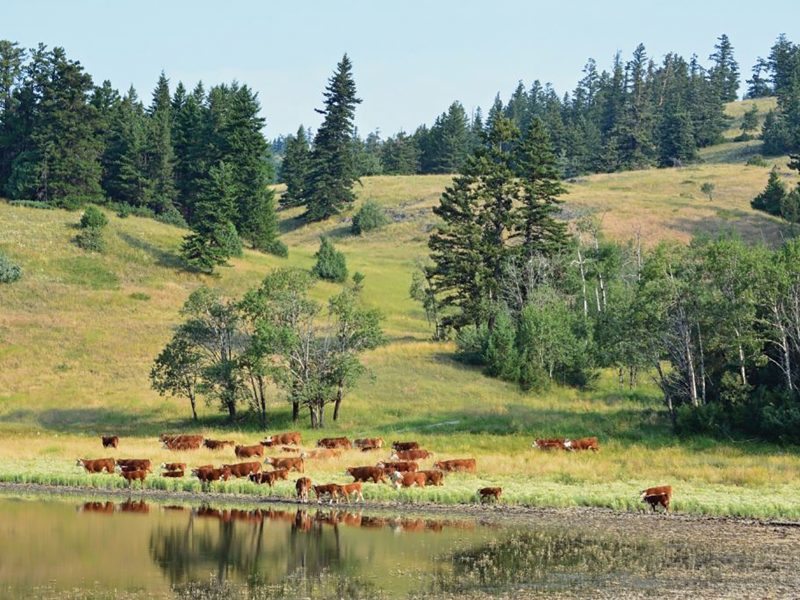
Crown land, which covers 94% of BC and includes 80% of the province’s rangeland, can be a busy intersection of criss-crossing tenures held by different interests.
On a typical stretch of Crown land in BC, there might be as many as five or six different tenures: grazing tenures for ranchers, but also tenures for guide outfitters, trappers, loggers and others.
Boon points out that, in the situation involving the HRFN, there was originally a natural barrier of trees that blocked cattle from accessing the mineral licks.
Logging in the area removed this natural barrier, and the cutting permit did not require the forest company to replace it with anything similar.
Georg Weitzel of Crystal Springs Ranch says that the current problems surrounding the licks began with the removal of the tree barrier.
“Prior to the logging, there were no issues at all,” he explains.
Boon respects the work done by the FPB but explains that their investigations are, by definition, limited in scope because they examine issues of regulatory compliance rather than the deeper contributing factors.
“They didn’t go in there and look at what are the causes necessarily; they looked at what is causing it now,” he says.
Another aspect of HRFN’s complaint relates to the impact on drinking water quality of cattle congregating in the Halfway River.
Boon points out that a good solution would be an off-stream watering system: diverting water out of the creek into a trough, which then overflows back into the river.
Previously, both forage and water were commonly understood to be included in the Animal Unit Months (AUMs) – measurements of grazing intensity calculated per animal. But because this was never explicitly spelled out, regulations issued under BC’s nine-year-old Water Sustainability Act don’t take livestock watering into account, an omission Boon maintains has complicated water diversion.
To grant a water diversion licence, the province’s Ministry of Forests now must first request permission from the Ministry of Water, Land and Resource Stewardship. This process also involves consultation with First Nations.
Weitzel explains that this process can be so difficult that many ranchers do not even attempt it.
“As far as developing off-site watering, that’s all very doable, but…the bureaucracy involved in getting permits to do that makes it almost impossible,” he says.
Weitzel explains that onerous regulations combined with lack of government support often prevent ranchers from engaging in stewardship activities.
“We’ve been here for 30 years; we want to be good stewards of the land and of the range. We do everything we can to address the issues, but right now everything is falling on the tenure holder cost-wise, labour-wise, and it just gets too much,” Weitzel says.
On April 15, the FPB reported that a separate investigation of two range agreement holders in the Ingram-Boundary range unit west of Grand Forks had concluded that the ranchers were following provincial grazing rules.
However, the FPB argued that the range use plans –documents required for ranchers who graze livestock on Crown land – were insufficiently detailed regarding invasive plants.
For Boon, the issue of invasive plants is related to another bureaucratic tangle: range use holders are not allowed to spray herbicides on Crown range, while the government is allowed to but often lacks the funding and staff to do so.
“As a tenure holder, they’re blaming our cattle for what we can’t control,” he says.
Where issues arise over the impact of range use practices on First Nations or the environment, Boon sees a common factor: a lack of provincial resources for a sector that he says is treated like “the ugly stepsister.”
“It used to be the Ministry of Forest and Range. They’ve taken ‘range’ out of it, and it’s almost like the Ministry of Forests has forgotten that range is a part of their responsibility,” says Boon.
Boon recognizes the immense value that the forestry sector brings to BC’s economy, but says the value of ranching is often overlooked.
“Very few of the Ministers of Forests over the past decades have truly understood the food production, the cattle industry and the range value on Crown land,” he says.
For Boon, this lack of attention to range is also visible in the current development of Forest Landscape Plans (FLPs), a new type of forest management plan introduced through changes to the Forest and Range Practices Act in 2021.
The provincial government promises that FLPs will provide “clear objectives and direction for the management of forest resource values at a landscape and stand level” and address “ecosystem resiliency in the face of climate change and increasing natural disturbances.”
While BC’s ranching sector is not in conflict with the forestry sector or efforts towards First Nations reconciliation, Boon says ranchers are concerned that consultations for FLPs are prioritizing these interests while ignoring other important stakeholders.
“They are sitting down at a table with First Nations and with the timber companies, and they’re planning a forest use plan, but they’re forgetting that there’s other tenures on there,” he says.
Boon explains that not fully consulting all interests could result in unforeseen difficulties down the road.
“How can you build a complete and thorough plan if you haven’t got all of the aspects of what that land supplies or is utilized for considered in the plan?” he asks.
Boon argues that recognizing the economic and food security value of range means giving BC ranchers a seat at the table in policy consultations, ensuring good forest management plans, and preventing conflicts surrounding range use practices before they begin.

 Red biosecurity remains for poultry