
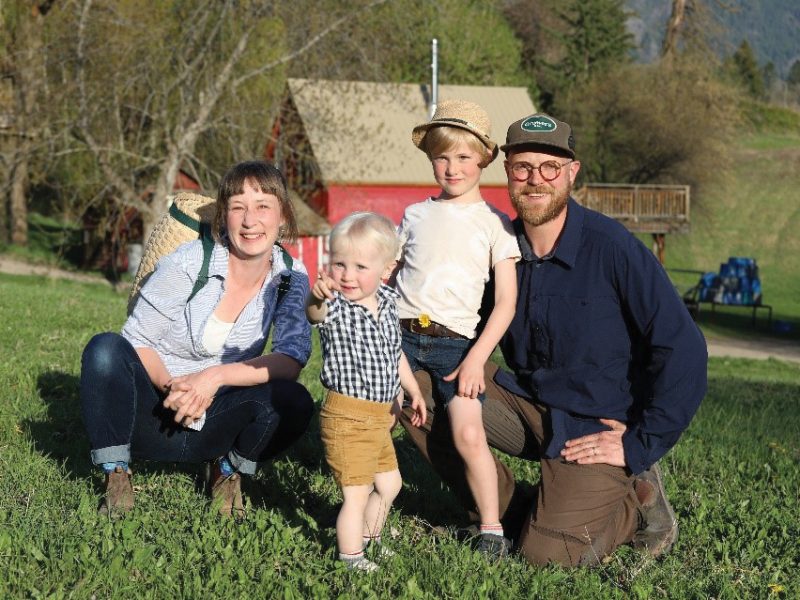
CRESTON – After eight years of careful, steady growth, Nigel and Laura Francis of Cartwheel Farm near Creston were ready to take their market garden to the next level.
Since 2022, they have invested significantly in state-of-the-art equipment and technology in their quest to operate fossil fuel-free and grow more food throughout the year.
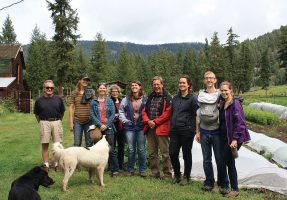
At a farm tour organized by Young Agrarians in September, the Francises described how they got into farming in the first place and the benefits they are realizing by investing in innovation.
The couple was living on Vancouver Island where Nigel was about to attend university to pursue law and Laura was building her career in community and economic development.
“The path before us just didn’t seem right,” Laura says. “We really wanted to make a difference in the world.”
While attending an online course in food sustainability through the University of California, Berkeley they realized that farming was an option that would feed their souls, their family and their community. During a vacation in the Kootenays, they fell in love with the Creston area and in 2014 purchased a two-acre property that had been farmed organically for two decades.
“Even though we didn’t have any farming background, it felt like the idea we had been waiting for,” Nigel says.
A year later, they started weekly produce deliveries to about 30 families in the Creston area. Today, Cartwheel’s CSA program helps feed 150 families a week with over 140 varieties of vegetables, herbs and fruits. It also supplies restaurants and grocery stores throughout the Creston Valley. The community connection is reinforced by a weekly blog and recipe sheet Laura prepares.
“We take the responsibility of providing quality food for our customers very seriously,” Laura says. “Creston is experiencing renewed vitality as the community becomes more concerned about food security. By supporting our business, our customers are also helping to build the area’s food culture and ecological renewal in some way.”
Solar panels
An energy assessment showed that 97% of the farm’s greenhouse gas emissions was from heating its original greenhouse with natural gas. To address this, the couple invested in a 96-panel solar array which supplies energy to two new greenhouses.
By the time the solar panels were installed in 2023, the farm was already in peak heat and other tasks took priority over starting a new garden around the panels. New beds will be created next spring with the hope that leafy greens will do well in the microclimate created by the panels’ shade.
“Since the panels came online in July, we’ve produced all our own energy plus energy stores for the future,” Nigel says. He estimates the farm has reduced its greenhouse gas emissions by half this year compared to 2023. An assessment will be done at the end of the season.
New greenhouses
In the meantime, the solar array is used to heat two new greenhouses brought in from China. The structures provide year-round crop protection from the elements and will help extend the farm’s growing season with minimal energy use.
The 39 by 114-foot greenhouses have louvres at the top that can be opened, and the sides rolled up for ventilation. Each greenhouse is equipped with a curtain; when the sun sets, motors roll them down over the whole structure, trapping the day’s heat and insulating against the cold. The curtains are expected to reduce if not eliminate the need for active supplemental heating. If heating is required, it will be provided by electric heaters, powered by the farm’s solar array.
The Francises first learned about this technology through workshops provided by the Rural Routes to Climate Solutions project. The learning events showcased year-round growing solutions being used successfully by Dong Jianyi at Freshpal Farms in Olds, Alberta.
Dong, a former geologist, was shocked to find no passive solar or insulated growing structures in Canada; they’re commonplace in parts of China. He took the leap to develop his own four-season farm and became passionate about educating Canadian growers about the value of the technology.
Dong became a friend and mentor to the Cartwheel team. He supported them in purchasing and importing the greenhouses and provided additional help during construction.
“It was quite a feat putting them up without an English parts list or manual of any kind,” Laura says. “Dong’s guidance has been invaluable.”
Cartwheel Farm is one the first farms in Canada to use this style of insulated greenhouse. The Francises hope that by showcasing this style of greenhouse they will inspire others to use the technology.
In-vessel composter
Once the solar array and high-tunnel greenhouses were installed, the couple purchased a BIOvator
in-vessel composter originally designed for the livestock processing industry. The
22-foot all-steel unit is fed about 1,000 pounds of waste each week. Stainless steel paddles mix waste material such as culled fruit or exhausted plants with wood chips – or in the case of Cartwheel Farm, spent grains from a local brewery.
“Like many other farms our size and scale, we used to have open piles of compost where the temperature was checked regularly and they were protected from the rain, a process that took months to produce usable compost. With the new composter, it’s a six-day process from start to finish. We get a large square tote of compost every week at huge cost savings,” Nigel says.
“Some of our ginger is used by the same brewery we get the grains from to produce their own products,” adds Laura. “It’s been a great relationship for our farm, the brewery and the community.”
Cartwheel’s environmental footprint is being further reduced by a new electric delivery van that replaced a well-used diesel van. One of only a few in use in BC, the new vehicle has a greater capacity, sliding doors for easy access and a lower centre of gravity. All-wheel drive and autonomous braking also help make deliveries in the mountainous Kootenays safer. When the day’s deliveries are done, it charges up overnight and is ready to go the next day.
Good investments
While the Francises invested significant funds of their own into their farm infrastructure, they also benefitted from funding opportunities through the BC On-Farm Technology Adoption Program, Columbia Basin Trust, the Investment Agriculture Foundation of BC, BC’s Beneficial Management Practices Program, and the BC Extreme Weather Program.
They have also invested in the health of their family.
“Because we’re in a small community and have close relationships with our customers, our sons Caleb and Edwin are growing up knowing the value of good food and sharing it with the community. They take produce to their doctors, teachers and friends – ensuring the people who matter to them are well fed,” says Laura.
“We don’t want to be much bigger, just more efficient while reaching our goal of being fossil free,” Nigel adds. “We’ve seen many farms start up only to fold under the pressure of attempting too much, too soon. But this has been a turnaround year for us. We’re confident we’re making good investments.”

 Staccato cherry rights defended