• Menu
  • Skip to primary navigation
  • Skip to main content
  • Skip to primary sidebar

Country Life In BC Logo

The agricultural news source in British Columbia since 1915

  • Headlines
  • Calendar
  • Subscribe
  • Advertise
  • About
  • Archives
  • Contact
  • Search
  • Headlines
  • Calendar
  • Subscribe
  • Advertise
  • About
  • Archives
  • Contact
  • Search

Primary Sidebar

Originally published:

NOVEMBER 2019
Vol. 105 Issue 11

Subscribe Now!

Sign up for free weekly FARM NEWS UPDATES

Select list(s) to subscribe to


By submitting this form, you are consenting to receive marketing emails from: Country Life in BC. You can revoke your consent to receive emails at any time by using the SafeUnsubscribe® link, found at the bottom of every email. Emails are serviced by Constant Contact
Your information will not be
shared or sold ever

Stories In This Edition

ALC gets an earful

Herding Hens

Food hub funding boost

Municipalities challenge ALC over process

No bad apples

Editorial: Taking stock

Back Forty: Remembering Aunt Dolly, and others

Viewpoint: Keeping BC farms (and farmers) growing

Farm status undermined by local bylaws

Big green gourd

Heavy rains don’t wash out potato hopes

Giant hornets headline beekeepers’ concerns

Honey producers honour industry leaders

Country Life in BC wins awards at conference

Bridging the urban-rural divide

New skills needed for technology-driven agriculture

Data drives more efficient poultry farming

Ag Briefs: New CEO appointed at BC Tree Fruits

Ag Briefs: Site launched for farmers’ institutes

Ag Briefs: Child labour feedback sought

Demand underpins cheesemaker’s expansion

Cranberry growers expect lower yields

Neighbours raise stink over cannabis farms

Sheep farmers share their experiences

Lots (and lots) of pumpkins

Federation moves forward on key initiatives

Riparian assessment requirements updated

On-farm slaughter a key skill for producers

On the move

Sidebar: Better than offal

Feedback on new watering regs a concern

Market Musings: The future in beef looks like a slam dunk

Growers all ears at silage corn field day

UBC dairy centre signs five-year lease

Falkland Dairy volume buyer at Holstein Sae

Mega-dairies are the future of US farms

Research: Bacterial leaf streak lacks chemical controls

Big beef show at BC Ag Expo

Farm News: Growing prospects brighten dark autum days

BC Young Farmers look to grow north

Horse Power

Day-long 4-H event puts emphasis on safety

Woodshed: Newt schemes to rescue Kenneth’s tractor

Good gourd! Giant vegetables weigh off

Jude’s Kitchen: Late fall harvest

More Headlines

Follow us on Facebook

Comments Box SVG iconsUsed for the like, share, comment, and reaction icons

7 days ago

... See MoreSee Less

View Comments
  • Likes: 4
  • Shares: 0
  • Comments: 0

Comment on Facebook

7 days ago

On the last day of the BC Organic Conference, Thursday, Molly Thurston of Pearl Agricultural Consulting helped growers learn how to manage bugs such as codling moth, wireworm, and rootworm in organic growing systems. Her talk alongside Renee Prasad included hands-on activities in which participants checked out various traps and examined pests under microscopes. Be sure to look for more upcoming ag events on our online calendar at www.countrylifeinbc.com/calendar/

#BCAg
... See MoreSee Less

On the last day of the BC Organic Conference, Thursday, Molly Thurston of Pearl Agricultural Consulting helped growers learn how to manage bugs such as codling moth, wireworm, and rootworm in organic growing systems. Her talk alongside Renee Prasad included hands-on activities in which participants checked out various traps and examined pests under microscopes. Be sure to look for more upcoming ag events on our online calendar at www.countrylifeinbc.com/calendar/

#BCAg
View Comments
  • Likes: 15
  • Shares: 0
  • Comments: 0

Comment on Facebook

1 week ago

Well-known organic farmer and podcaster Jordan Marr gets interviewed by Country Life in BC’s own columnist and potato mavin Anna Helmer during the opening session of the BC Organic Conference at Harrison Hot Springs yesterday. Sessions run today (Wednesday) and Thursday and include organic and regenerative growing practices and expanding and advocating for the organic sector, all under the background of the newly launched Organic BC banner.

#BCAg
... See MoreSee Less

Well-known organic farmer and podcaster Jordan Marr gets interviewed by Country Life in BC’s own columnist and potato mavin Anna Helmer during the opening session of the BC Organic Conference at Harrison Hot Springs yesterday. Sessions run today (Wednesday) and Thursday and include organic and regenerative growing practices and expanding and advocating for the organic sector, all under the background of the newly launched Organic BC banner.

#BCAg
View Comments
  • Likes: 37
  • Shares: 2
  • Comments: 1

Comment on Facebook

Interested in finding out more about this

3 weeks ago

Today, we remember those who sacrificed their lives or their well-being for our freedom. Lest we forget. ... See MoreSee Less

Today, we remember those who sacrificed their lives or their well-being for our freedom. Lest we forget.
View Comments
  • Likes: 8
  • Shares: 0
  • Comments: 0

Comment on Facebook

1 month ago

FarmFolk CItyFolk is hosting its biennial BC Seed Gathering in Harrison Hot Springs November 27 and 28. Farmers, gardeners and seed advocates are invited to learn more about seed through topics like growing perennial vegetables for seed, advances in seed breeding for crop resilience, seed production as a whole and much more. David Catzel, BC Seed Security program manager with FF/CF will talk about how the Citizen Seed Trail program is helping advance seed development in BC. Expect newcomers, experts and seed-curious individuals to talk about how seed saving is a necessity for food security. ... See MoreSee Less

Link thumbnail

BC Seed Gathering - FarmFolk CityFolk

farmfolkcityfolk.ca

Save the date for our upcoming 2023 BC Seed Gathering happening this November 3rd and 4th at the Richmond Kwantlen Polytechnic University campus.
View Comments
  • Likes: 1
  • Shares: 0
  • Comments: 0

Comment on Facebook

Subscribe | Advertise

The agricultural news source in British Columbia since 1915
  • Email
  • Facebook

ALC gets an earful

Small farmers feel frustrated

Peter Mitham photo

November 1, 2019 byAngela Abrahao, Peter Mitham, Jackie Pearase & David Schmidt

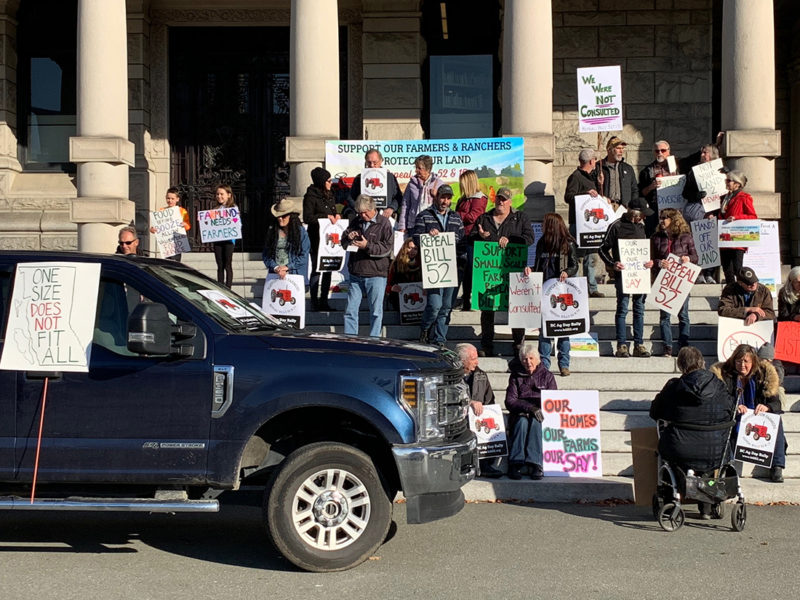
DELTA – Small-lot agriculture, secondary residences and the profound disconnect between farmers, local government and the Agricultural Land Commission are emerging as common themes at townhall sessions the province launched in September to figure out how it can support farming in the Agricultural Land Reserve.

The four-hour sessions featured presentations by ALC chair Jennifer Dyson, CEO Kim Grout and assistant deputy minister of agriculture James Mack, with time for questions and discussion. Six sessions have been held to date, including on Vancouver Island, in the Lower Mainland and Kelowna, Prince George, Dawson Creek and Castlegar.

The volume of feedback has prompted the addition of meetings in Cranbrook on November 5 and Kamloops on November 14 for farmers, landowners and other stakeholders to voice their concerns.

Small-scale producers have dominated many of the meetings.

“Most larger farms are busy harvesting corn, potatoes and other vegetables,” noted Lydia Ryall of Cropthorne Farm on Westham Island at the Delta meeting on October 1.

The other reason is that many small lots are too small to be farmed without the kind of diversification current regulations prohibit.

“My property can’t be farmed and I don’t want to be restricted,” one attendee stated, noting that there are more than 2,500 similar properties in Richmond.

However, what many at the meetings believe is necessary for farming is much different than what the ALC envisions. It’s also different than what many were allowed to do under previous governments and prior to an overhaul of regulations this past February that gave force and effect to Bill 52, which regulates housing and activities within the ALR. Additional regulations implementing Bill 15, which focuses on ALC governance and operations, are set for introduction this fall.

Those who attended the meeting in Prince George on October 3 voiced similar concerns.

Producers were visibly frustrated, expressing concerns over rising production costs and red tape that they feel leaves them without profit or a future for farming or ranching in BC.

Martin Lacasse, who works off-farm as an electrician, heard about the consultation on the radio while driving to work, and decided to attend.

“I’m not sure that any of these legislative changes are going to help a new farmer.  My brother is living on our family farm,” he says. “We’re both working in the trades. If we could work the 100 acres of field and make money off of it we would.”

Lacasse says if government wants young farmers, it needs to provide the support they need to succeed. His comments echoed those of older farmers who said programs originally intended to support farmers when the ALR was implemented have been stripped away.

“Farmers have felt for many years that the land is being protected but the farming is not,” said a Prince George landowner. “Two years ago in this area we had a commitment that those programs were going to be looked at and they have not changed at all.”

Turn the tables

Christine Watt travelled 430 kilometres from her farm in Loon Lake to voice her concern that the changes are being driven by non-farmers and stifle how farmers run their businesses.

“There is this idea that we need to make farmland cheaper, more accessible – oh, let’s get the young guys in here. I’m saying, let’s get a survey going and make businesses in Vancouver cheaper and devalue them so that our young entrepreneurs can go down there and start a business,” she says. “I don’t think it would go over very well.”

The lack of consistent answers from the ministry, the ALC and local government has undermined the confidence of many farmers, prompting some to stop planning for the future altogether.

Quesnel resident Christa Pooley and her family spent 18 months working with planners, accountants and lawyers to complete a farm succession plan. She has spent time researching the recent changes to the ALR but received different answers from the eight people she’s spoken with as she tried to figure out what documents she needed for her application to succeed. ALC land planners, agriculture ministry staff and even the agriculture minister’s office couldn’t give a single answer.

“We absolutely do not know where this legislation leaves us,” she says. “We can’t invest financial resources wisely if we have no idea if our succession plan will work within this legislation.”

A crowd of about 75 attended the meeting in Kelowna on October 10, the majority from local government and small-scale farms.

Questions and comments started early in the four-hour session, cutting short the official presentations.

“The ALC has become a police organization trying to stop the abuses. It’s not about enhancing farming,” said BC Cherry Association president Sukhpal Bal. “Start treating those bonafide farmers with some respect … and stop treating them as criminals.”

Bal urged the ALC to take a two-pronged approach that reins in non-compliance but also helps bonafide farmers get ahead.

Another cherry grower said the fact the ALC does not know the number of farms or where they are in BC is indicative of its ineffectiveness and disconnect from BC farmers.

“Until they start to care about agriculture … it’s all about preserving land, not about the farmer,” he said. “More needs to be done to encourage and enhance farming.”

A Sorrento chicken producer well acquainted with business start-ups described farming as “more challenging than any other business I’ve been in, mainly because of the bureaucracy.”

Bill 52 has created so much uncertainty that he’s been reticent to pursue a residence on his property for farm workers. Other producers have also run into hurdles, noting that some local governments are prohibiting additional housing in the ALR.

James Mack said that’s their call because municipalities have the right to determine what’s allowed under local zoning. But he said the ministry is trying to get things right, despite the criticisms.

“Point taken on our failures, where we’re at and what we’ve done,” he told the Kelowna meeting. “Our goal is the same as yours. The whole point is to make farming a great business to be in, not only for farmers but for British Columbians. They want to have a BC food supply. It’s our job to figure that out.”

The six-week consultation wraps up November 15. For more information and to register for the remaining two meetings, visit [https://engage.

gov.bc.ca/supportingfarmers].
 

Related Posts

You may be interested in these posts from the same category.

Islands Trust sidelines ag in policy statement

ALC rejects Cowichan dike removal

Council calls for review of farm classification rules

Regulatory hurdles threaten farm income solutions

Landowners push back against rail trail plans

ALC members appointed

Islands Trust turns 50

Illegal dumping surges on Fraser Valley farmland

Premier boosts fill enforcement

Kelowna fallow farmland returns

ALR policy review shows room for improvement

ALR settles Treaty 8 claims

Previous Post: « Neighbours raise stink over cannabis farms
Next Post: Sarafinchan leads BC Tree Fruit »

Copyright © 2025 Country Life in BC · All Rights Reserved