
PRINCE GEORGE – A third-party review of Agricultural Land Reserve policies by UNBC undergraduate student Matt Henderson hopes to capture the challenges North Cariboo producers face and recommend ways government can better support the industry.
And unlike many government initiatives, it is welcomed by farmers, ranchers and community partners.
“I would say that many, many agriculturalists have become exhausted with the process of ‘engagement’ because especially that 2018 ALR, ALC, ministry of ag engagement process, left a really, really, really bad taste in ranchers’ and farmers’ mouths,” says second-generation rancher and Cariboo Regional District Agriculture Development Advisory Committee chair Christa Pooley. “It really felt like inadequate consultation from the outset.”
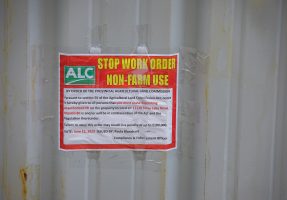
In 2018, the province introduced Bill 52, which aimed to address concerns about speculation and non-farm uses in the ALR. Home sizes were limited, soil removal was restricted and penalties for dumping were increased.
The changes met with opposition from producers, so the government held public consultations in fall 2019. Yet only five locations across the province hosted in-person meetings.
“It kind of felt like, ‘oh well, if we claw back this change and minimize that change, it will appease the people,’” Pooley says. “A lot of agriculturalists are beyond a place where they’re willing to engage with the ministry and so having this research carried out by a post-secondary institution, I see that there’s more appetite for engagement.”
As part of his student-led project, Henderson hosted a series of public facilitations throughout the summer using a dotmocracy, which allows participants to vote for ideas using stickers or markers. Five concepts that could support producers were generated in consultation with community partners. Then, people could vote as many times as they wished for the existing ideas, add and vote for their own ideas, or vote for other people’s ideas.
The dotmocracy was available in-person and online and allowed for completely anonymous participation.
Some of the original ideas included allowing flexibility for businesses to supplement farm income, such as a mechanics shop or welding on farms; complementary zoning for non-farming purposes that would benefit operations, such as farm equipment repair shops or abattoirs; returning to a two-zone system; legacy protection for generational farmers; and flexible policies with more supports provided through the application process with the Agricultural Land Commission.
Henderson’s preliminary results show that people from Williams Lake to Prince George want to see change and more localized context throughout policy development.
“When we have so many different voices from different sectors, regions, backgrounds all agreeing that something needs to be done … and we need to have more voices heard at the table, it’s pretty telling,” Henderson says. “Because policies here at home in BC are stifling the industry and the small and medium-sized farmers. … I just find it a little ironic where the powers that be are striving for and saying that we need to establish food security, eat local and such, but the policies that are in place are hindering the ability for anyone new coming into the farming industry and those that are already in the industry.”
Since the ALC was struck in 1973, many policies have stood the test of time, when instead policies should evolve with changing demographics, economic output and climate, Henderson says.
“If we’re serious about food security and providing … locally sourced foods to all British Columbians, we need to have policies that are actually in line with what needs to be done and we need to do it in a way that’s a lot more inclusive than what’s happening currently,” Henderson says. “Instead of an almost tone-deaf approach … in terms of what are believed to be the realities from the folks making these decisions in Victoria and Burnaby versus the realities that are happening in communities like Baker Creek or Horsefly. Places that have far different ecosystems, climates, scales, soils than places in the Fraser Valley and Okanagan.”
Indeed, the ALC recognizes the importance of protecting agricultural land from development but perhaps not how tight producers’ margins are and the need for flexibility around revenue streams.
“Yes, we need farmland, but we also need viable agricultural businesses,” Pooley says. “We need to find healthy ways to supplement farmers’ [incomes]. So, I’m not saying, you know, that every Joe Blow have 20 pieces of logging equipment and dump their waste oil on their best fields. But I think that there can be a happy balance.”
For example, licensed abattoirs, which benefit the farming community and could provide supplemental income, require the site to be zoned for use as an establishment and all resulting operational activities must be in compliance with the ALC Act. In the Cariboo especially, Pooley says, diversified income strategies such as hauling hay, fixing equipment, agritourism or logging are essential but considered as non-farm uses and restricted on agricultural land.
Most average-sized farms can’t operate without additional revenue streams, Pooley says.
“It feels like the government isn’t acknowledging how slim our profit margins are, and that if we don’t have supplemental income, we don’t have farms,” Pooley says.
This fall, Henderson will complete an independent study course in which he will identify the public’s top responses and present them to the ALC.
Pooley hopes that since this work was conducted and presented by a post-secondary institute instead of agricultural commodity groups, for example, the ALC will receive the information differently.
In addition, Henderson will draw up recommendations on how the BC Ministry of Agriculture and Food and the ALC can restructure operations to facilitate more transparency and effective community engagement.
“There are many great works done that recommend policy changes … but those that need to hear it, i.e. the Ministry of Agriculture and the ALC, are not designed or not inclined to respond to them in a way that will actually be impactful or seen as impactful to the agricultural community,” Henderson says.
One such recommendation is having a tiered system that gives more control to local governments in the decision-making process.
“If you’re wanting to make an improvement on your land and it’s well within your land and you’re not impacting anyone around you, then you can just go and do it,” Henderson says. “If you’re providing a third dwelling for your multi-generational outfit and you need to house grandchildren there as well, you can go to your local regional district for that.”
Overall, Henderson would like to see more input on farm policies from outside government walls.
“For problem-solving, we leave it to a select few to make the decisions for all. We need to have a more collaborative approach … and provide insight of what’s happening in our area,” he says. “This isn’t an unorthodox idea. It’s grounded and makes sense. It levels the playing field that allows for new, innovative ideas of how we get through crises like drought, wildfires, atmospheric rivers.”
 Country Life in BC tops awards