• Menu
  • Skip to primary navigation
  • Skip to main content
  • Skip to primary sidebar

Country Life In BC Logo

The agricultural news source in British Columbia since 1915

  • Headlines
  • Calendar
  • Subscribe
  • Advertise
  • About
  • Archives
  • Contact
  • Search
  • Headlines
  • Calendar
  • Subscribe
  • Advertise
  • About
  • Archives
  • Contact
  • Search

Primary Sidebar

Originally published:

January 2019
Vol. 105 Issue 1

Subscribe Now!

Sign up for free weekly FARM NEWS UPDATES

Select list(s) to subscribe to


By submitting this form, you are consenting to receive marketing emails from: Country Life in BC. You can revoke your consent to receive emails at any time by using the SafeUnsubscribe® link, found at the bottom of every email. Emails are serviced by Constant Contact
Your information will not be
shared or sold ever

Stories In This Edition

Victoria tweaks ALR rules

Ranch must allow anglers

Grappling with challenges

Editorial: Learning from leopards

Back forty: Livestock protection is a grey matter

Viewpoint: One zone shows foresight as BC ag evolves

Popham pursues ambitious agenda as 2019 arrives

Milk stocks rebuild but skimmed milk an issue

Holstein spring show grows, moves to Chilliwack

Dairy producers withhold national levies

Wave of retirements sweeps through dairy associations

Fund aims to give BC fruit growers a competitive edge

Ag Brief: New chair for Farm Industry Review Board

Ag Brief: BC Tree Fruits shake-up

Ag Brief: Thompson retires from dairy centre

New trap set to reduce Okanagan starling flocks

Consumer prices could buoy farm cash receipts

BC potatoes yield increase in 2018

‘Green rush’ overwhelms OK planning staff

Show, gala showcases BC agriculture

Hort show covers buds to spuds

Sidebar: Budding interest

Spotlight on dairy, innovation

Popular dairy tour showcases diversity

Overseas markets demand top quality

Sidebar: Gerbrandt coordinates berry research

Local seed initiative shifts focus to economics

Big dreams for small pepper growers

Cattle feeders bullish on packing plant

Research: Increasing green fodder could decrease allergies

Beekeepers learn to defend against wildlife

Online platform connects producers, consumers

Public trust programming to expand in 2019

Farmers institutes meet to forge connections

The rock road of water buffalo in BC

Wannabe: Pulling together

Woodshed: Deborah finds it’s better to give than receive

Jude’s Kitchen: Start healthy

More Headlines

Follow us on Facebook

Comments Box SVG iconsUsed for the like, share, comment, and reaction icons

7 days ago

... See MoreSee Less

View Comments
  • Likes: 4
  • Shares: 0
  • Comments: 0

Comment on Facebook

7 days ago

On the last day of the BC Organic Conference, Thursday, Molly Thurston of Pearl Agricultural Consulting helped growers learn how to manage bugs such as codling moth, wireworm, and rootworm in organic growing systems. Her talk alongside Renee Prasad included hands-on activities in which participants checked out various traps and examined pests under microscopes. Be sure to look for more upcoming ag events on our online calendar at www.countrylifeinbc.com/calendar/

#BCAg
... See MoreSee Less

On the last day of the BC Organic Conference, Thursday, Molly Thurston of Pearl Agricultural Consulting helped growers learn how to manage bugs such as codling moth, wireworm, and rootworm in organic growing systems. Her talk alongside Renee Prasad included hands-on activities in which participants checked out various traps and examined pests under microscopes. Be sure to look for more upcoming ag events on our online calendar at www.countrylifeinbc.com/calendar/

#BCAg
View Comments
  • Likes: 15
  • Shares: 0
  • Comments: 0

Comment on Facebook

1 week ago

Well-known organic farmer and podcaster Jordan Marr gets interviewed by Country Life in BC’s own columnist and potato mavin Anna Helmer during the opening session of the BC Organic Conference at Harrison Hot Springs yesterday. Sessions run today (Wednesday) and Thursday and include organic and regenerative growing practices and expanding and advocating for the organic sector, all under the background of the newly launched Organic BC banner.

#BCAg
... See MoreSee Less

Well-known organic farmer and podcaster Jordan Marr gets interviewed by Country Life in BC’s own columnist and potato mavin Anna Helmer during the opening session of the BC Organic Conference at Harrison Hot Springs yesterday. Sessions run today (Wednesday) and Thursday and include organic and regenerative growing practices and expanding and advocating for the organic sector, all under the background of the newly launched Organic BC banner.

#BCAg
View Comments
  • Likes: 37
  • Shares: 2
  • Comments: 1

Comment on Facebook

Interested in finding out more about this

3 weeks ago

Today, we remember those who sacrificed their lives or their well-being for our freedom. Lest we forget. ... See MoreSee Less

Today, we remember those who sacrificed their lives or their well-being for our freedom. Lest we forget.
View Comments
  • Likes: 8
  • Shares: 0
  • Comments: 0

Comment on Facebook

1 month ago

FarmFolk CItyFolk is hosting its biennial BC Seed Gathering in Harrison Hot Springs November 27 and 28. Farmers, gardeners and seed advocates are invited to learn more about seed through topics like growing perennial vegetables for seed, advances in seed breeding for crop resilience, seed production as a whole and much more. David Catzel, BC Seed Security program manager with FF/CF will talk about how the Citizen Seed Trail program is helping advance seed development in BC. Expect newcomers, experts and seed-curious individuals to talk about how seed saving is a necessity for food security. ... See MoreSee Less

Link thumbnail

BC Seed Gathering - FarmFolk CityFolk

farmfolkcityfolk.ca

Save the date for our upcoming 2023 BC Seed Gathering happening this November 3rd and 4th at the Richmond Kwantlen Polytechnic University campus.
View Comments
  • Likes: 1
  • Shares: 0
  • Comments: 0

Comment on Facebook

Subscribe | Advertise

The agricultural news source in British Columbia since 1915
  • Email
  • Facebook

Cattle feeders bullish on packing plant

Proposal to grow the local industry will keep cash in BC

December 31, 2018 byTom Walker

WESTWOLD – Townhall meetings as the new year gets underway will determine whether or not a beef packing plant proposed for Prince George will go ahead. If it does, it will mean changes in how the BC industry finishes cattle.

Someone intimately familiar with what that could mean is BC Association of Cattle Feeders executive director Andrea van Iterson, whose family has run Westwold View Farms near Kamloops since relocating  from Kelowna in 1993.

“I have this deep love for the place and the cattle industry,” she says. “I worked off farm for about eight years, but I’ve been back full-time for four years now.”

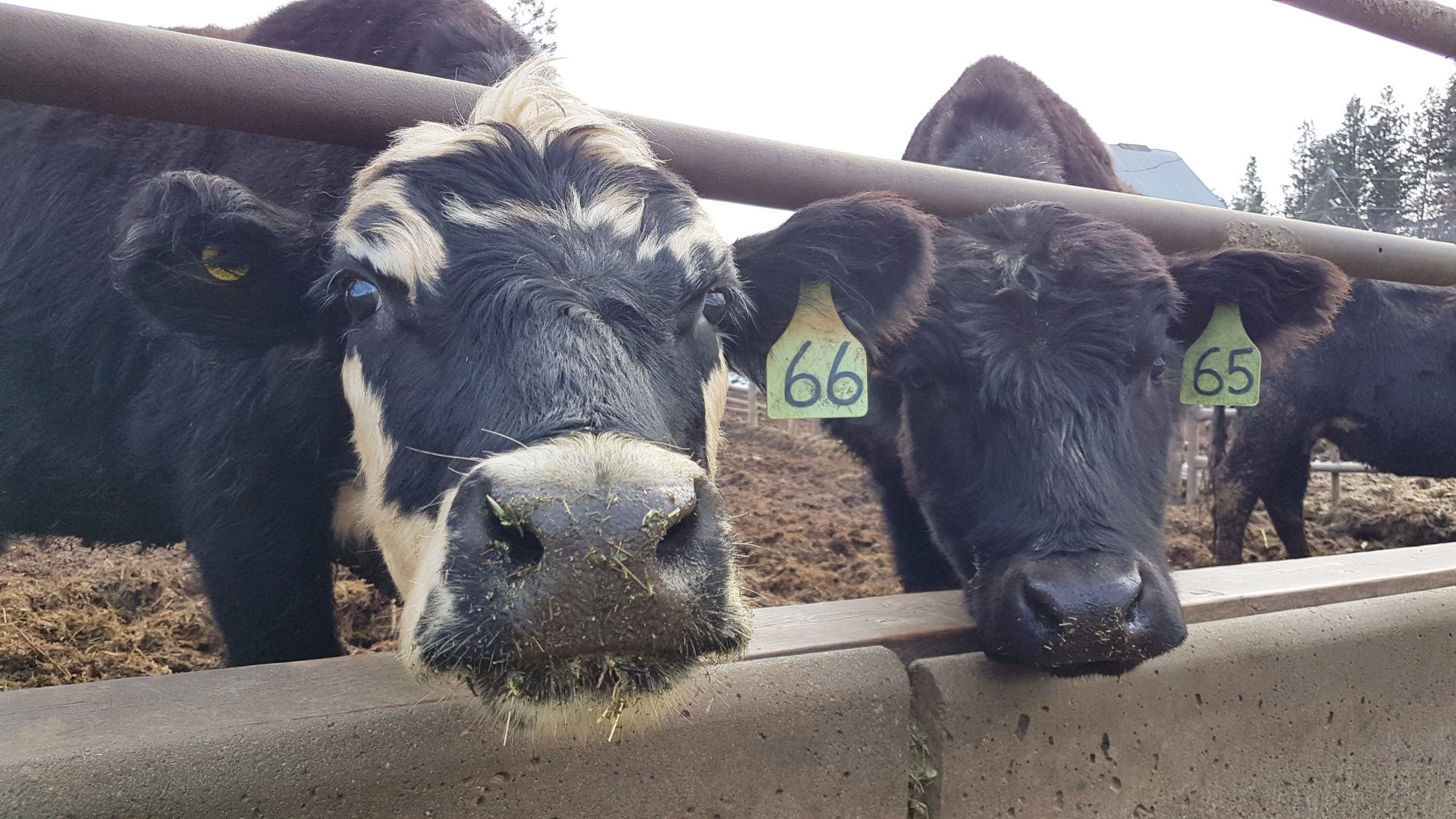
The farm includes a dairy as well as a backgrounding operation that feeds 2,500 animals each winter.

“We purchase calves in the fall, mostly through the BC Livestock Producers Co-op auctions in Kamloops, though we do get some from Alberta and some direct from ranchers here in BC,” she says.

They look for smaller calves between 350 and 500 pounds, both steers and heifers, and aim to double their weight. The steers are typically 875 to 900 pounds when they leave, while the heifers reach around 850.

The largest ones will begin to leave as soon as February and the last ones are out the door by May.

“Typically, our animals are under contract and go south to a finishing feedlot in the US,” she says. “But that depends on our cow plan each fall.”

The finishing feedlot doubles their weight again over the next six months, up to a slaughter size of 1,500 to 1,600 pounds.

While the pens will be empty by spring, the work doesn’t stop. Some grass-fed cattle spend the summer, but the operation hinges on growing its own forage.

Year-round work

“We bale alfalfa and we grow corn that we put up for silage and have some extra dairy hay that we are able to sell,” says van Iterson.

Cow manure and composted chicken manure nourishes the forage crops and is their only source of fertilizer. All the feedlot waste (sawdust and manure) is carefully composted and sold to commercial clients including landscapers, school districts and the city of Kamloops.

Costs are managed with the same eye to efficiency.

“There is no ‘let’s guess this,’” says van Iterson. “We try to buy our extra inputs like barley in the summer months when it’s a little bit cheaper and we will try to contract some so we have a pretty good idea going into the fall what our costs will be through the winter.”

Three unknowns are exchange rate fluctuations, how weather will affect the crops and price of extra feed ingredients, and, of course, calf prices.

“Some years, the calf prices are high and the cow-calf guy has a wonderful year and we are paying more for their calf,” says van Iterson. “And maybe the calf isn’t worth more out the other end, or maybe it is worth more, but we don’t take the opportunity when we should and prices drop through the winter.”

She says contracting is a way to hedge against price swings.

“We contract most of what we do, so that is our way of managing the risk,” she explains. “There is Western Livestock Price Insurance we can buy. It’s a government-run program, kind of like the crop insurance program but different.”

With respect to the proposed packing plant, she doesn’t think cattle feeders need convincing.

Excitement

“There is excitement in the feeding industry around the proposed BC packing plant,” she says. “If there is somewhere to kill cattle, we can get a supply of them.”

Westwold View has looked into feeding year-round but hasn’t done it, even though it could make economic sense.

“Any pounds that we put on the cattle we are getting paid for, so the longer we retain them that, is going to benefit us,” she says. “If we had a market in BC, we would never turn that away.”

A local packing plant would also remove middlemen from the market.

Right now, there’s a broker for every transaction. A producer sells calves at the auction mart, which takes a commission. Backgrounders feed them and when the animals go for finishing, they are going to go through a broker again as another trade occurs.

“There wouldn’t be the in-between backgrounder like us if there wasn’t money in it,” says van Iterson.

The new plant could create finishing opportunities in BC, helping keep more money at home. But producers need to see a clear benefit versus selling at auction.

“There is likely going to need to be some retained ownership through the feeding process so that they get their premium when the animal goes into the BC plant,”  says van Iterson.

On the whole, however, she thinks change will come.

“It is very welcome to the feeding industry,” she says. “Build it and they will come.”
Related Posts

You may be interested in these posts from the same category.

Rethinking the concept for mobile abattoirs

Island farmers renew request for local abattoir

Abattoirs required to cut back overtime

Meat inspection budget tightens

Province extends deadline for meat consultation

Ranchers to build beef brand

Ranchers set to meet

Prince George packing plant gets further study

Previous Post: « Online platform connects producers, consumers

Next Post: ‘Green rush’ overwhelms OK planning staff »

Copyright © 2025 Country Life in BC · All Rights Reserved