• Menu
  • Skip to primary navigation
  • Skip to main content
  • Skip to primary sidebar

Country Life In BC Logo

The agricultural news source in British Columbia since 1915

  • Headlines
  • Calendar
  • Subscribe
  • Advertise
  • About
  • Archives
  • Contact
  • Search
  • Headlines
  • Calendar
  • Subscribe
  • Advertise
  • About
  • Archives
  • Contact
  • Search

Primary Sidebar

Originally published:

JANUARY 2021
Vol. 107 Issue 1

Subscribe Now!

Sign up for free weekly FARM NEWS UPDATES

Select list(s) to subscribe to


By submitting this form, you are consenting to receive marketing emails from: Country Life in BC. You can revoke your consent to receive emails at any time by using the SafeUnsubscribe® link, found at the bottom of every email. Emails are serviced by Constant Contact
Your information will not be
shared or sold ever

Stories In This Edition

Full moon rising

New year, new era

Insurance premiums soar

Popham looks forward to a new term

Editorial: New openings

Back 40: New farmers are a crop worth growing

Viewpoint: Let’s get real about mental wellness on the farm

Trade issues, pandemic dog dairy producers

Dairy associations pull through challenging year

Second wave of pandemic hits close to home

Grain producers mark one of their worst harvests

Grower takes issue with groundwater limits

Grape phylloxera found on Vancouver Island

Pioneering entomologist remembered

Leasing farmland a vital strategy for farmers

Raspberry growers tackle new pest challenge

Province comes through with replant money

Pacific Ag Show embraces the digital realm

Berries, berries and more berries

Sidebar: Short course continues to educate growers

Green shoots on the vegetable front

Gala closes out opening day

Ag innovation day

The show must go on

CannaTech West returns

Optimism follows on the heels of 2020’s challenges

Rotational grazing improves soil health

Taking the guesswork out of herd management

Research: Highly sensitive pigs help solve soybean allergies

Bill Awmack honoured with leadership award

Farmers put electric tractors to the test

Kootenay farm advisors resume field days

Kelowna school embraces new container farm

Farm Story: Winter is a good time to problem-solve

Farm women encouraged to take a stand

Woodshed: Breaking the good (and not so good) news

Uncertainty prevails for BC fairs in new year

Jude’s Kitchen: Leftovers re-imagined make tasty meals

More Headlines

Follow us on Facebook

Comments Box SVG iconsUsed for the like, share, comment, and reaction icons

6 days ago

... See MoreSee Less

View Comments
  • Likes: 4
  • Shares: 0
  • Comments: 0

Comment on Facebook

6 days ago

On the last day of the BC Organic Conference, Thursday, Molly Thurston of Pearl Agricultural Consulting helped growers learn how to manage bugs such as codling moth, wireworm, and rootworm in organic growing systems. Her talk alongside Renee Prasad included hands-on activities in which participants checked out various traps and examined pests under microscopes. Be sure to look for more upcoming ag events on our online calendar at www.countrylifeinbc.com/calendar/

#BCAg
... See MoreSee Less

On the last day of the BC Organic Conference, Thursday, Molly Thurston of Pearl Agricultural Consulting helped growers learn how to manage bugs such as codling moth, wireworm, and rootworm in organic growing systems. Her talk alongside Renee Prasad included hands-on activities in which participants checked out various traps and examined pests under microscopes. Be sure to look for more upcoming ag events on our online calendar at www.countrylifeinbc.com/calendar/

#BCAg
View Comments
  • Likes: 15
  • Shares: 0
  • Comments: 0

Comment on Facebook

1 week ago

Well-known organic farmer and podcaster Jordan Marr gets interviewed by Country Life in BC’s own columnist and potato mavin Anna Helmer during the opening session of the BC Organic Conference at Harrison Hot Springs yesterday. Sessions run today (Wednesday) and Thursday and include organic and regenerative growing practices and expanding and advocating for the organic sector, all under the background of the newly launched Organic BC banner.

#BCAg
... See MoreSee Less

Well-known organic farmer and podcaster Jordan Marr gets interviewed by Country Life in BC’s own columnist and potato mavin Anna Helmer during the opening session of the BC Organic Conference at Harrison Hot Springs yesterday. Sessions run today (Wednesday) and Thursday and include organic and regenerative growing practices and expanding and advocating for the organic sector, all under the background of the newly launched Organic BC banner.

#BCAg
View Comments
  • Likes: 37
  • Shares: 2
  • Comments: 1

Comment on Facebook

Interested in finding out more about this

3 weeks ago

Today, we remember those who sacrificed their lives or their well-being for our freedom. Lest we forget. ... See MoreSee Less

Today, we remember those who sacrificed their lives or their well-being for our freedom. Lest we forget.
View Comments
  • Likes: 8
  • Shares: 0
  • Comments: 0

Comment on Facebook

1 month ago

FarmFolk CItyFolk is hosting its biennial BC Seed Gathering in Harrison Hot Springs November 27 and 28. Farmers, gardeners and seed advocates are invited to learn more about seed through topics like growing perennial vegetables for seed, advances in seed breeding for crop resilience, seed production as a whole and much more. David Catzel, BC Seed Security program manager with FF/CF will talk about how the Citizen Seed Trail program is helping advance seed development in BC. Expect newcomers, experts and seed-curious individuals to talk about how seed saving is a necessity for food security. ... See MoreSee Less

Link thumbnail

BC Seed Gathering - FarmFolk CityFolk

farmfolkcityfolk.ca

Save the date for our upcoming 2023 BC Seed Gathering happening this November 3rd and 4th at the Richmond Kwantlen Polytechnic University campus.
View Comments
  • Likes: 1
  • Shares: 0
  • Comments: 0

Comment on Facebook

Subscribe | Advertise

The agricultural news source in British Columbia since 1915
  • Email
  • Facebook

Grower takes issue with groundwater limits

Intended use governs water licences

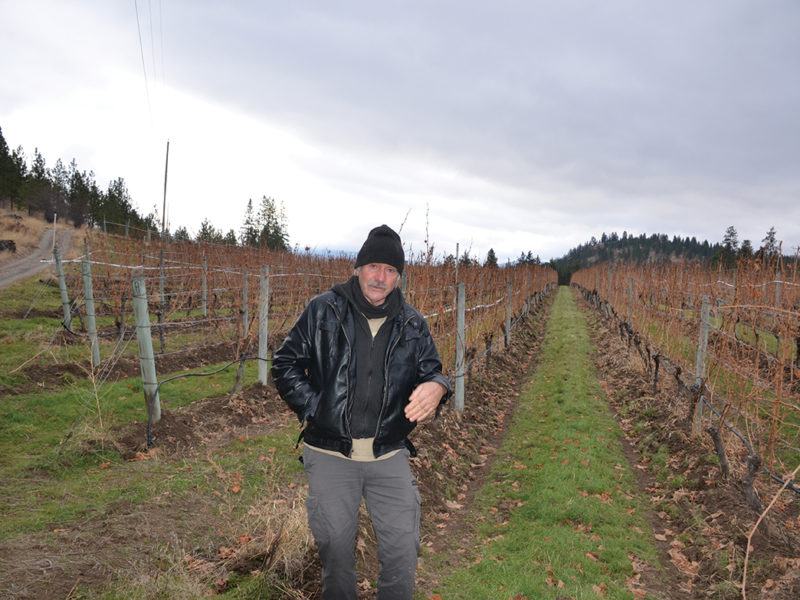
Oliver grape grower Hans Buchler says the province's decision to license groundwater use to crop unfairly limits his management and diversification options. photo / tom walker

January 1, 2021 byTom Walker

OLIVER – When Hans Buchler and his wife bought the land for their 18 acres of vineyard almost 40 years ago, one of the attractions was the water.

“There is a good well on the property, which was important,” he says. “When I talked to the district of Oliver, they told me it would be difficult and expensive to pump water up here, and there still isn’t a purveyor connection up to this bench.”

The bench sits north of Oliver in the shadow of McIntyre Bluff. The sandy soil supports grape vines for Covert Farms, Andrew Peller Ltd. and Okanagan Crush Pad. Buchler’s own vines are nestled in small pockets among rocky cliffs. When you notice the dry grasses and the antelope and rabbit brush popping up between the rocks, it is hard to imagine cultivating any crop without water. Indeed, the surface water rights on the property extend back to 1898.

But in order to tap groundwater under the new licensing regime the province introduced in 2016, Buchler has to specify the crop he intends to irrigate. He feels that backs him into a corner.

“When I began discussing my application with FrontCounter, I was told that my licence has to be tied to the crop that I currently grow, my grapes,” he says.

He feels this ignores the historic uses of the property, which in the past has supported livestock, forage and vegetable production. By licensing to crop, as the practice is known, he says FrontCounterBC is unfairly constraining him.

“Wine is a luxury item,” he says. “With the realities of climate change and food security, we may need this land for growing vegetables. I’ve had livestock here in the past and have even grown forage.”

Jeff Nitychoruk, senior water stewardship officer for Okanagan-Shuswap with the BC Ministry of Forests, Lands, Natural Resource Operations and Rural Development, says groundwater allocations are tied to crop under section 30 of the Water Sustainability Act.

“If we were to issue a license that was designed for maximum allocation for forage, regardless of what was being grown, we would be setting people up for non-compliance of section 30,” he says.

Buchler filed his licence application three and a half years ago, in June 2017. The water use calculator the province provides applicants directed him to seek a licence for an annual allocation of 42,400 cubic metres for each of his two parcels. But that’s less than half the allocation he would need if he was growing apples.

FrontCounterBC says applicants can simply apply for a new groundwater licence if they change crops, but Buchler says it’s an expensive undertaking. Given the province’s duty to consult other stakeholders, he worries there wouldn’t be enough water to spare if he went back and asked for more.

“The amount of proof you would have to provide through environmental assessments and aquifer assessments would make it pretty much impossible for most farmers,” he says. “You are talking tens if not hundreds of thousands of dollars to have that type of assessment performed.”

Buchler believes that his surface water source, Park Rill Creek, is already over-allocated.

“I expect that I would be told that there was no more water volume available,” he says. “In very dry summers in the past, we have nearly run out of water.”

He also worries that a new license would jeopardize his first-in-time/first-in-right status.

Changing viticultural practices may also affect water demand. The growing adoption of organic practices in the Okanagan and Similkameen could see greater extractions to enhance cover crops and control emerging challenges such as red blotch virus.“There are several studies that are showing that doubling the amount of water for diseased vines helps control the virus for a time,” says Buchler.

Watering is cheaper than pulling up and replanting an entire vineyard with virus-free stock and waiting the three years before the vines are in full production. But the new groundwater regime isn’t flexible enough to accommodate such shifts, he contends.

“The people at FLNRORD who are administering the water licensing program seem to be completely out of touch with the needs of the farming community,” he says. “They have told us that our traditional water rights can be grandfathered in, which in my mind means that I would get to keep the volume of water that I now have.”

But that was never the intention of the legislation says Mike Wei, a consultant who was the province’s technical expert during development of the Water Sustainability Act and the Groundwater Protection Regulation.

“Grandfathering” is not a term found in the legislation, and staff are discouraged from using the word in explaining the licensing process to applicants, he says.

Buchler could appeal, but there is a catch.

“They have told me that I can appeal the allotment in my license, but of course I have to get the license first.”

With files from Peter Mitham
Related Posts

You may be interested in these posts from the same category.

Southern Interior irrigators shut down

Island farmers fish for water solutions

Groundwater enforcement picks up

Water licence fight highlights need for change

Westwold producers challenge curtailment

Watershed strategy could hang ag out to dry

No licence, no problem

Watershed security report

Grape growers assess damage

Groundwater users could lose rights next year

Feeling the heat on water

Water licensing process needs streamlining

Previous Post: « Leasing farmland a vital strategy for farmers
Next Post: Let’s get real about mental wellness on the farm »

Copyright © 2025 Country Life in BC · All Rights Reserved