
CRANBROOK – The province seems to be acting first and asking forgiveness later when making changes to the Agricultural Land Reserve, and that’s not working for ranchers in the East Kootenays and Kamloops region.
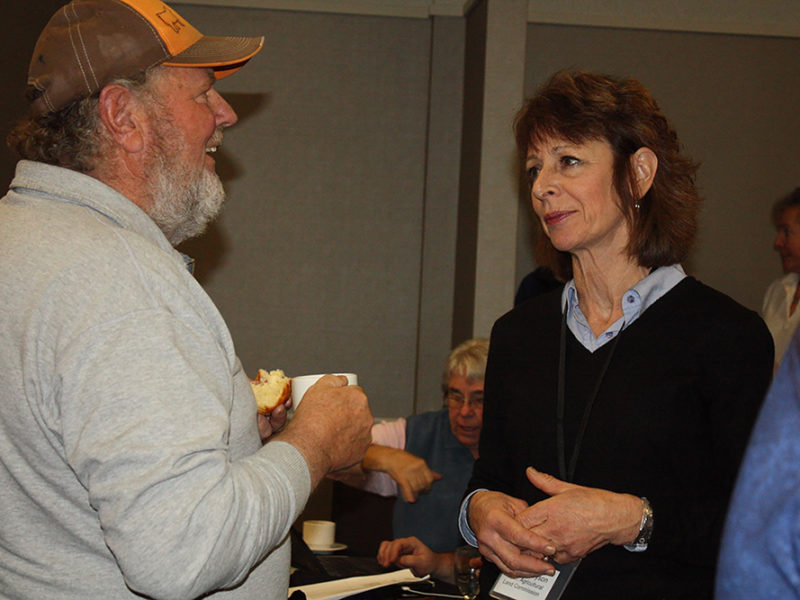
Close to 60 farmers and landowners met in Cranbrook on November 5 for the seventh in a series of eight public meetings the BC Ministry of Agriculture hosted this fall to hear how it could better support farming in the ALR.
Agricultural Land Commission chair Jennifer Dyson, CEO Kim Grout and assistant deputy agriculture minister James Mack received yet another earful from growers.
“The idea of two zones came from the Kootenays and the north,” said Randy Reay, a Jaffray rancher and land use chair for the Kootenay Livestock Association. “Nobody came to ask us if we would support a change. There was not even one of these engagement meetings scheduled for the Kootenay region.”
The meetings were originally scheduled to end in Castlegar on October 30, but the ministry added dates in Cranbrook and Kamloops in response to public demand.
While the meetings were framed as information sessions, Reay, like many presenters throughout the consultation, was intent on being heard.
“We are not allowed to make a presentation at this meeting; we are being told we are here to listen,” Reay adds. “Well, we’re here to tell you we are not.”
Speakers voiced concerns that changes to regulations governing the ALR are not supporting Kootenay farmers. Bill 52’s elimination of two zones, introduced by the BC Liberals in 2014 to give growers in marginal areas greater flexibility, was criticized.
“A single zone is wrong for this area,” said Faye Street, who spent 30 years ranching near Jaffray.
“We don’t have the climate or the soil or the access to markets that farmers in the Lower Mainland and the Okanagan do.”
She says the ability to earn a second income on the farm by welding or parking logging trucks keeps local farms viable.
Second homes, particularly where farm succession is concerned, was a big issue.
“Is the family farm a bad word?” asked Reay. “I don’t want to move into a trailer, and I don’t want to move off the farm. I still have some years of experience to lend to my children.”
A mobile home doesn’t add value to a farm, Wycliffe rancher Anke Brander said. It’s a depreciating asset even if the owner spends $25,000 for a well and $25,000 for a septic field. It’s more difficult to insure, and will ultimately need to be replaced.
“And they look like shit,” she added.
This creates uncertainty.
“Lenders are hesitant and insurance companies don’t want to cover a temporary structure,” says rancher Donna Morrison.
Regional District of East Kootenay director Stan Doehle pointed out that the ALC refused 72% of secondary residence applications over the last two years even though the regional district endorsed all of them.
One speaker scoffed at the idea that any farmer would build in the middle of a productive field; that was something “only a city guy” would do.
But then a city guy spoke up, saying he was having trouble building housing for his ranch even though the province has said housing for farm help is welcome.
“[I] am looking to expand into ranching,” said Darin MacDonald, who is in the process of relocating from Calgary to Elkford. “I have hired a qualified ranch manager to help me build a herd, but my application for on-ranch housing was turned down.”
He said his only recourse is to request “reconsideration” from the same panel that rejected his application on the basis of “new evidence” – something he doesn’t have.
“I submitted a very fulsome application with a business plan that has the full support of the regional district and the mayor. The panel did not even visit my property,” he said. “I want to hear that the government cares about us and is really supporting farming,” he says. “Are we a forgotten area? Do we fall through the cracks?”
Too little, too late
The same question surfaced in Kamloops, where more than 100 people gathered for the final public engagement session on November 14.
Producers support the Agricultural Land Commission and appreciate the opportunity to provide input on the legislative and regulatory changes but said the current meetings are too little, too late.
BC Cattlemen’s Association general manager Kevin Boon said his organization has the ear of the ALC but regular farmers aren’t given a sense of the impacts of the conversations taking place in government. This results in a sense of being ignored.
“And, the next time we have a change in government there will be another request to change the ALC,” he added. “Governments like to make their mark to say they’re doing something in agriculture.”
Kamloops rancher Lucille Dempsey told the panel that all levels of government need to be listening and be part of the solutions that support agriculture.
“Agricultural advisory committees should be a mandatory part of all local governments,” she said. “If you want to protect farmland and support farmers, local government needs to be on side at all times.”
Housing, soil health, support for organic farmers, improved weed control and mapping, and the desire for fewer regulations and more incentives for agriculture were other issues raised at the meeting.
“If we can make farming profitable, the land and water will take care of itself,” Boon said, to the crowd’s applause. “We have to get it back to where we can get more for our product than it costs to produce it.”
Worthwhile
Mack says the town hall meetings were worthwhile and productive.
“I think it was definitely high-value to do it. It was amazing to see the similarities and differences across BC,” he told Country Life in BC after the meeting.
However, he says the province needs to do more to communicate with farmers and landowners.
“We need a more disciplined, organized way to communicate. … We recognize we need to do a better job,” he said. “It’s definitely something that’s a priority for us going forward.”
Dyson says communication can be difficult across commodity sectors, and reaching small-lot farmers not connected to any particular commodity is especially difficult.
The use of social media as an information source, particularly among new and young farmers, has also led to a glut of misinformation about recent changes to the ALR.
“They’re getting their information from social media and that’s an absolute disaster because it’s created a tremendous amount of concern and fear,” she said.
While anger, fear and frustration have been common themes throughout the town hall meetings, Dyson lauds the opportunity for relationship-building the consultation process provided.
“We have a ministry right now that is so receptive to finding an approach and they’re listening,” she said. “We are all going to come to pieces of an answer that can craft solutions better and together. That’s what this is about.”
The online consultation process closed November 15 but stakeholder meetings with academia, the BC Agriculture Council, Union of BC Municipalities and farmers’ institutes continued throughout November. Mack expects feedback to continue rolling in through December.
A summary of the consultation process will be released in the new year and a discussion with the agriculture minister to develop a staged action plan will follow soon after.
“The direction is to move quickly on this,” said Mack. “People put a lot of time into the process and so we want to prove to them it’s authentic and it’s going to result in changes.”
Changes are just what Faye Street asked the panel to deliver at the Cranbrook meeting.
“My kids are good ranchers but they look at what my husband and I are going through and they say that there is not a chance in hell that they will take over the farm,” she said. “You have an opportunity to change that.”
 BC agritech attracting major partners