• Menu
  • Skip to primary navigation
  • Skip to main content
  • Skip to primary sidebar

Country Life In BC Logo

The agricultural news source in British Columbia since 1915

  • Headlines
  • Calendar
  • Subscribe
  • Advertise
  • About
  • Archives
  • Contact
  • Search
  • Headlines
  • Calendar
  • Subscribe
  • Advertise
  • About
  • Archives
  • Contact
  • Search

Primary Sidebar

Originally published:

August 2018
Vol. 104 Issue 8

Subscribe Now!

Sign up for free weekly FARM NEWS UPDATES

Loading form…

Your information will not be
shared or sold ever

Stories In This Edition

Shaved, showered and shampooed

New regs rolled out for pot growers

Egg farm decommissioned

Richmond cranberry grower honoured

Editorial: Ground for reform

Back Forty: Facing a tenuous future of feeding the world

OpEd: Wildlife federation’s audit request full of holes

Armyworm posing little risk this season

Letters: Dairy feeling price pressures

Abbotsford waits for clarity on ALR guidelines

Chicken quote to increase 20% by 2020

Dairy incentive days this fall

Aquilini seeks exclusion for former nursery

Business risks looms large at national meeting

Maple Ridge denies exclusion bid for dairy

Fire damage won’t delay blueberry shipments

Good weather marks return to normal conditions

Cherries set for near-record crop this season

Laser system has potential for bird control in crops

Hazelnut growers get replant funding

Gulf Islands farmers want rules respected

Young Agrarians push small-scale premium

Value pinned on local ecosystem services

Cash crunch threatens BC berry growers

Hop sector brewing a bright future

IPM for SWD a tall order, says crop consultant

Audit request takes aim at cattle ranchers

Forage action plan nears completion

Site C fund directors get to work

Abattoir recommendations delayed till fall

Research: Smart flowers have the tools to attract clever bees

Science should underpin colony management

Abbotsford tour puts spotlight on innovation

Summer fun at Stock Show

Business smarts needed for farm success

Wannabe: Signs of hope’s fulfilment

New day for Century Growers

Woodshed: Role playing turns up heat for Deborah

Seasonal pastime

Community is key crop for Kelowna farmers

Jude’s Kitchen: Crisp and cool entertaining

More Headlines

Follow us on Facebook

Comments Box SVG iconsUsed for the like, share, comment, and reaction icons

6 hours ago

The Township of Langley Farm and Ranch Exhibition Society is hosting a public open house this evening to gather input on plans to transform the historic Belmont Farm into an agricultural exhibition, education and heritage hub. Farmers, ranchers, and community members are invited to share their feedback. The open house is at the George Preston Rec Centre, 6-8 pm.

Township of Langley Farm and Ranch Exhibition Society
#BCAg
... See MoreSee Less

The Township of Langley Farm and Ranch Exhibition Society is hosting a public open house this evening to gather input on plans to transform the historic Belmont Farm into an agricultural exhibition, education and heritage hub. Farmers, ranchers, and community members are invited to share their feedback. The open house is at the George Preston Rec Centre, 6-8 pm. 

Township of Langley Farm and Ranch Exhibition Society 
#BCAg
View Comments
  • Likes: 6
  • Shares: 0
  • Comments: 0

Comment on Facebook

9 hours ago

The sold-out Southern Interior Horticulture show continues today. Education sessions range from rodent control to new tree fruit varieties, with the afternoon devoted to improving spraying techniques for orchardists and vineyard managers. When not listening to speakers, producers are checking the trade show.

#BCAg
... See MoreSee Less

The sold-out Southern Interior Horticulture show continues today. Education sessions range from rodent control to new tree fruit varieties, with the afternoon devoted to improving spraying techniques for orchardists and vineyard managers. When not listening to speakers, producers are checking the trade show.

#BCAg
View Comments
  • Likes: 6
  • Shares: 0
  • Comments: 0

Comment on Facebook

11 hours ago

The BC Poultry Association has lowered its avian flu biosecurity threat level from red to yellow, citing declining HPAI risk factors and fewer wild bird infections. Strong biosecurity practices helped BC limit cases this winter to 38 premises, down from 81 last year. For more, see today's Farm News Update from Country Life in #BCAg#BCAg ... See MoreSee Less

Link thumbnail

Poultry biosecurity notches down

www.countrylifeinbc.com

Declining risk factors for highly pathogenic avian influenza (HPAI) have prompted the BC Poultry Association to lower the industry’s biosecurity threat level from red to yellow. The decision…
View Comments
  • Likes: 11
  • Shares: 2
  • Comments: 1

Comment on Facebook

🐥💛

1 day ago

The application deadline for cost-shared funding through the Buy BC program is coming up on February 20. Up to $2 million through the Buy BC Partnership Program is available annually to BC producers and processors to support local marketing activities that increase consumer awareness of BC agriculture and BC food and beverages. For more information, visit buybcpartnershipprogram.ca/.

Buy BC

#BCAg
... See MoreSee Less

Link thumbnail

Home - Buy BC Partnership Program

buybcpartnershipprogram.ca

Buy BC Partnership Program Increase your visibility with Buy BC The Buy BC Partnership Program is a fundamental component of Buy BC that provides up to $2 million in cost-shared funding annually to lo...
View Comments
  • Likes: 3
  • Shares: 0
  • Comments: 0

Comment on Facebook

1 day ago

The Sik-E-Dakh (Glen Vowell) First Nation's Skeena Fresh hydroponic operation has doubled production capacity thanks to a $130,632 Northern Development Infrastructure Trust grant. Growing lettuce, kale, herbs and more in shipping containers, the operation uses 90% less water than traditional farming while providing 1,200 people with year-round access to fresh, locally grown greens. Their story is in the February edition of Country Life in BC, the agricultural news source for BC’s farmers and ranchers.

Northern Development Initiative Trust
#BCAg
... See MoreSee Less

The Sik-E-Dakh (Glen Vowell) First Nations Skeena Fresh hydroponic operation has doubled production capacity thanks to a $130,632 Northern Development Infrastructure Trust grant. Growing lettuce, kale, herbs and more in shipping containers, the operation uses 90% less water than traditional farming while providing 1,200 people with year-round access to fresh, locally grown greens. Their story is in the February edition of Country Life in BC, the agricultural news source for BC’s farmers and ranchers. 

Northern Development Initiative Trust 
#BCAg
View Comments
  • Likes: 15
  • Shares: 1
  • Comments: 0

Comment on Facebook

Subscribe | Advertise

The agricultural news source in British Columbia since 1915
  • Email
  • Facebook

Forage action plan nears completion

Wildlife tops list of challenges for producers

July 29, 2018 byTom Walker

SMITHERS – The province is developing a forage action plan for private land, BC Cattlemen’s Association members heard at their annual general meeting in Smithers in June.

“Our goal is to increase and improve the quality and quantity of forage on private land,” BC Ministry of Agriculture livestock specialist Geneve Jasper told ranchers.

Seven regional engagement sessions have been held across BC to date. Agriculture staff have reviewed local data and practices in other jurisdictions. Industry reps and regional agrologists were interviewed and an online survey completed.

“We wanted to establish background and identify challenges, priorities and areas for action,” says Jasper. “Forage is our biggest commodity by area in the province.”

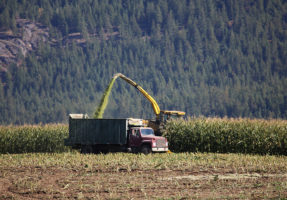
In 2016, 78% of farm acreage in BC was in forage and pasture, including tame pasture and land seeded to alfalfa, corn for silage and forage for seed. BC forage production fed 776,000 livestock animals in the province that year, including beef and dairy cows, sheep, lambs and goats, horses, llamas, alpacas and bison.

Across the province, more than half of producers regularly test their forage for protein, dry matter and minerals the online survey found, while about the same number conduct regular soil testing.

“But we still have a lot of producers who do not regularly test either their forage crop or their soil,” notes Jasper.

Some 70% have adopted new forge management techniques such as grazing systems, but financial costs limit innovation.

Wildlife challenges

Wildlife is the top challenge forage producers across the province face, she says.

“Every region noted this as an issue, whether it was waterfowl, ungulates or bears,” she explains.

Other challenges include the availability of water and suitable, fairly priced land for growing forage, as well as climate and weather changes.

“Drought conditions are becoming more common, as is too much water at certain times, such as we have seen this year,” she says.

The survey highlighted the challenge of controlling invasive plants, pests and diseases on forage land.

“It’s evolving as a significant challenge across BC,” says Jasper. “There is a lack of monitoring, and producers would like to see more of a focus on future invasive outbreaks.”

Most producers also identified a need for more local and relevant research and knowledge transfer.

The engagement sessions identified soil health and forage quality as a particular concern.

“There was a lack of soil and growing conditions to produce alfalfa and higher-protein grasses,” says Jasper. “I know that’s certainly an issue in my region, the Cariboo.”

Meanwhile, the equine sector faces challenges finding low-sugar forage.

The problems stem from long-term neglect of soil health, says Jasper.

“Management techniques, soil testing, and input analysis are not generally adopted and there is not sufficient research and return on investment for dealing with soil health and forage quality issues,” she explains.

The forage strategy is also considering what industry, stakeholders and producer groups can do to improve matters. The top area for attention is wildlife, and the need to balance the public’s love of wildlife and crop production.

“One grower at the coast said we are growing more forage to rear more waterfowl birds,” Jasper says. “He wanted to know how we can fix this.”

Producers called for improving compensation for wildlife damage, as well as managing wildlife numbers through increased hunting and the development of crops unattractive to wildlife.

More land needed

Increasing the availability of land suitable for growing high-protein grasses, with access to water, was the next priority for action. It was suggested that regulations be used to incentivize the productive use of land suitable for forage.

Participants called for more action on invasive plants, pests and diseases. They felt the BC Weed Control Act and its regulations need to be enforced, and increased monitoring of invasive plants was needed.

A number of recommendations focus on research and knowledge transfer, including the development and trial of forage species and varieties specific to individual regions, as well as research into forage management practices and systems. Producers called for research commitments that could outlive government funding cycles.

Government is still needed, however. BC’s agriculture ministry was urged to undertake research as an impartial source of knowledge with the reach needed to disseminate information to individual regions.

A draft plan has just been completed by the Vancouver consulting firm Ference and Co., Jasper notes. It will be submitted to the ministry, which will establish priorities then develop work plans following consultations with stakeholders. There is no schedule for completion.

A second phase of the project will look at forage on Crown land.
Related Posts

You may be interested in these posts from the same category.

Seed-saving at risk

Cow

Reducing waste will save money on winter feed

Alfalfa winterkill puts chill on Nechako Valley

Previous Post: « Prince George packing plant gets further study
Next Post: Hazelnut growers get replant funding »

Copyright © 2026 Country Life in BC · All Rights Reserved