
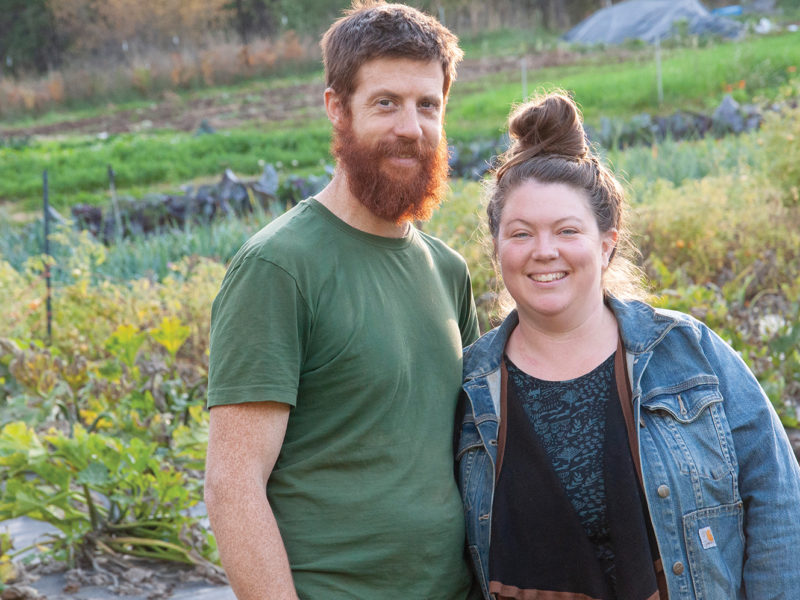
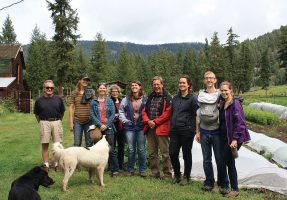
NELSON – One of the Nelson area’s larger market gardens, Bent Plow Farm, is a model that other farmers and agriculture enthusiasts are excited to see. About 30 people braved heavy rains
September 27 to attend a field day organized by Kootenay & Boundary Farm Advisors and Young Agrarians.
But if visitors huddled under umbrellas against the downpour, Bent Plow owner Scott Humphries says the fields just soak it up.
“This will be dry tomorrow,” he explains. “The drainage is too high. … We could put irrigation on, and in 24 hours it would be dry and wouldn’t get waterlogged.”
It’s a challenge common to growing in a landscape carved by glaciers and characterized by acidic alluvial silt and morainal till.
“The glacier came and dropped stuff, and with its kilometre-thick weight, ground and compacted it,” says Humphries.
Due to the farm’s undulating topography, it’s even a challenge to add nutrients, such as green compost and fish emulsions. Drip irrigation allows too much fertilizer to settle in dips and furrows. This means much of the watering is done by hand.
“We did a lot with watering cans,” he says.
Humphries and his wife Emma Sowiak farmed for two years in the Ottawa Valley before moving to Nelson in 2016. They spent the following year preparing their certified organic 1.5-acre market garden.
“It was just a brown field,” Sowiak says in the shelter of their packing shed. “We’re slowly building it up – our irrigation, our production shed. Even the soil is building up.”
Humphries and Sowiak both began farming early in life, but their formative years were quite different. Sowiak was raised in an intentional community north of Nelson where residents cultivated an orchard and raised chickens, while Humphries’ father ran a seventh-generation 100-acre beef farm in Ontario where he grew up around tractors and hay production.
In 2010, Humphries met a couple running a market garden, an eye-opening experience.
“It was cool to see a different side to agriculture,” he says. “You’re more in touch when your hands are in the ground, as opposed to driving a tractor.”
Sowiak attended university in Ottawa, and later joined an urban farm incubator program in which a dozen farmers shared the workload in exchange for their own plots. Of those, 11 are still farming in various ways — one, for example, grows microgreens, while another has a rooftop garden at Ryerson University.
“It’s been interesting seeing how we all followed different paths,” she says.
After she met Humphries, the couple started the Ontario incarnation of Bent Plow, a name that’s as self-explanatory as it sounds.
“It’s because we had a bent plow his dad found,” says Sowiak. “Working here, too, we’ve bent enough tools.”
“There’s something poetic about the imperfection of farming,” adds Humphries, who tells the guests that he’s pulled up to 1,000 pounds of rocks out of a single bed.
An impressive feature of the farm is a drive-through packing shed, which has a walk-in fridge and dry room, and has power ready for a 15-foot cooler if needed. As much as possible, equipment and supplies are moved around with wheeled carts.
“I highly recommend concrete floors,” says Emma.
In 2018, they began selling at the Nelson farmers market and launched a community-supported agriculture (CSA) program in 2019 for 20 subscribers, a number that grew to 95 this year. Each box contains seven items, with early season boxes containing lettuce and radishes, and later season boxes including pumpkins and beets.
“We’re putting in the seven best vegetables at that moment,” says Sowiak. “It gives customers an appreciation of eating through the season.”
They also enjoy receiving unfamiliar types of produce –“anything with a different size, shape or colour,” says Sowiak – which included pointy cabbage, black futsu squash and shishito peppers.
They also pack 40 six-item boxes, which the West Kootenay EcoSociety purchases to distribute to lower-income families through its Farms to Friends program, helping to dispel a common misconception.
“There’s an idea that local produce is not accessible to lower-income folks,” says Sowiak.
To pack the CSA boxes, they set up four or five tables of vegetables, which two employees pack while one replenishes the stock. When deliveries are made, recipients don’t have to worry that their box will be left out in the hot summer sunshine – Humphries delivers them starting at 2 a.m.
“Everyone gets their box by 7,” says Sowiak. “Our customers really like it.”
The CSA is an excellent way to form stronger ties to the community, and also gives the farmers an opportunity to try growing a wider range of produce in a limited quantity.
“We like the CSA because it’s a nice direct connection to the customers,” says Sowiak.
“You can really grow a little bit of everything,” says Humphries. “And we kind of like to grow everything. It’s nice that there’s something different in the box.”
That also allows for better crop rotation, and makes Humphries and Sowiak better growers.
But she candidly admits they don’t like everything they grow.
“Our staff gets sick of cantaloupe,” says Sowiak, who also notes that she doesn’t like to see anything go to waste.
“I didn’t even like them, and I ate an entire one for lunch,” Humphries says, to laughter from the visitors. “And then I kind of wanted another one.”
A significant advantage of the CSA is that it provides the couple with income up front, rather than relying solely on market shoppers to buy produce.
“It’s kind of like a jump-start to the season financially,” says Sowiak.
That allowed them to make two significant purchases this year: an industrial salad spinner, which can handle up to 15 pounds of greens at a time, and roller tables for a greenhouse, which can be raised, lowered and moved side-to-side to maximize available space.
They also swear by their Polaris Ranger UTV (utility task vehicle), which is used to carry harvested produce to the packing shed and apply compost to the garden beds.
“We don’t carry anything,” says Humphries. “This is the best and most used tool on the farm.”
Despite the rainy start to the evening, the couple enjoyed the opportunity to show off their farm to the visiting group – in smaller communities, lending support and advice to others in similar businesses is a key to success.
“That comes from working collaboratively, not cutting each other down,” says Humphries.
That philosophy applies on the farm, as well, with Humphries and Sowiak each having defined roles – he handles much of the outdoor work, which she joins in while also handling the administrative side.
“I love the challenge of maintaining the infrastructure, and when things go wrong on the farm and fixing it,” says Humphries. “And it’s nice seeing crops grow well that maybe didn’t do well the year before.”
Sowiak says it’s the best of both worlds, “getting to be a small business owner, but also getting to work with my hands. Not many jobs have both of those.”
And the opportunity to work with her husband is special, too.
“We complement each other nicely in this small business,” she says.


 US approves SWD parasite